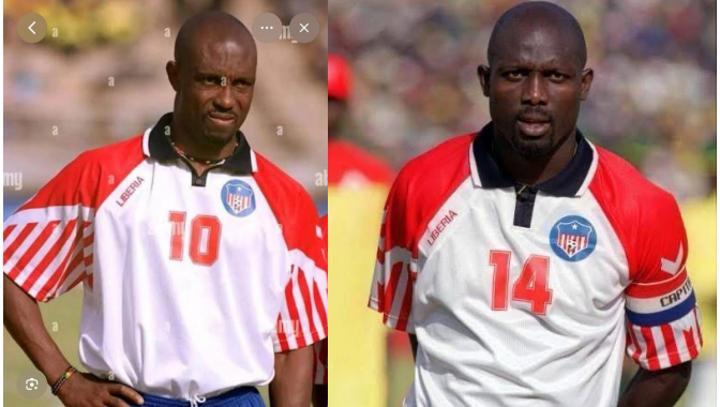
Africa-Press – Liberia. Veteran sports journalist Wleh Bedell has waded into the perennial debate over who truly dominated Liberia’s domestic football scene in the 1980s, declaring that George Manneh Weah left the local stage as an “undisputed conqueror” before his global ascent.
In a strongly worded social media post that has reignited fervor among football enthusiasts, Bedell dismissed “boring arguments” that seek to place other local legends above the man who would eventually become Africa’s only Ballon d’Or winner.
“There should be no so-called debate,” Bedell wrote. “George Weah did not only conquer Europe in 1995… he started from his native Liberia where he earned conqueror status.”
The 1980s Rivalry: Weah vs. Debbah
Bedell’s intervention targets a long-standing narrative rooted in the mid-1980s.
Historically, some fans and commentators have pointed to the late Herbert Grisby’s 1986 assessment, which labeled James Salinsa Debbah as Liberia’s most celebrated player.
That claim was bolstered by the 1986 three-team tournament involving Israeli club Harbor Jerusalem and traditional rivals Invincible Eleven (IE) and Mighty Barrolle.
Debbah, then starring for Barrolle, finished that season as MVP and top scorer with 27 goals.
However, Bedell argues that while Debbah owned 1986, the following year saw a shift in the hierarchy that was never reversed.
The 1987 “Breakthrough”
According to Bedell, the 1986/87 season belonged squarely to Weah. Donning the iconic number 14 jersey, Weah led Invincible Eleven (IE) to a historic double, clinching both the LFA First Division league title and the knockout championship.
Weah ended that campaign as the league’s top scorer with 23 goals and was crowned Most Valuable Player.
Bedell also pointed to a high-profile international club tournament hosted at the ATS and SKD stadiums, featuring regional giants such as Tonnerre Yaoundé (Cameroon), Flamengo (Nigeria), and Fisheries (Sierra Leone).
Weah’s “virtuoso displays” during that competition earned him tournament MVP honors and caught the eye of Tonnerre Yaoundé scouts, who moved quickly to secure his signature.
From Monrovia to the World
Bedell recounted the pivotal moment when former Liberian defender Stephen Tardeh introduced Weah to Cameroon’s national coach, Claude Le Roy. This meeting became the catalyst for Weah’s move to Europe.
Reflecting on an interview Weah once gave to Pitch TV, Bedell highlighted the exchange where Le Roy initially confused Liberia with Libya. Once the distinction was made, Le Roy recommended Weah to his friend, a young French manager named Arsène Wenger.
“Wenger asked me to look for strikers. I will tell him about you,” Le Roy reportedly told Weah.
“Unplayable”
The move to AS Monaco preceded stints at Paris Saint-Germain and AC Milan. Bedell recalled Weah’s famous response to French striker Jean-Pierre Papin, who had expressed doubt about the Liberian’s ability to succeed in Italy: “Weah is Weah, Papin is Papin.”
For Bedell, the data and the dominance are undeniable.
“Let’s be truthful,” Bedell emphasized. “Weah left the local scene in 1987 as the best player. He was unplayable, beyond big for the local stage, and needed a greater challenge. The records are there.”
The journalist’s comments have sparked a fresh wave of nostalgia and debate across Monrovia’s “Hataye” centers and social media platforms, as a new generation of fans grapples with the legacy of Liberia’s golden era of football.
For More News And Analysis About Liberia Follow Africa-Press