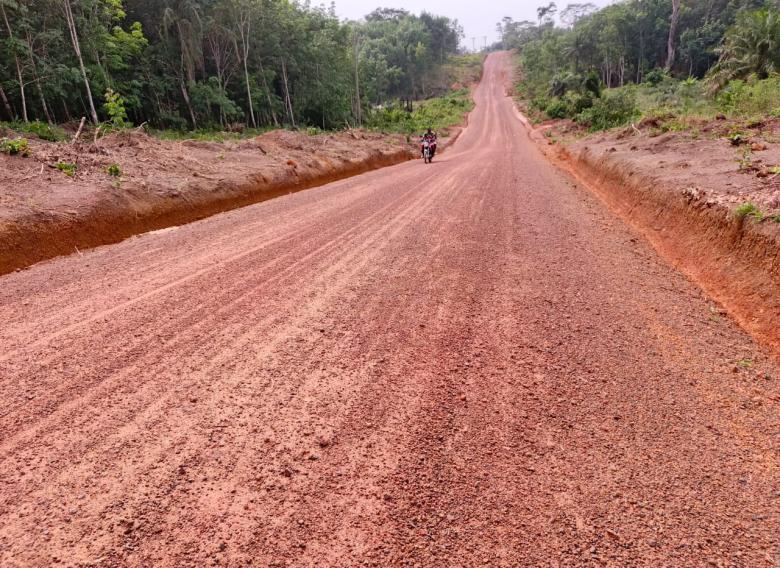
Africa-Press – Liberia. A view of a section of the paved road between Phebe Junction and Gbonota, Sanoyea District, Bong County
BONG COUNTY, LIBERIA—Residents and road users along the Phebe Junction–Sanoyea–Totota corridor are praising the Government of Liberia for ongoing rehabilitation works being implemented through the Ministry of Public Works, describing the project as a major improvement to mobility and economic activity in the area.
The corridor, which links Bong County to strategic parts of Gbarpolu, Lofa, and Montserrado Counties, has long been considered a critical but neglected economic route. Years of deterioration left communities isolated during rainy seasons, disrupted trade, and contributed to frequent motorcycle accidents.
The government’s rehabilitation of the Phebe–Sanoyea–Totota corridor is estimated at approximately 45 kilometers.
The rehabilitation effort follows government commitments announced in 2025 under a phased infrastructure program, supported through national budget allocations and legislative advocacy. Officials have indicated that the project is designed to improve rural connectivity, strengthen agricultural trade routes, and reduce transport hardship across central Liberia.
A Corridor Long Strained, Now Slowly Reopening
Before the intervention, residents describe the road as nearly impassable during heavy rains, cutting off entire communities from markets, schools, and essential services.
Motorcyclists, who serve as the main transport providers along the route, recall years of danger and instability.
“In the past, when the rain came, the road was slippery and dangerous. Bikes would slide, and people could fall,” said Prince Flomo, a motorcyclist from Raymond Town. “But now we see improvement, and we are grateful.”
Commercial motorcyclist Prince Flomo, who operates along the route between Gbonota and Phebe Junction
He also urged fellow riders to exercise caution as the road improves, stressing the need to avoid speeding in partially completed sections to prevent accidents.
His account reflects the experience of many riders who say the improved sections are already reducing accidents and travel delays, although some areas remain under construction.
Citizens Applaud Government and Local Leadership
Across Balamah Town and surrounding communities, residents are openly expressing appreciation for the project, crediting national leadership and local representation for prioritizing the corridor.
Community members also acknowledged Senator Prince K.Moye Sr., Chairman of the Bong Legislative Caucus, for advocating the inclusion and prioritization of the road in the national development agenda.
“We want to say thank you,” said Jeremiah Kartah of Balamah Town. “The government is trying. This road is helping us, and we are ready to support them for a better future.”
Kartah added that the improved road is restoring connectivity.
In this photograph, Jeremiah Kartah of Balamah Town speaks with a reporter during a recent media visit to the community
Kartah added that the improved road is restoring connectivity between previously isolated communities, while also urging motorcyclists to be cautious.
“When the road is good, everything can move,” he said. “We can travel, we can do business, and we can live better. But I also urge riders to be careful and not over speed.”
Women Traders Report Early Economic Relief Among the most impacted are petty traders, particularly women, who depend on the corridor to transport agricultural produce such as oranges, bananas, and other farm goods to nearby markets.
Mamie Momo, a female petty trader observed transporting her goods to market, said the road has already eased her daily struggles.
Petty trader Mamie Momo pictured with her purchased goods in Balamah, Suakoko District
“When the road was bad, it was very difficult to carry our goods to market,” she explained. “Now movement is easier, and we are able to sell faster and reduce losses.”
Her testimony reflects a broader rural reality in Liberia, where road conditions directly affect household income, food security, and the survival of small-scale trading activities.
From Policy Commitment to Ground Reality
The rehabilitation is part of Liberia’s broader post-2024 infrastructure agenda, which prioritizes feeder and secondary roads to improve rural connectivity and stimulate agricultural productivity.
The administration of Joseph Nyuma Boakai has repeatedly highlighted infrastructure development as a central pillar of national recovery and inclusive growth.
Public Works officials have similarly maintained that road investment is essential to reducing transport costs, linking production zones to markets, and improving access to services across rural Liberia.
Public Confidence and Political Support
The project has also generated expressions of political goodwill among residents, with many linking visible progress to renewed national leadership.
“If the government continues like this, we will stand with them,”Kartah said. “development is what we want.”
From Isolation to Gradual Connectivity
Historically, the corridor has been associated with isolation, seasonal disruption, and economic stagnation. During peak rainy seasons, entire stretches often became impassable, cutting off access to essential services.
Today, although rehabilitation is ongoing, residents say the narrative is shifting from hardship to gradual reconnection.
Motorcyclists report improved travel conditions in several sections, traders are moving goods more efficiently, and communities are regaining access to regional markets.
Sustaining the Momentum
Despite widespread appreciation, citizens are urging government and contractors to ensure the project is completed to standard and maintained sustainably.
Still, their tone remains overwhelmingly positive.
“This road is bringing change,” Kartah reiterated. “We are thankful, and we want the government to continue.”
Government of Liberia road infrastructure targets and investment plan (2025–2029). Credit: Nukanah Kollie (with ChatGPT assistance)
The Boakai administration has projected about US$925.3 million for road infrastructure development over 2025–2029 to address Liberia’s major deficit, where only about 10% of roads are paved. The World Bank (https://www.worldbank.org) notes that Liberia’s situation reflects broader regional challenges, with about 43% of roads paved in sub-Saharan Africa and limited road density, highlighting persistent gaps in rural access and connectivity.
According to the Ministry of Public Works, the program targets about 4,000 kilometers of road works over the period, funded through a mix of 40 percent government financing (about US$370 million) and 60 percent from PPPs and development partners, including the World Bank and African Development Bank (https://www.afdb.org). The plan aligns with the ARREST Agenda for Inclusive Development, a US$8.3 billion national framework, and includes about 485 kilometers of primary road rehabilitation, alongside key projects such as an US$80 million World Bank urban road project in Monrovia and a US$40 million AfDB-supported regional corridor project
For More News And Analysis About Liberia Follow Africa-Press