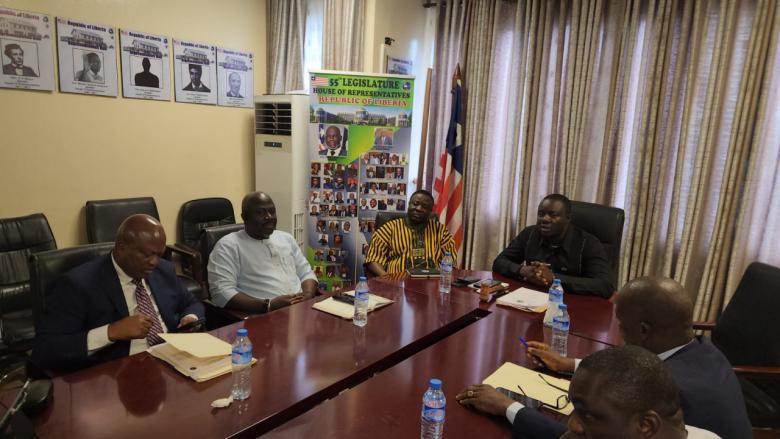
Africa-Press – Liberia. An inquiry into the status of the controversial Access Agreement between Guinea and Liberia was spearheaded by the House Specialized Committee with two key line ministries of the Executive Branch of the Liberian government providing conflicting accounts over the very existence, legitimacy, and implementation of the deal.
At the hearing that lasted for more than two hours, the Ministries of Justice and Foreign Affairs provided doubtful accounts that somewhat exposed institutional disconnects – lack of coordination within the executive branch of government. The ministries’ testimony also raised further doubts about whether Guinea has ever acknowledged or ratified the agreement that is supposed to govern cross-border mineral transport, particularly iron ore.
Foreign Affairs Denies Knowledge of Agreement
The most startling moment at the hearing came from the Deputy Foreign Minister for Administration at the Ministry of Foreign Affairs, Gabriel Salee, who told lawmakers that the Ministry of Foreign Affairs “has no information” on the agreement.
“We have no idea about the status of this agreement. We didn’t participate in this agreement at any level,” Salee opened up.
His statement prompted disbelief from committee members, who pointed out that international agreements are, by law, transmitted, processed, and often printed through the Ministry of Foreign Affairs.
Representative Ivar Jones Raises Key Concerns
One of several lawmakers shocked by this startling revelation was Margibi County District 2 Representative, Ivar K. Jones, who questioned the legitimacy of this agreement.
Rep. Jones specifically questioned whether the Guinean Parliament had ratified the agreement and whether Liberia had even shared its ratified version with Conakry.
“Unless it is domesticated in Guinea, it’s not binding on them. If we pass it here and they don’t do it there, it cannot work. This is a bilateral agreement,” stressed the Margibi County lawmaker.
Rep. Jones’ concern is one of many; there have been growing concerns that Liberia may have moved ahead on a cross-border project without confirmation whether its counterpart country had completed its end of the legal process.
Justice Ministry Offers Contradictory Defense: ‘It’s Just Logistics’
Where Foreign Affairs distanced itself, the Ministry of Justice, represented by Deputy Minister for Economic Affairs, Cllr. Charles D. F. Karmo II, justified the agreement.
Cllr. Karmo noted that the arrangement is successor to previous protocols dating back to 1973, 1983, and 2013, all designed for the evacuation of Guinean ore through Liberian territory.
“It’s a logistics operation. We have excess capacity. We are required as per this agreement to allow the movement of products through our rail… The objective aligns with African mining frameworks.”
He claimed that a 2021 communication between both governments remains valid and that if Guinea objected to the transport of its minerals via Liberia, it would formally notify Monrovia.
Cllr. Karmo also defended the government’s dealings with Ivanhoe Liberia (HPX/SMFG), labeling the company “responsible” and insisting the agreement has sufficient safeguards.
“Our action to enter into an arrangement with Ivanhoe is not threatening. The IMCC handled this with expert oversight. We can terminate the agreement if the other side fails.”
But under questioning, Karmo admitted to key gaps; no confirmation that Guinea ratified the agreement, no evidence Liberia verified the status of the deal in Guinea, no recent bilateral engagement (“more than a year ago”), and clarity whether Liberia was invited to the dedication of Guinea’s 850-meter rail segment
Lawmakers Unconvinced
Representative Blue Benson bluntly expressed what many are thinking – something that has the propensity to hamper such a deal.
“I believe nothing is going to happen unless the Guinean government agrees,” intoned the Montserrado County District 17 lawmaker.
Representative Michael Thomas of Montserrado County District 4 also questioned the due diligence behind the government’s engagement with Ivanhoe Liberia.
“Have we done extensive background checks? We fear this may be like those regular concessions with issues of noncompliance,” he expressed.
Rep. Thomas believes that Liberia was apparently not invited to the high-profile rail dedication in Guinea, a symbolic snub that raised the question of whether Conakry recognizes the arrangement at all.
Representative Dorwohn Twain Gleekia of Nimba County District #6 pointed to Article 3.3 of the agreement, which mandates that Guinea be fully aware of any action Liberia takes under the Access Agreement.
“Are the two countries even aware of this agreement? Has Guinea accepted it?” asked Rep. Gleekia.
Representative Jerimiah Sokan of Grand Gedeh District is one lawmaker who is displeased with this deal, and expressed serious concern also.
“There is no protocol without the Head of State’s affirmation. How can we enter such a major economic agreement without systematic consent from our sisterly country? Are we acting in desperation?”
As the hearing dragged for several hours without any tangibles, Representative Prince K. Koinah of Bong County District #1 proffered a motion for postponement until next Tuesday, December 10, 2025, citing too many unresolved issues.
The motion was then unanimously voted upon by committee members with the Chairman of the Specialized Committee, Bong County District 7 Representative Foday Fahnbulleh knocking the gable in affirmation of the decision.
Insight Of The Agreement
The 2019 Implementation Agreement between Liberia and Guinea was never meant to be symbolic. It was designed as the governing framework for how any Guinean mining company could request access to Liberia’s rail and port infrastructure. The agreement established a clear approval sequence: Guinea would first determine whether a company was eligible to use the corridor, and Liberia would then evaluate the formal access request through a joint Monitoring Committee and the Inter-Ministerial Committee. These bodies were created to ensure that neither country acted alone and that all decisions followed the same transparent process.
The agreement also instructed the Technical Secretariat to prepare a standard Access Agreement template so that every mining operator would be held to the same terms and procedures. It was a way of preventing special arrangements, ensuring fairness, and maintaining consistency across all future users.
Yet when the Concession and Access Agreement between Liberia and Ivanhoe Liberia (HPX/SMFG) surfaced, there was no public indication that any of these steps had been taken. There was no published eligibility process in Guinea, no documented access request in Liberia, no record of committee reviews, and no confirmation that the agreement followed the standard format required by the Implementation Agreement. The absence of these elements raises legitimate questions about whether the CAA was negotiated outside the very framework both governments created to guide such decisions.
For More News And Analysis About Liberia Follow Africa-Press