Africa-Press – Liberia. Spatial data is an important tool that guides decision making processes around the protection, restoration, and management of biodiversity – and countries are starting to unleash this powerful tool.
According to a recent study, Nature is Counting on Us, there is a 233% increase in the frequency of map usage from the post-2010 NBSAP to the Sixth National Report to the Convention on Biological Diversity, leading to more actionable national policies.
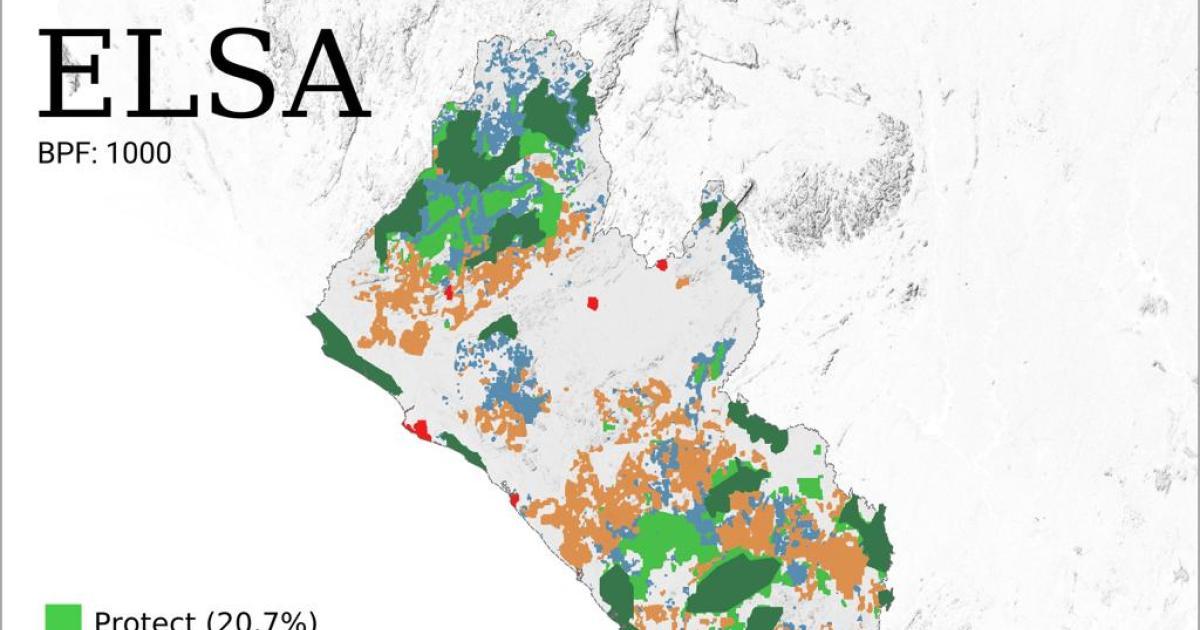
Liberia is a leader in using spatial data to meet not only its biodiversity commitments, but also its commitments related to sustainable development and climate change. Led by the Environmental Protection Agency (EPA) and United Nations Development Program (UNDP) in Liberia, the project Mapping Nature for People and Planet in Liberia is using cutting-edge data to map the country’s essential life support areas (ELSAs).
These are critical places where actions to safeguard nature can sustain critical benefits for Liberians, including ecosystem integrity, restoration and conservation, food, and water security, mitigation, and building resilience to the impacts of climate change, among other critical themes.
In addition, Liberia will get access to the UN Biodiversity Lab platform and will be able to use a private workspace on the platform. Information and data used for the ELSA project will be accessible in this private project, which will provide access to the best national and global data layers, and tools to monitor and report on initiatives in the areas of food and water security, climate change, restoration, protection of species, carbon storage, and disaster risk reduction across the country, the EPA has said.
Liberia will be able to learn from other countries on how to build and implement a Map of Hope to accomplish national priorities and make use of satellite data, and it can position itself as a champion through effective implementation.
“The Sustainable Development Goals clearly emphasize the importance of nature for humanity and the economy. More than half of the SDGs depend directly on nature. Biodiversity loss was repeatedly identified in 2020 and 2021 as one of the major risks we face,” Louis Kuukpen, UNDP Deputy Resident Representative, said in remarks. “The various ecosystem goods and services provided by nature, such as food, fresh water, and clean air, to name but a few, are essential for our survival. A key priority for UNDP is therefore to continue to support Liberia in the implementation of the SDGs and other policies that aim to preserve natural ecosystems that support human well-being and livelihoods.”
EPA Deputy Executive Director, Randall M. Doubayou II, said that biodiversity is abundant in Liberia, and “we take satisfaction in being pioneers in advancing the cause of solutions based on nature on both a national and international scale.”
He added that mapping essential life support areas is paramount to supporting informed decision making that will direct “our development partners toward the realization of our national development goal. Liberia is strongly committed to preserving and safeguarding its natural resources, encouraging environmentally friendly solutions to counteract climate change, and providing a clean, healthy environment while promoting economic development.”
Liberia launched the project in 2022, holding a first consultation between October 31 and November 4, 2022. At this event, policy and geospatial information experts participated in discussions to define Liberia’s top ten most important targets relative to nature, climate, and sustainable development to guide the ELSA analysis. The consultation also identified national spatial data that could be used to map each of these targets.
The project attracted broad participation from national agencies and non-governmental organizations. Participating experts included representatives from the Environmental Protection Agency, the Liberia Institute of Statistics and Geo-Information Services, the Liberia Maritime Authority, the Liberia Land Authority, and the University of Liberia, as well as international organizations such as UNDP and Conservation International. This project has been made possible thanks to the support of the Swedish International Development Cooperation Agency (SIDA).
During this first workshop, the Deputy Executive Director of the EPA, pointed out that the spatial webtool resulting from this project – would help Liberia identify and prioritize nature-based solutions to protect, sustainably manage, and restore ecosystems in ways that will conserve critical biodiversity, mitigate, and foster resilience to the impacts of climate change.
For More News And Analysis About Liberia Follow Africa-Press