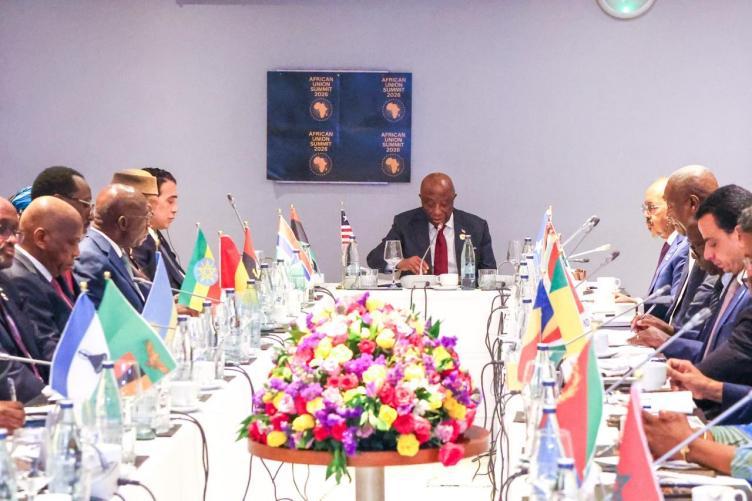
Africa-Press – Liberia. The Government of the Republic of Liberia on Saturday convened a High-Level Consultation on the future of the United Nations and the election of the next Secretary-General, on the margins of the 39th Ordinary Session of the African Union (AU) Assembly.
The closed-door breakfast meeting, hosted by President Joseph Nyuma Boakai, brought together three sitting Presidents, two Vice Presidents, two former Heads of State, eleven Foreign Ministers, and Ambassadors and Permanent Representatives from approximately 25 countries.
Liberia convened the consultation in its capacity as Chair of the African Group in New York for February 2026, seeking to promote unity, strategic clarity, and proactive African leadership at what it described as a pivotal moment for global governance.
UN at a Crossroads
The meeting comes as the United Nations prepares to elect its next Secretary-General amid growing concerns about institutional effectiveness, legitimacy, and responsiveness—particularly in areas of peace and security, sustainable development, and the priorities of the Global South.
“The United Nations stands at a crossroads, and Africa must decide in which direction we would like to see it move,” President Boakai declared. “Africa must not be a passive observer in shaping the future of the United Nations.”
While emphasizing that the UN remains indispensable, President Boakai underscored the need for systemic and inclusive reforms grounded in the realities of Member States.
He highlighted Africa’s longstanding commitment to multilateralism, noting Liberia’s status as one of four African original signatories to the UN Charter and the continent’s central role in advancing the UN’s peace and development agenda.
Africa’s Role in Selecting the Next Secretary-General
Leaders participating in the consultation agreed that Africa must play a decisive role in the upcoming selection of the next UN Secretary-General, reflecting the continent’s significant share of UN membership and its growing geopolitical weight.
Participants endorsed the formation of a coalition of willing countries—through their Foreign Ministers—to work alongside the African Three (A3) members of the UN Security Council to advance agreed principles for the selection process.
The A3 currently comprises Liberia, Somalia, and the Democratic Republic of Congo.
Countries represented at the meeting included Rwanda, Angola, Egypt, Ethiopia, Guinea, Libya, and Nigeria, among others.
Engaging the Permanent Five
The consultation affirmed the need for guiding principles centered on protection and strengthening of multilateralism, safeguarding Global South interests, restoring trust in international institutions, enhancing effective delivery and ensuring leadership capable of navigating a fragmented global order.
The coalition, working closely with the A3, plans to engage the Permanent Five (P5) members of the Security Council to secure support for Africa’s position on both the Secretary-General selection process and broader UN reform.
Leaders also committed to sustained coordination with the African Union Committee of Ten (C10) on UN Reform to advance the Common African Position.
A Call for African Unity
A central theme of the informal consultation was the urgent need for African unity amid what leaders described as a global crisis posing an existential threat to multilateralism.
President Boakai stressed that Africa must speak with one voice and act with strategic clarity to influence the direction of global governance.
“Africa must not be a passive observer,” he reiterated, affirming the continent’s responsibility—and right—to shape reform and leadership at the United Nations.
The consultation forms part of Liberia’s broader diplomatic engagement during its 2026–2027 tenure on the UN Security Council and concluded with a shared commitment to sustained dialogue and coordination in support of Africa’s collective agenda.
For More News And Analysis About Liberia Follow Africa-Press