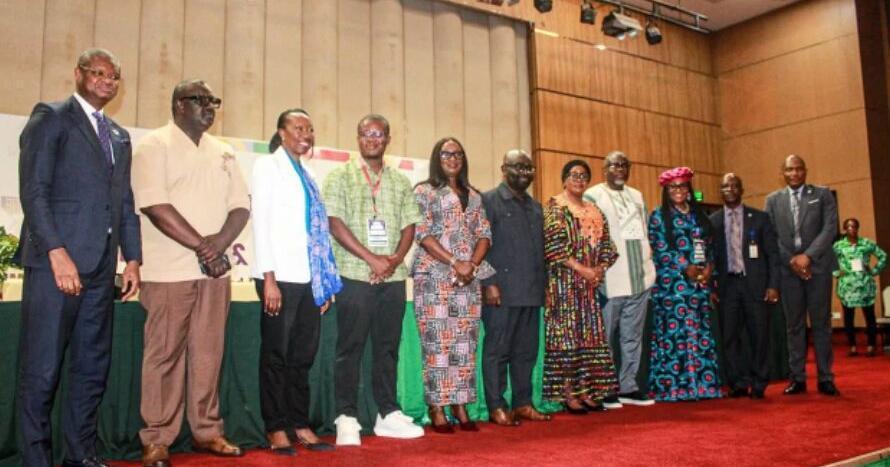
Africa-Press – Liberia. Liberia is accelerating a renewed push to strengthen its micro, small, and medium enterprise (MSME) sector, as government officials, development partners, financial regulators, and private sector leaders converged on Day Two of the MSME Conference to outline reforms aimed at improving capacity, access to finance, and market opportunities.
The conference opened with a recap of Day One by iCampus Liberia CEO Mr. Luther Jeke emphasizing the critical role of strong market access, skills development, partnerships, and innovation in driving sustainable business growth.
Delivering a keynote address on behalf of the Office of the President, Minister of State for Presidential Affairs, Hon. Samuel A. Stevquoah, reaffirmed the government’s commitment to MSME development. He disclosed that US$5 million has already been disbursed under Phase One of the MSME program, with an additional US$5 million approved for Phase Two.
According to Minister Stevquoah, the next phase will focus on decentralizing MSME services, expanding financing partnerships, and operationalizing the proposed New Entrepreneurs Investment Bank to improve access to capital nationwide.
Several international and national partners highlighted their contributions to MSME growth. Environmental Protection Agency (EPA) Executive Director, Dr. Emmanuel K. Yarkpawolo, called for stronger standards, testing, and certification regimes while assuring participants of reduced bureaucratic barriers.
World Bank Country representative, Dr. Georgia Wallen, announced US$8.5 million in MSME financing support alongside US$3.5 million dedicated to enterprise training, while acknowledging structural challenges affecting implementation.
UNDP Country Representative, Mr. Aliu Mohammed Dia, reaffirmed UNDP’s commitment, citing the MSME Growth Accelerator Program as a key intervention. Meanwhile, Liberia’s Expo 2025 Commissioner-General, Ambassador Julie Andy, stressed the need for women’s economic empowerment and reduced dependence on imports through local production.
LIBA President, Mr. James Strother, noted that MSMEs currently contribute about six percent to Liberia’s economic growth and called for increased funding and policy support to unlock the sector’s full potential.
Government officials, including Information Minister Jerolinmek Piah, Youth and Sports Minister Jeror Cole Bangalu, and Deputy Minister for Gender, Children, and Social Protection Gbeme Horace-Kollie, emphasized the need for improved inter-ministerial coordination, MSME-friendly policy reforms, local procurement, and gender-responsive economic initiatives.
Participants also benefited from two instructional laboratories. Lawrence Cole of the Liberia Business Registry guided entrepreneurs through step-by-step business registration processes, while Isaac D. Stephens of the Liberia Revenue Authority outlined SME tax structures and underscored the role of MSMEs in national development.
Key recommendations from the sessions included improving retail market access, strengthening packaging and quality systems, establishing a credit guarantee scheme, creating a digital MSME marketplace, and developing shared manufacturing facilities.
A high-level panel discussion, moderated by Edossos Jeletonvolo, brought together Patience B. Randa, Marcus B. Zarway, Elvis Kuchel, and Karl-Henrik Olassi Jacobsen. Panelists explored policy reforms, public-private partnerships, regional market integration, regulatory simplification, and access to finance.
Speaking from a program management and private sector development perspective, Marcus B. Zarway, an experienced development practitioner with over 16 years in economic policy reform, MSME development, youth empowerment, and extractive sector governance said preparatory work under the newly launched MSME support initiative has largely been completed, with full implementation scheduled to begin in January.
The program, officially launched in July, is intended to move from planning into nationwide execution. Zarway explained that the initial phase focused on operational frameworks and coordination mechanisms to ensure program readiness.
Despite progress, he pointed to deep-rooted structural challenges, particularly the absence of a centralized national MSME database.
“Many small businesses appear only where personal linkages exist,” Zarway noted. “What is missing is a central platform where anyone, anywhere in the world, can easily identify Liberian products and the businesses behind them.”
He disclosed that work is ongoing with the Ministry of Finance and Development Planning through the Small Business Administration (SBA) to establish a comprehensive digital MSME portal. The platform would support data sharing, policy formulation, capacity assessments, and improved market exposure.
Zarway further stressed the need to diversify MSME financing beyond traditional loans, advocating for equity financing and collaborative funding models to support viable businesses that lack conventional collateral.
He also called for decentralizing MSME support services, noting that most programs remain concentrated in Monrovia, forcing entrepreneurs from the counties to travel long distances without consistent follow-up.
Complementing the MSME discussions, Deputy Governor for Economic Policy at the Central Bank of Liberia (CBL), Dr. Musa Dukuly, outlined reforms aimed at deepening financial inclusion through digitalization, interoperability, and modernization of the credit infrastructure.
Dr. Dukuly acknowledged that the lack of collateral remains a major obstacle to MSME financing. To address this, the CBL is advancing reforms to recognize movable collateral, such as equipment, while strengthening credit information systems.
He said digital financial services are central to the CBL’s 2025–2029 policy framework, with new regulations expanding digital credit access and transaction limits especially for rural communities excluded from traditional banking.
Interoperability among mobile money platforms, he added, will reduce transaction costs and encourage cashless transactions across networks.
“Our objective is a financial ecosystem that reduces cash dependency and expands inclusion,” Dr. Dukuly said.
He also cited low long-term deposits and high non-performing loans as constraints on lending to growth sectors such as agriculture. To mitigate risk, the CBL and development partners are exploring credit guarantees, solidarity lending, and national unique identification systems.
Dr. Dukuly encouraged businesses to take advantage of existing financing windows, including a US$6 million line of credit, as broader reforms continue.
Taken together, the discussions and commitments signal a coordinated national effort to shift Liberia’s MSME sector from fragmented support mechanisms toward a more integrated, data-driven, and inclusive growth model positioning small businesses as key drivers of economic recovery, job creation, and long-term development.
For More News And Analysis About Liberia Follow Africa-Press