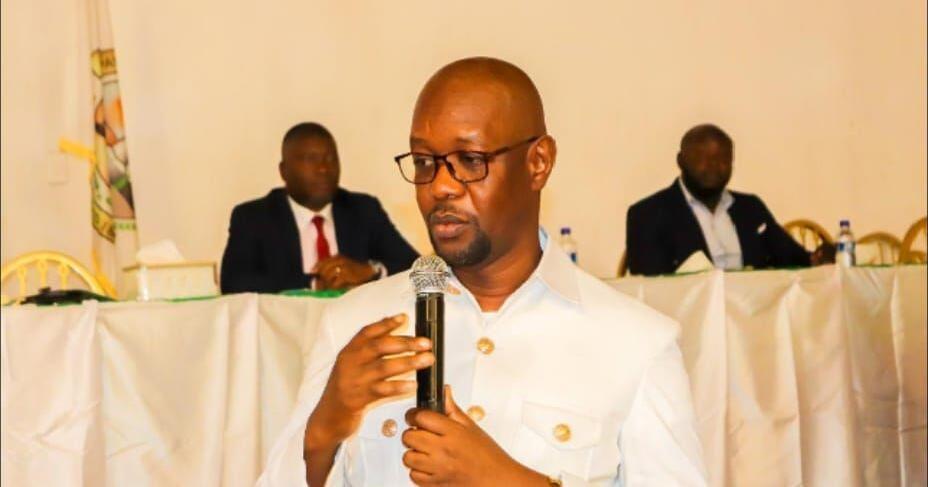
Africa-Press – Liberia. In a city that mirrors Liberia’s rapid urban growth, complex social diversity, and persistent infrastructure strain, Mayor Robert S. Bestman II used his 2025 State of the City Address to deliver more than a routine year-end report. Speaking Monday, December 15, 2025, at the Paynesville City Hall Ballroom, the Mayor offered a measured account of progress, challenges, and ambition—painting Paynesville as a city cautiously but deliberately stepping into modern urban governance.
The address, Mayor Bestman’s second since his 2023 appointment by President Joseph Nyuma Boakai, underscored a central theme: incremental reform under severe fiscal and logistical constraints, but with growing institutional confidence and international visibility.
“This year we strengthened community ties, advanced modernization, expanded educational opportunities, and reinforced our shared vision for a safe, inclusive, and thriving city despite fiscal and logistical challenges,” Bestman told residents.
One of the most striking moments of the mayor’s report was Paynesville’s first-ever official commemoration of Ramadan, a symbolic but politically significant gesture in Liberia’s most diverse city.
For the first time, the Paynesville City Corporation formally joined the Muslim community with donations to the Central Mosque and a Ramadan dinner hosted at City Hall—an act Bestman described as reinforcing “interfaith solidarity and mutual respect.”
In a city often strained by political and social divisions, the move signaled an intentional shift toward inclusive urban leadership, recognizing Paynesville not just as Liberia’s largest city by population, but also one of its most culturally plural.
Climate Change Meets City Governance
Beyond symbolism, the mayor’s report placed Paynesville squarely within continental climate and urban policy conversations—a notable achievement for a municipality long consumed by basic service delivery struggles.
In February, a delegation from the city’s Department of Finance, Environmental and Revenue toured Freetown City Council, participating in the inaugural African Urban Heat Summit. That engagement directly informed the launch, on July 31, 2025, of Paynesville’s first-ever Climate Action Plan (PCAP).
The opening of a Heat Park at ELWA Junction, accompanied by a keynote from Freetown Mayor Yvonne Aki-Sawyerr, symbolized a shift toward green infrastructure and climate resilience.
Analysts say this positions Paynesville among a small but growing group of African cities recognizing climate adaptation not as a future concern, but as a present governance obligation.
Perhaps the most diplomatically significant milestone highlighted was Paynesville’s Sister City Agreement with Hamilton, Canada, signed on September 23, 2025.
The agreement makes Paynesville the first African city to establish such a partnership with Hamilton, opening pathways for technical cooperation, education exchange, and shared urban planning strategies.
In an era where subnational diplomacy is becoming a key development tool, the partnership reflects a growing confidence in Paynesville’s institutional identity—and Liberia’s quiet re-entry into international municipal networks.
With a population overwhelmingly young, Mayor Bestman placed heavy emphasis on education and youth empowerment.
Through a partnership with the Nyonblee Cares Foundation, the city supported STEM education for about 100 high school students, while more than 250 school principals and teachers participated in city-facilitated dialogues on education quality.
These initiatives, though modest in scale, speak to a broader recognition: Paynesville’s future stability hinges on whether its youth can access skills aligned with a modern economy.
A recurring theme in the report was modernization through technology—often overlooked at the municipal level in Liberia.
The City Corporation now operates a functional website, maintains active social media platforms, and hosts a weekly radio program on Truth FM, with relays on Punch FM. The mayor publicly credited Soft Solution, a Liberian-owned tech firm, for enabling the digital infrastructure.
More transformative, however, has been the automation of revenue collection. Using tablets, the city registered over 10,000 businesses between February and November 2025, significantly improving accountability and mapping the city’s economic footprint.
Observers say this reform quietly tackles one of Liberia’s oldest municipal problems: revenue leakages rooted in manual systems.
Infrastructure development under Mayor Bestman has been cautious but targeted.
Construction is ongoing on a new two-story City Hall office complex, featuring 14 offices, conference rooms, and a cafeteria—designed to reduce congestion and improve service delivery. Two new JAC pickups, procured through the national budget, have boosted zoning enforcement and land recovery efforts, including the reclamation of public spaces such as the LBS children’s playground.
These gains, the mayor emphasized, were achieved “within a constrained budget”—a recurring reminder of the city’s financial limitations.
Despite notable gains, the mayor was candid about Paynesville’s most visible and stubborn challenge: solid waste management.
Paynesville and its surrounding areas generate an estimated 600–800 tons of waste daily, yet only 40–45 percent is formally collected. Hundreds of tons remain unmanaged, clogging waterways and polluting neighborhoods.
“Lack of infrastructure and funding continues to constrain our response,” the report noted, underscoring the scale of the problem relative to available resources.
The waste crisis serves as a sobering counterpoint to modernization efforts, reminding residents that urban growth without matching infrastructure can quickly overwhelm progress.
The report also highlighted significant investments in human capacity, with staff trained in environmental governance in Beijing, law enforcement seminars, HR conferences, firearms training, and smart-city management.
In collaboration with the Liberian National Police, Paynesville City Police strengthened patrols and participated in national observances—signaling closer alignment between municipal and national security structures.
The mayor paused his report for a moment of silence in memory of five family members lost in a tragic fire incident—a reminder that governance is not only about systems and statistics, but about human lives.
He pledged stronger fire awareness campaigns and improved emergency response mechanisms, acknowledging gaps that can no longer be ignored.
A City in Transition
Mayor Bestman closed with gratitude—and realism.
“While challenges persist, Paynesville City is steadily advancing in a positive direction,” he said, emphasizing unity, accountability, and collaboration as guiding principles.
The 2025 Year-End Report presents Paynesville not as a finished success story, but as a city in transition—experimenting with modern governance tools while grappling with the heavy burdens of urbanization, limited funding, and rising citizen expectations.
Whether Paynesville can turn incremental reforms into systemic change may ultimately define not just the Mayor’s tenure, but the future of Liberia’s fastest-growing city.
For More News And Analysis About Liberia Follow Africa-Press