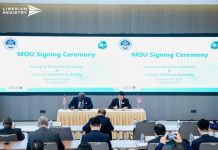
Africa-Press – Liberia. The Liberian Senate on Monday, November 3, commenced public hearings into the proposed US$365 million road concession agreement between the Government of Liberia and PAVIPORT AL Associates, Inc., a private consortium seeking to finance and construct several key national road corridors under a Build-Operate-Transfer (BOT) arrangement.
The hearings, which began Thursday, October 30, 2025, in the Senate Chambers, are being conducted by a Joint Committee comprising members from the Committees on Public Works, Concessions and Investment, Transport, Ways, Means, Finance and Budget, Public Accounts and Audits (PAC), and Judiciary, Human Rights, Claims and Petitions.
The proposed agreement — submitted by the Executive Branch in July 2025 — seeks legislative ratification for the asphalt pavement of five major road corridors over a five-year period, covering a total of 255 kilometers. The roads include St. Paul Bridge to Klay (Bomi County); Klay to Bo Waterside (Grand Cape Mount County); Klay to Tubmanburg (Bomi County); Madina to Robertsport (Grand Cape Mount County), and Voinjama to Mendikorma (Lofa County).
Under the BOT model, PAVIPORT AL Associates, Inc. will finance, construct, and operate the roads for a specified concession period before transferring ownership back to the Government of Liberia.
The total cost of the project is estimated at US$364.8 million, making it one of Liberia’s largest infrastructure undertakings since the completion of the Monrovia–Gbarnga–Ganta–Guinea border highway under the Sirleaf administration.
Key Officials Cited for Clarification
The Senate has cited several top government officials to provide justification and additional information on the agreement, including Minister of Public Works & Rural Development, Minister of Finance & Development Planning, Minister of Justice, Minister of Transport, Chairman of the National Investment Commission (NIC), and the Executive Director of the Public Procurement and Concessions Commission (PPCC).
The Joint Committee is expected to probe issues relating to financial feasibility, procurement compliance, legal authority, and public interest protections embedded within the agreement.
“This is a multi-million-dollar commitment that could have far-reaching implications for Liberia’s infrastructure financing model,” a Senate source familiar with the proceedings told the Daily Observer. “We must ensure that due diligence is done and that the country gets value for money.”
The public hearings come at a time when Liberia’s road network remains one of the weakest in West Africa, with fewer than 10% of its 12,000 km of roads paved, according to the World Bank’s 2024 Infrastructure Diagnostic Report. The vast majority of rural communities are cut off during the rainy season, impeding access to markets, schools, and healthcare.
Despite billions spent over the past two decades on road rehabilitation through donor grants and public investment, maintenance and sustainability remain critical gaps. In many counties, including Bomi, Lofa, and Grand Cape Mount — areas covered under the PAVIPORT proposal — road degradation continues to undermine local commerce and agricultural productivity.
Analysts argue that while the BOT model offers potential to mobilize private financing for public infrastructure, Liberia’s regulatory and institutional capacity to manage such arrangements remains limited.
“Private financing can accelerate infrastructure development, but only when supported by strong governance, transparency, and proper risk-sharing mechanisms,” said a former Deputy Minister of Public Works. “Otherwise, the country risks inheriting unsustainable debts or poorly executed projects.”
Regional Lessons and Comparative Experiences
Other African nations have experimented with Public-Private Partnerships (PPPs) and BOT models in road construction — with mixed outcomes.
In Kenya, the Nairobi Expressway, constructed under a US$550 million BOT deal with the China Road and Bridge Corporation, has improved traffic flow but faced criticism over high toll rates and opaque concession terms.
Ghana’s Accra–Tema Motorway Expansion Project, also structured under a PPP framework, demonstrates how transparent stakeholder engagement and phased toll recovery can yield sustainable results.
Conversely, Sierra Leone’s 2019 attempt at a similar arrangement for the Lungi Bridge Project was abandoned after feasibility and environmental concerns raised public outcry.
These case studies underscore the importance of public consultations, cost transparency, and strong oversight — lessons Liberian lawmakers appear determined to heed during this review process.
Public Expectations and Next Steps
As the Senate hearings unfold, public anticipation remains high. Many Liberians see the proposed roads as vital arteries for regional trade and connectivity — particularly the Voinjama–Mendikorma corridor, which links Liberia to Guinea and supports agricultural exports.
However, skepticism persists over funding transparency, maintenance plans, and potential toll costs for commuters. Civil society groups have already called for the full publication of the concession agreement and impact assessments before ratification.
“We welcome road development, but we must not repeat past mistakes,” said an influential Montserrado County lawmaker recently. “The public deserves to know how this deal will affect future budgets, toll payments, and local livelihoods.”
Infrastructure remains a cornerstone of Liberia’s ARREST development agenda, championed by President Joseph N. Boakai. Yet, with public debt nearing US$2 billion and fiscal constraints tightening, the government faces a delicate balancing act — mobilizing private capital without compromising public interest.
If ratified under robust terms, the PAVIPORT road project could serve as a model for sustainable infrastructure financing. But if mismanaged, it risks deepening fiscal burdens and eroding public trust.
Many believe that the Senate’s handling of the PAVIPORT deal will serve as a litmus test for Liberia’s commitment to transparency, accountability, and transformative development in one of its most critical sectors — the roads that bind the nation together.
Meanwhile, the Joint Committee is expected to submit its recommendations and report to the Senate Plenary before the end of the legislative session.
For More News And Analysis About Liberia Follow Africa-Press