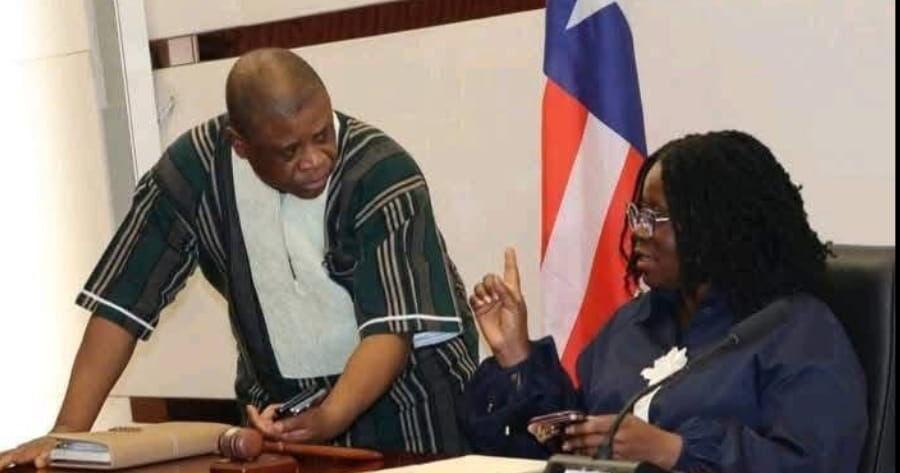
Africa-Press – Liberia. Liberia’s fragile transitional justice process faces renewed uncertainty following moves by Senators Nyonblee Karnga-Lawrence (Grand Bassa) and Joseph Jallah (Lofa), who have separately introduced bills in the Liberian Senate seeking to establish a War and Economic Crimes Court (WECC).
The proposals come even as the Office for the Establishment of the War and Economic Crimes Court of Liberia (OWECC-L) — created under Executive Orders issued in 2024 and 2025 — is already operational and implementing a structured plan toward justice and reconciliation. Many are sensing an overlap of mandates and conflicting timelines.
The OWECC-L, established by the Executive Branch as part of Liberia’s post-war accountability framework, has been conducting broad consultations with civil society, victims’ groups, and international partners. It is currently holding stakeholder meetings and has developed a comprehensive roadmap for establishing both a War Crimes Court and a National Anti-Corruption Court.
According to sources close to the process, these consultations are designed to ensure that Liberia’s approach aligns with international standards of transitional justice, emphasizing participation, sequencing, and national ownership.
Observers warn, however, that the Senate’s recent legislative maneuvers could undermine this carefully coordinated process. “Transitional justice cannot be treated like an ordinary political bill,” one governance analyst told reporters. “It requires broad-based consensus, institutional coordination, and credibility among victims and the wider public.”
Political Undercurrents and Alleged External Influence
The timing and intent of the Senate bills have raised eyebrows within policy and diplomatic circles. Allegations have surfaced that Senator Karnga-Lawrence recently met with Dr. Alan W. White, a controversial foreign figure associated with international justice operations and allegedly received financial incentives to push for the bill’s introduction.
Reports suggest that White has held closed-door meetings with several Liberian officials and political actors, prompting concerns about external influence and ulterior motives behind the legislative initiative.
While these claims remain unverified, they have nonetheless fueled debate over whether the recent push in the Senate represents a genuine commitment to justice or a politically motivated attempt to hijack a sensitive national process.
Officials at the OWECC-L maintain that Liberia’s transitional justice roadmap must proceed methodically and consultatively to avoid reigniting old divisions. The Office’s ongoing engagements with victims, survivors, and local communities—some of whom still bear the physical and psychological scars of the country’s civil wars—are seen as crucial steps in building national consensus.
“Transitional justice is a process, not a political tool,” said one civil society representative who works closely with the OWECC-L. “The office has been deliberate and transparent to ensure victims’ voices are central. Any attempt to fast-track or politicize this process could derail years of effort to build peace and trust.”
The Liberia Council of Churches, human rights groups, and victims’ networks have echoed similar sentiments, urging lawmakers to collaborate with, rather than bypass, the OWECC-L.
A Delicate Balance Between Legislative Authority and Executive Planning
Under the Liberian Constitution, the Legislature holds authority to establish courts. However, analysts argue that such authority should complement, not conflict with, executive-led transitional justice frameworks already in motion.
“Liberia is at a critical juncture,” said a former member of the Truth and Reconciliation Commission (TRC). “We cannot afford institutional turf wars between the Executive and the Legislature. Transitional justice must be guided by integrity, inclusiveness, and a shared national vision.”
Since the end of the country’s 14-year civil conflict (1989–2003), calls for accountability have persisted. The Truth and Reconciliation Commission (TRC), which concluded its work in 2009, recommended the establishment of a war crimes court and the prosecution of individuals responsible for gross human rights violations and corruption.
However, successive governments have been hesitant to act, citing concerns over peace, stability, and political backlash. The establishment of the OWECC-L in 2024 under President Joseph Nyuma Boakai was therefore hailed as a major breakthrough in implementing the TRC’s long-delayed recommendations.
Liberians now watch anxiously as their leaders navigate this renewed debate. Advocates warn that fragmentation, political interference, or donor manipulation could erode public confidence in the transitional justice process.
“The success of Liberia’s post-war justice system will depend on whether our leaders prioritize the rule of law and victims’ rights over political expediency,” said another rights advocate. “We’ve come too far to allow opportunism to derail our nation’s healing.”
For many, the current moment is a test of national maturity—whether Liberia can reconcile its quest for justice with the discipline and coordination needed to implement it responsibly.
For More News And Analysis About Liberia Follow Africa-Press