Africa-Press – Malawi. Climate change, once a distant reality, seems to be rearing its ugly face in Malawi, disrupting food security goals and people’s way of life. Since January 2022, when Tropical Cyclone Ana made landfall, followed by Gombe in March that year and, in 2023, Freddy, Malawians do not know where disaster will hit next. And, as WEZZIE GAUSI, BLESSINGS TAMBALA, INNOCENT KALIKOKHA and RICHARD CHIROMBO write, portents of trouble are already manifesting, with the rainy season far from its peak, a development that should put all stakeholders on alert.
When, as early as October 18 2023, the Department of Climate Change and Meteorological Services (DCCMS) warned that the 2023-24 rainfall season may spark some disasters, one could not help it but wonder why the warning was coming this early in the season.
Lucy MtilatilaAccording to DCCMS Director Lucy Mtilatila, the rains started in October.
“In November, there are chances of below normal rainfall in some places, especially in the Southern and Northern regions, and in December and January above normal rainfall should be expected,” Mtilatila said.
“Looking at the way the forecast is; yes, extreme events are expected.
“Unfortunately, it seems we will experience both ways. With the below normal rainfall, there are chances that they can trigger dry spells and drought in some places. With more and above normal rainfall, chances of having very high rainfall amounts are also there. So, it seems we may experience both extreme events,” she added.
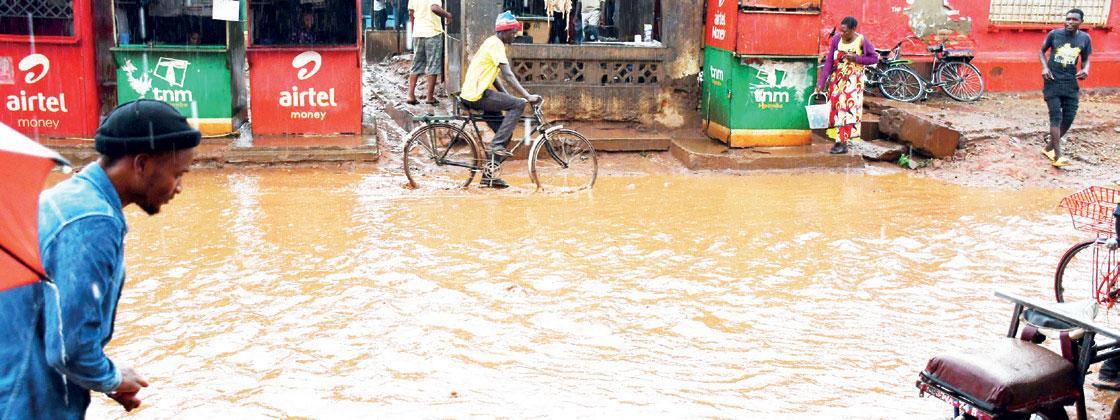
And, as it were, the department was soon vindicated by nature itself. By today, the country has already had three scares, starting with Lilongwe City, where rainwater created mud that ended up trapping vehicles.
In Machinga District, people from 84 households from three villages in Traditional Authority Mposa are desperate after Lingoni River burst its banks and running waters displaced them. Mposa Village Development Committee Vice Chairperson Felister Laston said this happened after rains fell in droves in the area.
“The area received heavy rains that lasted for about four hours, resulting into the flooding of Lingoni River. We started receiving heavy rains at 7am on Tuesday and, by 9am, almost 36 houses were submerged due to flooding waters from the river,” Laston said.
She added that by 1pm, 84 houses were submerged, with 89 people seeking refuge in a mosque. “Out of the 89 people, 49 are children from Kam’bona, Mlomba and Manja villages. We appeal to well-wishers and the government to come to the rescue of the people in the area.
“Both children and adults have abandoned their houses as water levels keep on increasing. These people are lacking food, clothes and other necessities,” she said.
Machinga District Relief and Rehabilitation Officer Daniel Mandala said they went to the area to assess the situation. One of the casualties of the rains is Manja Dyke, which has been destroyed by rain water even before completion of the works.
And, again this week, disaster struck in Nsanje District, where a woman was reported dead and about 27 households displaced in Chipondeni and Masenjere areas in the Shire Valley district.
This time, it is Thangadzi and Milole rivers that burst their banks due to rain water. Councillor for Kalulu Ward, Rose Makiyi, said things could have been worse had community members not moved in fast.
“This is because a baby was rescued from Thangadzi River, which affected people of Chipondeni,” Makiyi said.
According to Nsanje District Council spokesperson Robert Nayeja, in cases of disaster, council officials wait for reports from Area Civil Protection Committee members. Meanwhile, the Roads Authority (RA) has said it has a contingency plan to handle challenges motorists may face in Lilongwe City when rains come.
RA spokesperson Portia Kajanga said this yesterday when asked about the authority’s readiness for the rainy season following last week’s nasty experience in the city, where some vehicles got stuck in mud after moderate rainfall.
Some roads and bridges in the city are being rehabilitated, such that the roads have changed face. Speaking after touring the construction site of Lilongwe Bridge on Thursday, Kajanga said the authority already met with all contractors to prepare for the rainy season.
She said the contractors have been ordered to submit plans on how they intend to work during the season. “Residents of Lilongwe must be assured that everything is in place. We all know that construction works take years and we always prepare for any eventualities.
“So, for this rainy season, we have vehicles that have been specifically assigned to be pulling out vehicles that will be stuck in the mud. These vehicles will be providing the services for free 24/7. And, in case some roads are impassable, we have gravel in place that will be thrown in such areas,” Kajanga said.
Lilongwe Police Station Traffic Station Officer Nestol Mafosha said they are ready to conduct traffic patrols. “Police have always been there, controlling traffic and making sure that road users are following all road regulations. We will work hand-in-hand with contractors as well as the Road Authority so that our roads are passable during the rainy season,” Mafosha said.
Some of the road construction projects happening within Lilongwe involve the construction of the six-lane road from Parliament Building to Shoprite and the expansion of the M1 Road from Crossroads.
Most of the roads under construction are behind schedule. This is happening at a time the country’s new disaster risk management law has not yet been operationalised.
The Disaster Risk Management Act focuses on disaster preparation and prevention, unlike the existing law— which focuses on activities to be undertaken after disaster has struck.
The Act also focuses on the creation of a Disaster Risk Management Fund, which will ensure that funds are available for use in times of disaster. “We are hoping that it will be operational as soon as we get the go-ahead to gazette it,” said Commissioner for Disaster Management Affairs Charles Kalemba.
He said the department is prepared for any disaster that may come. On his part, Natural Resources Committee of Parliament Chairperson Werani Chilenga has said Malawi is not serious on the issue of preparedness.
“We, as a country, are not serious and, as such, we are not prepared for the disasters. There is no plan from Dodma [Department of Disaster Management Affairs] on how they are going to handle possible disasters. This is very unfortunate,” Chilenga said.
Malawi is still reeling from the effects of Tropical Cyclone Freddy, which displaced thousands of people and killed hundreds after making landfall in Malawi on March 11.
For More News And Analysis About Malawi Follow Africa-Press