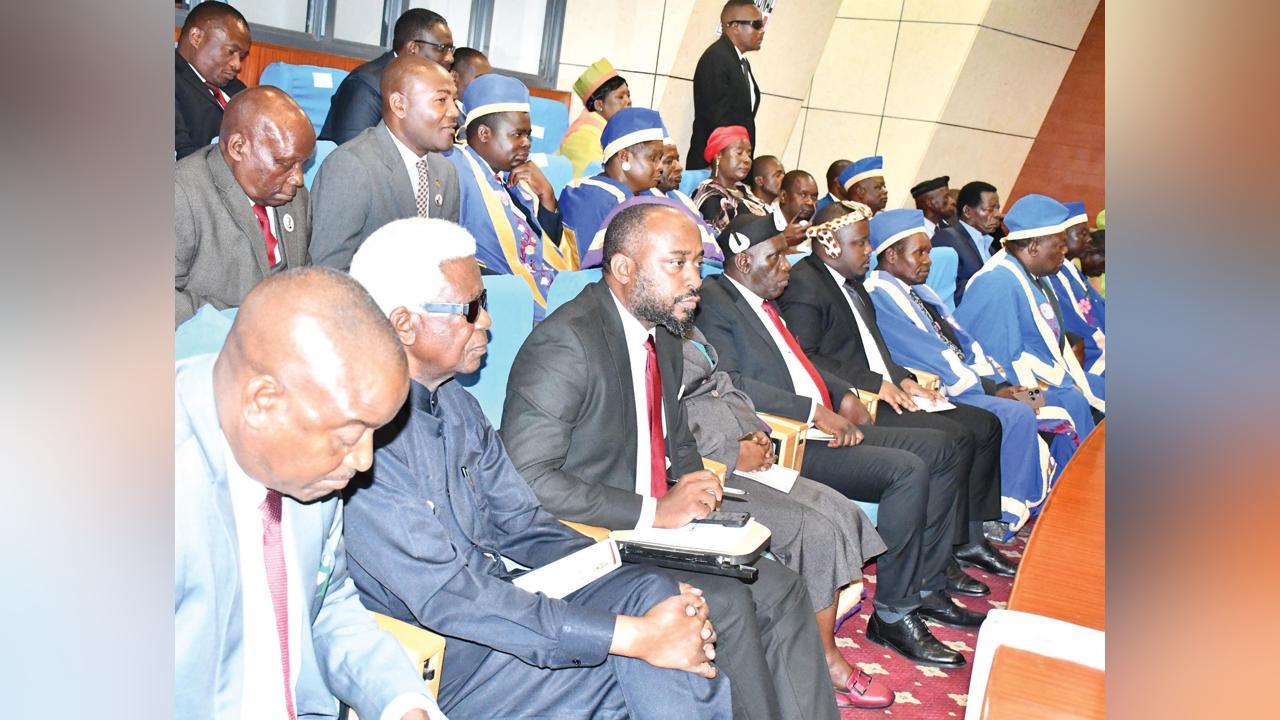
Africa-Press – Malawi. President Lazarus Chakwera Friday delivered a State of the Nation Address (Sona) that carried a mixture of previous unmet promises and risks facing familiar challenges that have affected delivery of previous statements, our analysis shows.
In his statement, Chakwera touted Malawi’s progress in wealth creation opportunities as the country moves towards 2063. According to the National Planning Commission (NPC), implementation of the 10-year plan of MW2063 (MIP-1) is expected to move the nation towards the goal of graduating to a middle income economy by 2030.
However, the 2023 MIP-1 progress report shows that the efforts to create wealth are far from being achieved. The report says to achieve middle income status by 2030, Malawi’s economy must grow by an average of six percent per annum.
According to the report, Malawi achieved such high growth rates in the 1970s and recently sustained moderate growth rates in the 2000s with agriculture being the driver for growth. Now the trends are on the contrary, reads the report, suggesting that there is some hard work to do to achieve and sustain such growth rates.
In the 2022-2023 budget, government allocated 13 percent of its resources to drive wealth creation and self-reliance; 5.6 percent of the budget (K115 billion) to eight agribusiness programmes; K34 billion to industrialisation and K36 billion to job creation representing 1.6 percent of total budget each.
Under pillar one which is agriculture and commercialisation, Malawi aspires to increase the share of agriculture, forestry and fishing to Gross Domestic Product from 22.8 percent in 2020 to about 27.8 percent by 2030 but the share of agriculture, forestry and fishing to GDP marginally declined to 22.4 percent.
The report further says at the intervention level of implementation of 85 percent of MIP-1, 20 percent are on track with agriculture mechanisation and irrigation development being the focus areas which are lagging behind in implementation.
In his Sona last year, Chakwera said the government made progress on the first 10-year implementation plan of MW2063 (MIP-1). The country is also struggling to turn mining into a forex earner although it is under the Chakwera administration’s ATM [agriculture, tourism and mining] strategy.
Three weeks ago, the Minister of Mining Monica Chang’anamuno said the mining sector contributes around one percent of the country’s GDP. She said while the country has been involved in small-scale mining over the years, it is not doing enough on serious mining that would bring in big money. Under mining, Chakwera’s 2023 and 2024 Sonas spoke almost about the same things.
For example, he talked about the establishment of the Mining Regulatory Authority; operationalization of the National Mining Company; construction of a state-of-the-art mineral processing laboratory complex and the formalization of the artisanal and small-scale mining sector and reviewing poorly negotiated mining agreements.
These are largely on paper at this point, if at all, pointing at further delays for Malawi to make mining a real deal. In an interview Friday, Director of Mines Sam Sakhuta said the mining company was registered but is yet to change signatories.
On the artisanal and small scale mining sector, he said the Ministry of Mining has just finished reviewing artisanal and small scale mining policy which has been submitted to the Ministry of Justice for further scrutiny before sending it to Parliament for approval.
Chakwera pointed out what has shackled Malawi’s progress. “Ever since I announced the reforms, I was going to effect in this sector three years ago, we have faced resistance, roadblocks, and rebellion,” he said.
He added: “But we have prevailed. I am therefore happy to report, Madam Speaker, that during the year gone by, we have set up the institutional framework for bringing sanity to and creating wealth from our mining sector.
”
He also recited several projects on his progress list when in truth several of them have been dumped by contractors for various reasons and their completion date might not be anytime soon.
“There are also other works that are on the verge of completion for the enjoyment of Malawians.
For instance, significant progress has been made on the Lilongwe City road expansion programme, specifically on Kenyatta Road, Sharrar Street, and Mzimba Street, which will be completed in the new financial year,” Chakwera said.
But works on Mzimba road, for example, have stalled since December last year because the contractor, China Civil Engineering Corporation, is demanding an adjustment of the pricing escalation formula.
Then there was an age-old song about Domasi and Mponela community hospitals. These two have been appearing in most Sona statements since the People’s Party administration in 2013. To date, they are still far from completion due to funding challenges.
Church and Society of the Blantyre Synod of the Church of Central Africa Presbyterian executive director Reverend Master Jumbe said it is time the Chakwera administration move away from finding fault elsewhere in Russia and Ukraine and cyclones.
He also urged the administration to take corruption by its horns if Malawi is to make progress. “Malawians expected to hear why the Tonse government is failing to address the cancerous problem of corruption which was one of its promises.
It is sad that Malawi is drifting backwards as far as corruption perception is concerned,” he said. Chakwera’s Sona Friday was titled: “Taking stock and advantage of our progress in achieving economic recovery and resilience.”
For More News And Analysis About Malawi Follow Africa-Press