Africa-Press – Malawi. The Malawi Human Rights Commission (MHRC) has released a report following a public inquiry it conducted.
The report has exposed discrimination that persons with disability face when accessing public services across the country.
MHRC released the report in Lilongwe Monday.
The report has exposed discrimination which persons with disability face when accessing employment opportunities and health, education and disaster risk management services, among others.
– Advertisement –
For example, the inquiry has exposed the shortage of specialist teachers, inadequate learning materials and inaccessible school infrastructure, which it says forces learners with disability to face exclusion, bullying and poor academic performance.
“The commission finds that the inaccessibility of school infrastructure and facilities, therefore, makes it impossible for learners with disabilities to fully participate in the teaching and learning process on an equal basis with others. This limits their prospects of excelling in their education,” it says.
On health, the inquiry found that there was inaccessible infrastructure, lack of disability awareness among health workers, shortage of essential medication and discriminatory behaviour in the provision of sexual reproductive health and rights services.
“The inquiry established deep-rooted discriminatory practices against women and girls with disabilities who seek sexual reproductive health and rights (SRHR). Women with disabilities reported having faced a hostile environment when seeking SRHR in health facilities, where, among others, some healthcare workers, especially “nurses”, often subject them to “discriminatory, insensitive, derogatory and bullying” remarks,” it says.
– Advertisement –
On employment, the inquiry has exposed discrimination in recruitment, inaccessible world places, lack of reasonable accommodation and weak enforcement in legal provisions.
It says this forces women with disability to face double discrimination whereas qualified individuals are denied promotions due to lack of accessible materials.
“The inquiry established that during recruitment interviews, many employers fail to provide reasonable accommodation to enable candidates with disabilities to compete on an equal basis with others,” it says.
On disaster risk management, the inquiry exposes that during relief distribution, persons with disability do not access disability specific needs such as assistive devices, dietary requirements, among others, as the authorities provide relief items focusing only on food, blankets and shelter materials.
The commission has directed the Ministry of Health to provide reasonable accommodation, through enforcement of accessibility standards, in all health facilities by installing ramps to ease mobility of wheelchair users and the blind, among other things.
“The Ministry of Health and district health offices should ensure that sexual reproductive health services are accessible to women and girls with disabilities without discrimination.
This should include thorough investigations and disciplining of all healthcare workers who ridicule women with disabilities [when they are] seeking SRHR services,” it says.
The commission has also recommended that the Ministry of Education, Science and Technology should review teacher education training curricula to develop robust disability-inclusive teacher training curricula that address specific disability category requirements as a means of fostering inclusive learning.
“The Ministry of Education should train and recruit more special needs teachers, with continuous professional development in inclusive pedagogy, sign language and braille. The Ministry of Education, in collaboration with district councils, should ensure that school infrastructure and facilities adhere to universal design standards that promote physical accessibility for learners with disabilities,” it says.
On employment, the commission has recommended that the Department of Human Resource Management and Development, the Local Government Service Commission, and Civil Service Commission should enforce anti-discrimination provisions in recruitment, including the mandatory provision of reasonable accommodation, including accessible interview venues, materials such as braille, large print and sign language interpreters.
MHRC has also recommended that Dodma and Macoda should collaborate and develop communication and early disaster warning system guidelines that are disability-inclusive, taking into consideration diverse disability needs.
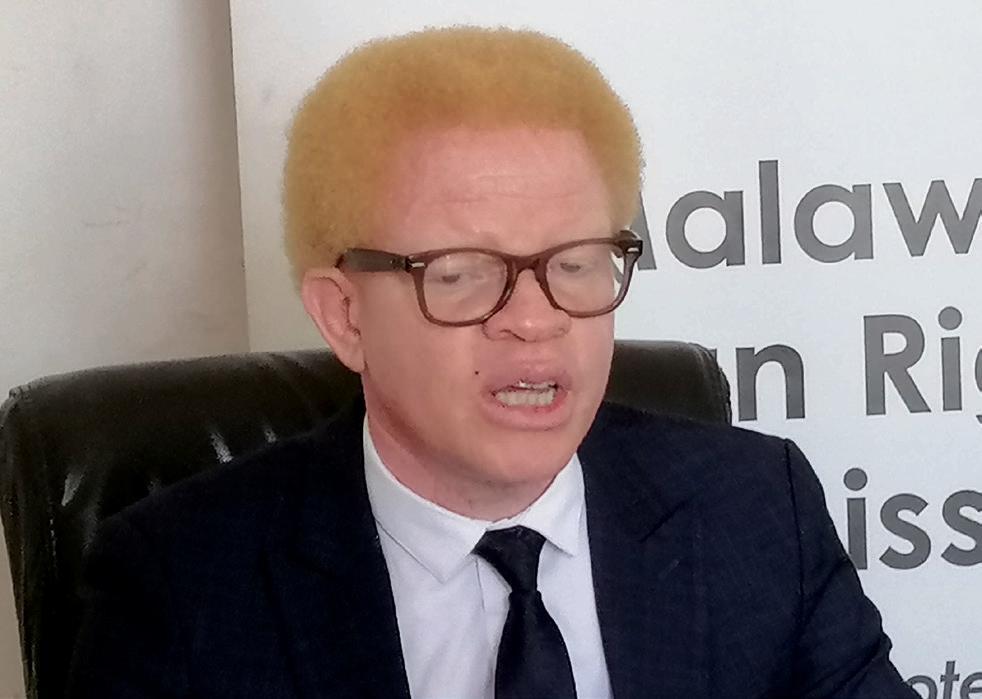
In an interview, MHRC Commissioner Boniface Massa said the commission expected all concerned stakeholders to act on the recommendations.
“It is our high expectation that heads of those institutions [Ministry of Health, Malawi Council for disability Affairs, Department of Disaster Management Affairs, Ministry of Education] will be able to look at this report and provide recommendations.
“Our follow-up step is engagement because we are not there to police these institutions but we are reminding them of their duty and responsibility to ensure that their services are inclusive of the needs of people with disability,” Massa said.
Ministry of Gender Director of Disability and the Elderly Programmes David Njaidi said the government would engage all government institutions that were targeted on the matter.
“We had the same concern that the Malawi Human Rights Commission has raised and we need to build capacity of government [institutions] as well as other agencies on disability issues,” Njaidi said.
For More News And Analysis About Malawi Follow Africa-Press