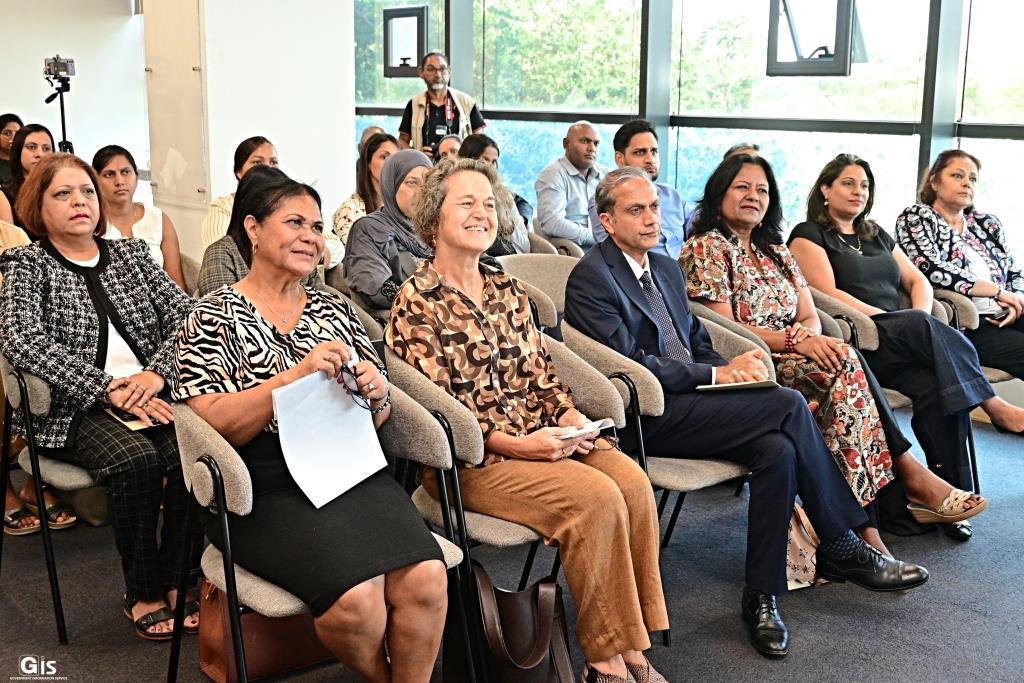
Africa-Press – Mauritius. A five-day Multi-Sectoral Training of Trainers and Coordination Workshop on “Consolidating a Survivor-Centred Gender-Based Violence (GBV) Response in Mauritius”, organised by the Ministry of Gender and Family Welfare, in collaboration with United Nations Population Fund (UNFPA) Mauritius, opened, today, at The Docks in Port Louis, as part of the 16 Days of Activism Against GBV.
The Minister of Gender and Family Welfare, Mrs Arianne Navarre-Marie; the United Nations Resident Coordinator for Mauritius and Seychelles (ad interim), Dr Anne Ancia, WHO Representative; the Director of Public Prosecutions, Mr Rashid Ahmine; and the Ombudsperson for Children, Mrs Aneeta Ghoorah, were present.
In her address, Minister Navarre-Marie underscored the need for resilience, collaboration and continuous capacity-building in the fight against GBV, stressing that only a multisectoral and coordinated approach can drive real change. According to her, the training, led by expert consultants, goes beyond technical knowledge and will strengthen participants’ self-awareness, listening skills and ability to support traumatised individuals through a trauma-informed, survivor-centred approach across key sectors.
The Minister pointed out that ongoing staff training is essential as officers increasingly confront complex cases of domestic violence, and the quality of support offered can determine whether survivors begin to heal or remain silent.
While acknowledging recent legislative and service improvements, she said that committed, well-trained professionals are central to progress. On that score, she urged participants to act as ambassadors of transformation, driven by empathy, courage and determination, and affirmed that collective effort is key to building a strong, coherent and survivor-centred national system.
Speaking on behalf of the United Nations Resident Coordinator for Mauritius and Seychelles, the WHO Representative, Dr Ancia, highlighted the rapid rise of digital forms of GBV and the need for national systems to adapt accordingly. She noted that GBV remains a significant concern in Mauritius, affecting one in four women, adding that strong engagement is visible across social services, ICT, law enforcement, the judiciary and civil society.
Dr Ancia outlined UNFPA’s recent work in reviewing and harmonising Standard Operating Procedures across all sectors involved in GBV prevention and response, providing Mauritius with a modern, survivor-centred framework aligned with international standards. Despite this progress, she pointed out, survivors still experience inconsistent levels of support, especially with the growing prevalence of online harassment, image-based abuse and identity theft.
The Training of Trainers programme aims to strengthen intersectoral coordination and ensure more coherent support for survivors, whether online or offline. According to Dr Ancia, the multisectoral roadmap to be developed, along with discussions on a national GBV steering committee, will further reinforce long-term collaboration. She reaffirmed the UN’s commitment to providing technical assistance, adding that Mauritius has all the elements needed for a strong, future-ready GBV response system.


For More News And Analysis About Mauritius Follow Africa-Press