Africa-Press – Mauritius. As part of the 16 Days of Activism Against Gender-Based Violence (GBV) campaign, a special Rodrigues Day was held, today, at the Sir Harilal Vaghjee Memorial Hall, followed by a roundtable discussion dedicated to examining the state of GBV in Rodrigues.
The event brought together the Speaker of the National Assembly, Mrs Shirin Aumeeruddy-Cziffra; the Minister of Information Technology, Communication and Innovation, Dr Avinash Ramtohul; Members of Parliament and the Parliamentary Gender Caucus; as well as the United Nations Development Programme (UNDP) Resident Representative for Mauritius and Seychelles, Mrs Alka Bhatia. Young recruits from the Rodrigues Police Force were also in attendance.
An initiative of the Speaker and the Parliamentary Gender Caucus, with support from the UNDP, the campaign seeks to raise public awareness on preventing all forms of violence in Mauritius, with particular emphasis on GBV.
In her address, the Speaker underscored that GBV affects individuals across all communities and social groups, regardless of socio-economic background, ethnicity, religion, or geographic location. She called for collective action to eliminate all forms of violence.
With regard to the rise of cyber violence, Mrs Aumeeruddy-Cziffra noted that the growing reach of the internet, mobile technologies, and social media has fuelled an increase in online abuse targeting women and girls. This emerging global threat, she warned, carries serious economic and societal repercussions.
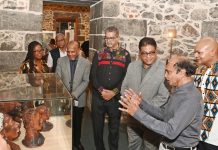
Speaker Aumeeruddy-Cziffra also pointed out that the artwork on GBV displayed at the venue, noting that the pieces not only expose abuse, challenge victim-blaming, but also encourage resilience and social transformation. She commended the artists for their meaningful contribution to addressing GBV through creative expression.
In her remarks, Mrs Alka Bhatia praised the initiative, describing GBV as a “pervasive human rights violation”. She outlined the UNDP’s global efforts to combat GBV by supporting legal reforms, strengthening police and institutional capacities, empowering survivors, integrating GBV prevention across development programmes, and tackling new challenges such as digital violence. She also pointed to key obstacles in Rodrigues, namely entrenched societal norms, patriarchal beliefs, the financial dependence of many victims on their abusers, and gaps in service coordination.
Roundtable Discussion
The roundtable, chaired by the Speaker, examined current GBV trends in Rodrigues. Statistics presented showed 107 GBV cases reported in 2025—involving 14 male and 93 female victims—compared to 98 cases in 2024, which included 21 male and 77 female victims. Participants emphasised that socio-cultural norms, stigma, fear of perpetrators, and certain cultural or religious beliefs continue to pose major challenges in addressing GBV on the island.
Participants voiced out the importance of empowering individuals to report violence and protect those at risk. According to the participants, preventing GBV requires early and sustained intervention, particularly through sensitising children to challenge rigid gender stereotypes and develop respectful relationships. Key strategies discussed included comprehensive school-based education, empowerment of women and girls, active involvement of men as allies, transformation of societal attitudes towards gender roles, and the creation of safe environments that promote equality and break cycles of violence.
The importance of reliable data to guide policy actions and ensure that interventions respond effectively to the realities faced by survivors was also highlighted. During the discussion, the rise of digital GBV, with women increasingly targeted through cyberstalking, online harassment, and other forms of digital abuse were also on the agenda.