
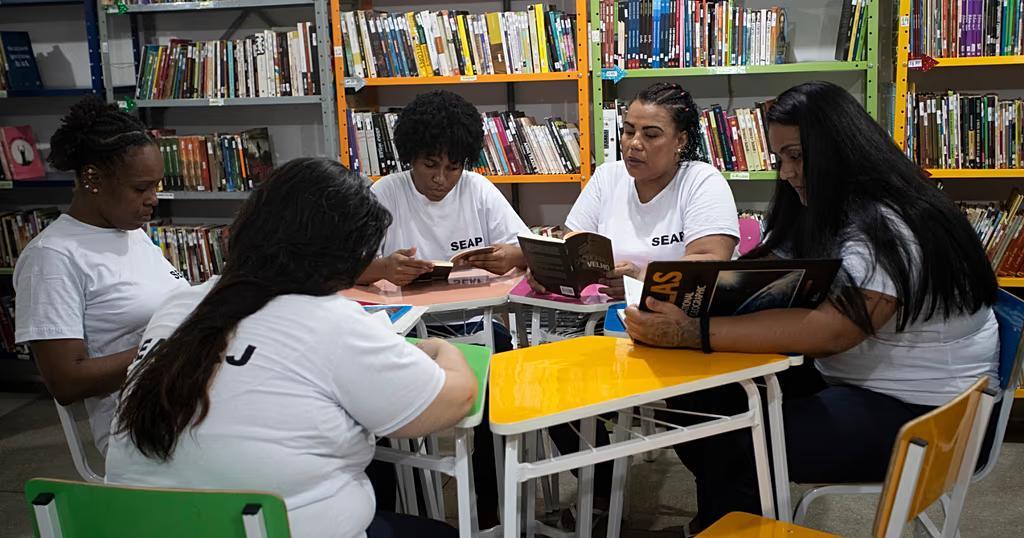
Africa-Press – Mauritius. When 33-year-old Brazilian woman Emily de Souza heard about a program allowing her to shave off four days from her prison sentence by reading a book, she seized the opportunity to reconnect with a cherished habit.
Like tens of thousands of detainees across the country — including former President Jair Bolsonaro — she signed up for a sentence reduction program that encourages inmates to immerse themselves in literary works in exchange for reducing their sentences by up to 48 days per year.
The possibility of reuniting earlier with her 9-year-old autistic son, who her mother and aunt are looking after, only ramped up her motivation to participate in the project. “One day is an eternity because it feels like it’s never going to end,” said de Souza, who is incarcerated at the Djanira Dolores de Oliveira Women’s Prison in Rio de Janeiro, which houses approximately 820 female detainees.
Brazil, which has one of the highest per-capita incarceration rates in Latin America, stands out for having one of the most formalized and nationwide systems for sentence remission via reading in the world.
The rapidly growing program, which was first formally regulated in 2012 and then standardized across Brazil in 2021, received renewed attention earlier this year after the Supreme Court authorized Bolsonaro — who is serving a 27-year sentence for attempting a coup — to take part.
Andréia Oliveira, coordinator of female prisons and LGBTIQ+ inclusion in Rio state’s prisons, said that access to reading programs and schools helps the individual once they have left prison — but also society.
“When we encourage education, ludic activities, knowledge, we return to society someone who can reconnect, respect rules,” she said.
Since 2022, literature professor Paulo Roberto Tonani has been conducting workshops in prisons so detainees in Rio can benefit from the measure.
“Our goal, which underpins everything we do, is to ensure this right. First, the right to lower one’s sentence through reading, to participate in this process, in this project. And second, to truly consider access to literature. We draw inspiration from Antonio Candido when he speaks of literature as a right, and a human right.”