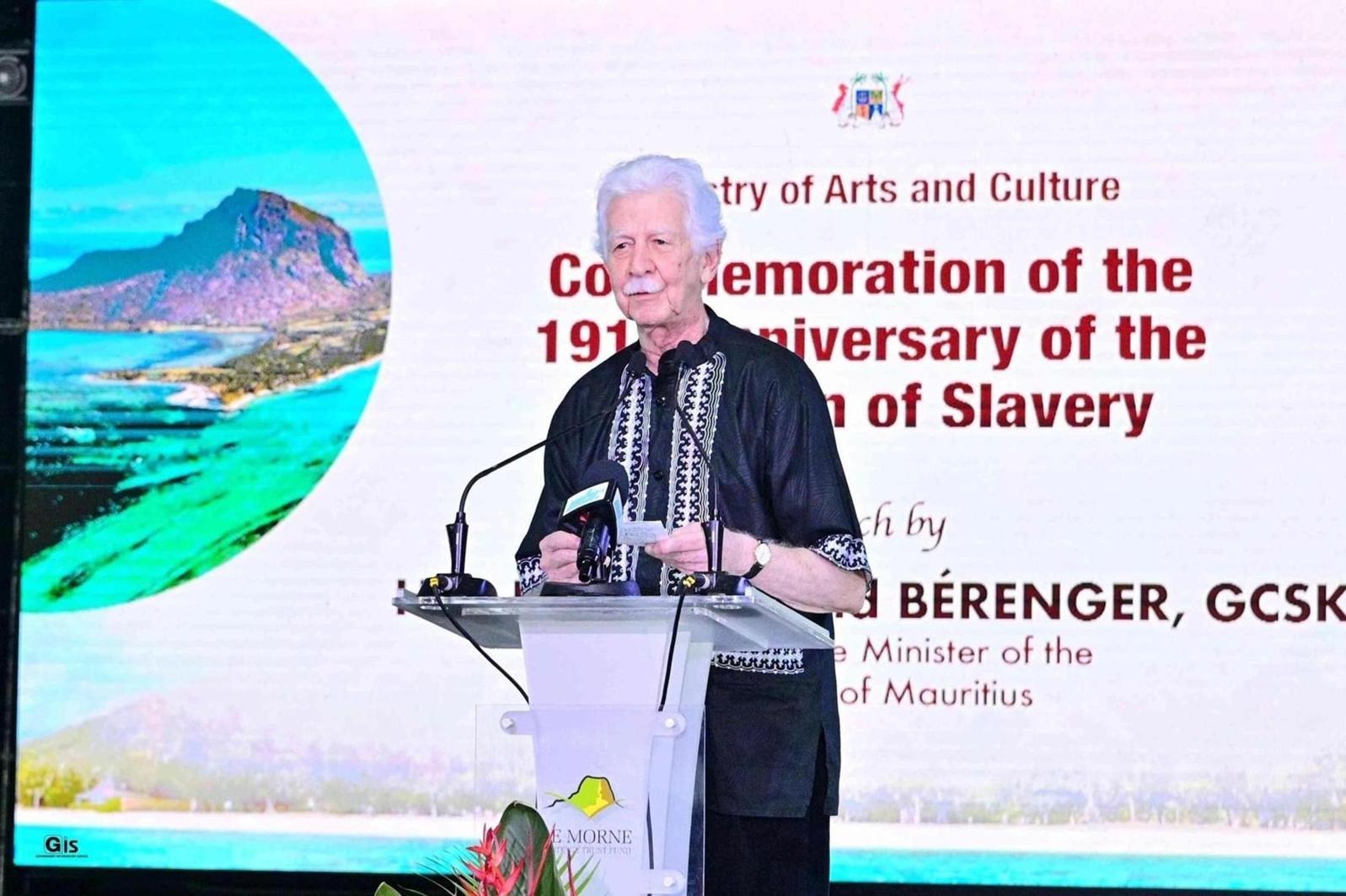
Africa-Press – Mauritius. The importance of knowing and preserving the history of Mauritius, particularly that of slavery and indentured labour, was underscored, yesterday, during the official ceremony marking the 191st Anniversary of the Abolition of Slavery, held at Le Morne.
Delivering the keynote address, the Deputy Prime Minister, Mr Paul Raymond Bérenger, stressed that a duty of remembrance is indispensable for strengthening national unity and encouraging citizens, especially the youth, to become advocates of freedom. He highlighted that slavery and indentured labour form the core of the country’s history and its unity in diversity.
The commemorative activity was organised by the Ministry of Arts and Culture, in collaboration with Le Morne Heritage Trust Fund, the National Heritage Trust Fund and the Nelson Mandela Centre for African Culture.
The ceremony featured a wreath-laying at the International Slave Route Monument, during which the Vice-President of the Republic of Mauritius, Mr Jean Yvan Robert Hungley; the Deputy Prime Minister; the Minister of Arts and Culture, Mr Mahendra Gondeea; the Junior Minister of Arts and Culture, Mrs Marie Veronique Leu-Govind; along with other dignitaries, paid homage to enslaved ancestors. Ministers, Members of Parliament and members of the Diplomatic Corps were also present at the event held at Le Morne Public Beach, which included speeches, slam performances and musical renditions, followed by a cultural programme.
The Deputy Prime Minister urged young people to learn about the global history of slavery and its repercussions across different regions, including Mauritius, noting that such knowledge would not only enrich them intellectually but also empower them. He commended the artists for their cultural performances, which depicted the suffering of slaves and the evolution of sega, and called for more such initiatives to educate and foster unity among the diverse Mauritian population.
Moreover, Mr Bérenger drew attention to the difference between slavery and the slave trade stating that the distinction clarifies between the movement of people and the enduring structures that oppressed them. He elaborated on the Transatlantic, Indian Ocean, African–Middle Eastern and intra-African slave trades while recalling the process and attempts to abolish slavery in Mauritius, under colonial French rule, and its final abolition under colonial British rule. He pointed out that following the abolition of slavery in Mauritius, financial compensation was granted solely to slave owners, and former slaves were subjected to several years of apprenticeship.
In addition, the Deputy Prime Minister highlighted the significance of Le Morne as a historical site bearing witness to resistance and rebellion.
For his part, the Minister of Arts and Culture underlined that the commemoration was not only about remembering the pain and sacrifice of enslaved ancestors who laid the foundations of the country, but also about celebrating their courage and determination.
Referring to the symbolism of Le Morne, Mr Gondeea described it as a representation of humility, resistance and inner strength, as well as a call to respect shared history, ancestors and self. He reaffirmed Government’s commitment to ensuring greater recognition and respect for Le Morne so that its inhabitants can live with pride and dignity. He spoke about an investment of Rs 50 million over three years for projects including the restoration and preservation of the Open Air Museum at Trou Chenille and the mountain trail, stressing that respect, valorisation and pride remain at the core of the Ministry’s endeavours.
Addressing the gathering, Junior Minister Veronique Leu-Govind highlighted the need to root out discrimination that still stems from slavery. She expressed concern as well over the growing drug scourge, noting that many families suffer as children who are drug users disrupt family life. She called for collective action to tackle this problem, which continues to severely affect numerous households.