What You Need to Know
A recent workshop in Port Louis focused on enhancing economic relations between Mauritius and South Africa. Key discussions included trade, investment, and the strategic partnership that has developed since the 1990s. The event highlighted the importance of bilateral agreements and the role of the private sector in driving economic growth.
Africa-Press – Mauritius. A workshop on the theme “Catalysing Growth: Deepening Mauritius – South Africa Economic Relations, Trade and Investment” opened, yesterday, at Le Suffren Marina and Resorts in Port Louis, at the initiative of the Ministry of Foreign Affairs, Regional Integration and International Trade, the South African Chamber of Commerce in Mauritius and Stewards Investment Capital.
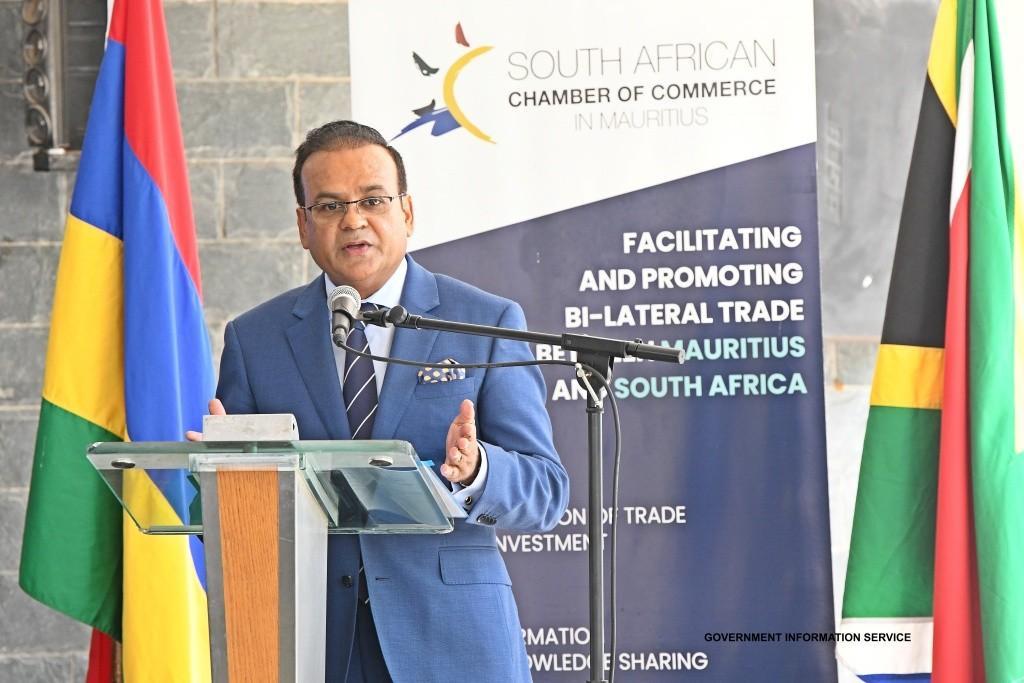
The Minister of Foreign Affairs, Regional Integration and International Trade, Mr Dhananjay Ramful; the President of the South African Chamber of Commerce and CEO of Stewards Investment Capital, Mr Bilal Adam; members of the Chamber; and other distinguished guests were present.
In his keynote address, Minister Ramful underlined that Mauritius values its strong bilateral relations with South Africa, which have expanded significantly since the establishment of diplomatic relations in the early 1990s.
He recalled that collaboration between the two countries spans several sectors including trade, education, culture and tourism, supported by various bilateral agreements such as the Bilateral Investment Treaty, the Double Taxation Avoidance Agreement and the General Cooperation Agreement signed in 2023, which provides for a Joint Commission to further deepen cooperation.
He highlighted that South Africa is a strategic economic partner for Mauritius and the second-largest source of Foreign Direct Investment in the country, representing around 14% of total Foreign Direct Investment (FDI) and 62% of African-origin FDI, with cumulative investments of about USD 500 million over the past seven years.
Trade between the two countries has also grown steadily, and in 2025, South Africa was ranked as Mauritius’ top export destination, representing 12.6% of total exports valued at Rs 9.6 billion, while also being the fourth largest source of imports, accounting for 6.5% of total imports amounting to Rs 20.6 billion, he stated.
Minister Ramful further spoke about Government’s economic diplomacy strategy and the vision of an “Innovative Mauritius”, which focuses on high-tech, sustainable and ocean-based industries, including fintech, renewable energy, the blue economy, ICT and biotechnology.
He also highlighted that Mauritius will host the 18th U.S.–Africa Business Summit in July 2026, which will serve as a major platform for investment and partnership opportunities across Africa.
The Minister also emphasised that Mauritius remains a preferred investment gateway into Africa through the Mauritius International Financial Centre, which operates under rigorous international standards and provides a secure and efficient platform for businesses to expand into regional and global markets.
He noted that both countries have complementary strengths, with South Africa offering industrial capacity and access to supply chains, while Mauritius provides financial services expertise, an efficient business environment and access to international markets through its network of trade agreements.
He concluded by stressing that while diplomatic relations provide the framework for cooperation, it is the private sector that drives economic activity, adding that Government will continue to act as a facilitator to strengthen business, trade and investment relations between Mauritius and South Africa for the benefit of the region.
For his part, Mr Bilal Adam highlighted that in an increasingly uncertain global environment where capital is becoming more selective, investors are seeking jurisdictions that can offer both scale and strong institutional structures.
In this context, he emphasised that the Mauritius–South Africa corridor is becoming increasingly strategic, noting that Mauritius’ geographic position at the crossroads of Africa and Asia, together with its regulatory stability, reinforces its role as an investment platform and a cost-effective business continuity base for global companies seeking resilience, diversification and operational efficiency.
Mauritius and South Africa established diplomatic relations in the early 1990s, leading to a significant expansion of bilateral ties. Over the years, both nations have signed various agreements to enhance cooperation in trade, education, and tourism, fostering a strong economic partnership that benefits both countries. The strategic importance of this relationship has grown, with South Africa becoming a key source of foreign direct investment for Mauritius, reflecting their complementary economic strengths.