Africa-Press – Mozambique. President Chapo: “We inaugurate a new chapter in bilateral relations, in the year marking 50 years of genuine friendship between our countries”
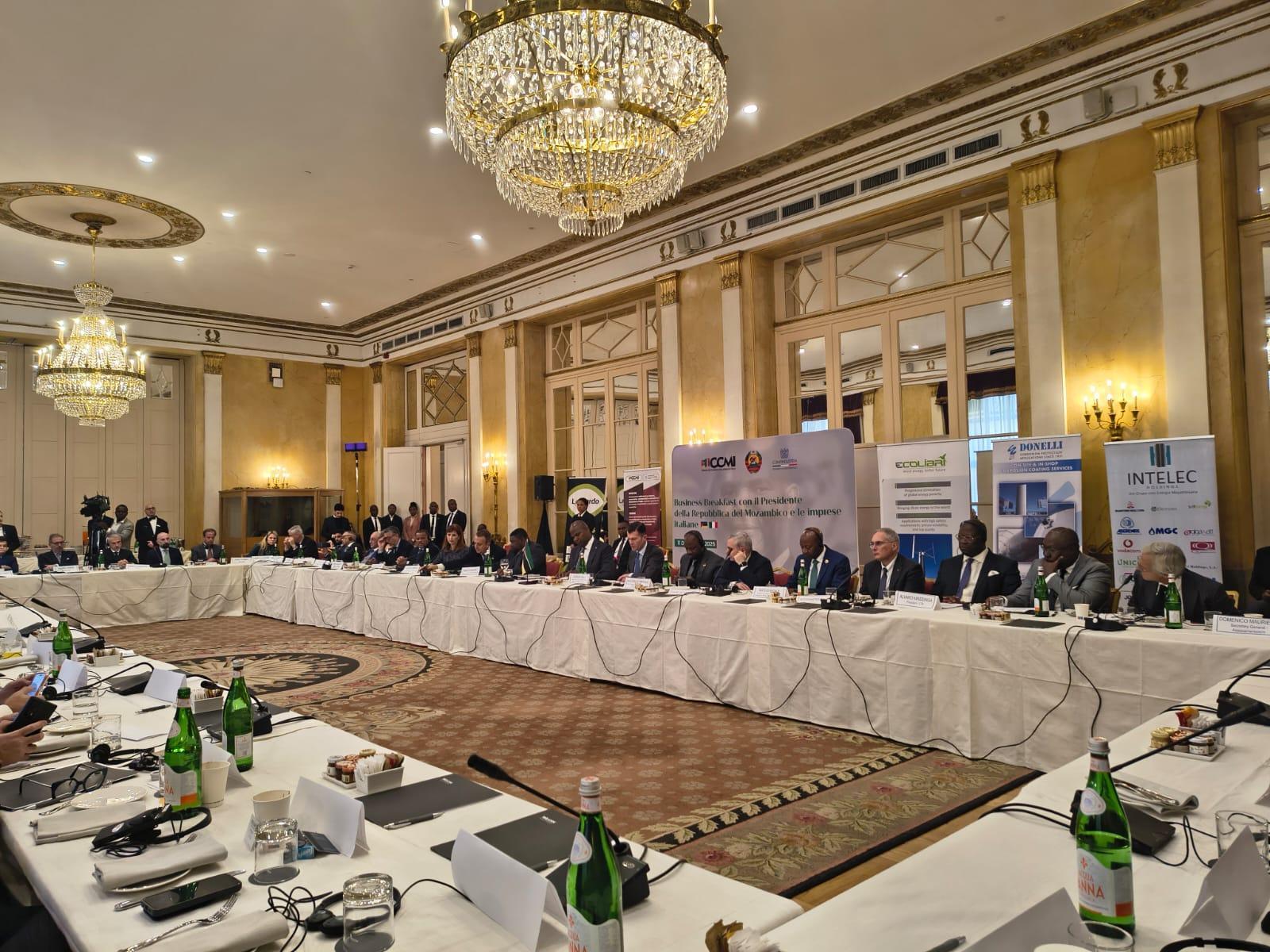
The Italy-Mozambique Business Roundtable held tis Thursday in Rome focused on involving Italian companies in Mozambique’s development plan and encouraging investment across key sectors — including energy, engineering, construction, logistics, technology, and agroindustry — to support the diversification of Mozambique’s economy. The event took place at the Westin Excelsior Hotel and was organised by the Mozambique-Italy Chamber of Commerce (CCMI), in collaboration with the Embassy of the Republic of Mozambique in Rome and Confindustria Assafrica and Mediterranean, as part of President Daniel Chapo’s visit to Italy.
Alongside President Chapo, participants included Mozambican Minister of Economy Basilio Zefanias Muhate; Italy’s Undersecretary for Foreign Affairs and International Cooperation Giorgio Silli; Vice-President of Confindustria for Export and Investment Attraction Barbara Cimmino; and Mozambique-Italy Chamber of Commerce (CCMI) President Simone Santi.
Opening the meeting, President Chapo highlighted that Mozambique is entering a new phase of development based on fiscal stability, economic modernization, simplification of the business environment, economic reforms, and private sector promotion. He emphasised Italy’s key role in supporting this process.
“Today, we inaugurate a new chapter in bilateral relations, coinciding with the 50th anniversary of authentic friendship between our countries. Since the national liberation struggle, Italy has shown solidarity towards Mozambique. In difficult times, your country stood by us, demonstrating a solidarity that the Mozambican people will never forget,” said Chapo, recalling that Rome was the site where, in 1991, the Peace Accords ending 16 years of civil war were signed.
“Since then, Rome has symbolised our rebirth, and being here today means continuing that story. Mozambique is open to private sector investments. Our development is not improvised but founded on a clear, pragmatic, results-oriented vision. Our goal is to diversify the economy and create opportunities for SMEs,” the Mozambican President added, stressing the importance of developing modern, inclusive infrastructure and enhancing human capital. The strategic objective, Chapo continued, is to “build a more competitive, sovereign Mozambique that is open to business and foreign investment.”
A key area of synergy between Italy and Mozambique is the energy sector, given Mozambique’s vast natural resources and Italy’s industry expertise.“We need know-how, and Italy can provide it,” said Chapo, referring to the Coral South and Coral North projects led by Eni, and the Mozambique LNG project operated by TotalEnergies in Cabo Delgado, supported by Saipem. He also highlighted agriculture and agroindustry as priority sectors for Italian companies.
“Mozambique is one of the countries with the greatest agricultural potential, where Italy has advanced know-how, especially in agro-logistics and cold chain preservation. Italy can also be our partner in establishing factories and in sectors like textiles, pharmaceuticals, and natural resource processing,” he added, noting Mozambique’s significant reserves of critical materials.
Undersecretary Silli emphasised that Italy regards the strengthening of its partnership with Mozambique as strategic, particularly within the framework of the Mattei Plan, where Maputo is a priority country. “The Italy-Mozambique partnership already has a solid foundation, but the potential is still enormous. We want to support Italian companies in Mozambique, foster the development of Mozambican industry, and promote inclusive local growth,” said Silli.
After a decline in 2023, trade between the two countries has rebounded, exceeding €424 million in the first eight months of the year — a 20% increase — with direct investments nearing €200 million.
Silli also announced the near completion of a new framework cooperation agreement between the two countries.
“The bond of friendship between Italy and Mozambique is deep and sincere, celebrating 50 years of diplomatic relations this year,” Silli concluded. He reaffirmed the government’s commitment to strengthening relations in key sectors such as energy, infrastructure, agriculture, and youth training, benefiting Italian businesses.
Barbara Cimmino, Vice-President of Confindustria for Export and Investment Attraction, described President Chapo’s visit as a major opportunity to enhance bilateral dialogue. She noted Mozambique’s rising importance due to its strategic location, natural resources, and central role in implementing the Mattei Plan for Africa.
“As Confindustria, we are committed to helping Italian companies open new cooperation opportunities in strategic sectors identified by the government. Italian firms bring quality, innovation, and a co-development model that creates value in countries where they invest. With this spirit, we aim to broaden and diversify trade exchanges and investment flows towards shared priorities,” Cimmino said. “We are ready to strengthen our partnerships in Mozambique and across Africa and contribute to building new, shared, long-term growth prospects.”
Simone Santi, President of the Italy-Mozambique Chamber of Commerce, stated that Mozambique enjoys privileged relations with Italian businesses and that the collaborative system they have established is working effectively.
“We selected 26 companies with a combined turnover of €12.6 billion. Key interests focus on critical materials, energy (oil, gas, renewables), dams, and agricultural transformation,” Santi said. He described Mozambique as a growing country with a young president and a technically skilled government implementing reforms to change the perceptions of risk among entrepreneurs. “The risks are outweighed by the potential for substantial business volumes,” he added.
Santi also highlighted Mozambique’s government efforts to enhance security, noting the restart of TotalEnergies’ mega project and the presence of Eni, with two major projects, and Saipem, which will employ around 20,000 people and provide subcontracts to about 3,000 companies.
The roundtable included representatives from 26 of the largest Italian companies in energy, engineering, construction, logistics, technology, agroindustry, and innovation sectors, including Cassa Depositi e Prestiti, Leonardo, Fincantieri, Saipem, Webuild, CMC, Renco, Bonatti, and Inalca. Mozambique’s side was represented by the state energy company ENH-Empresa Nacional de Hidrocarbonetos and the Energy Regulatory Authority (ARENE).
Mozambique remains one of the leading destinations for Italian investments in Africa. Companies like Eni and Saipem have played central roles in Mozambique’s energy sector, particularly the Coral North FLNG project, with a total investment exceeding $7.2 billion.
Other significant Italian firms — Baker Hughes, Renco, CMC Ravenna, Inalca, Ecolibri, Donelli — operate in energy, construction, food industry, logistics, sustainable technologies, and high-impact socioeconomic projects.