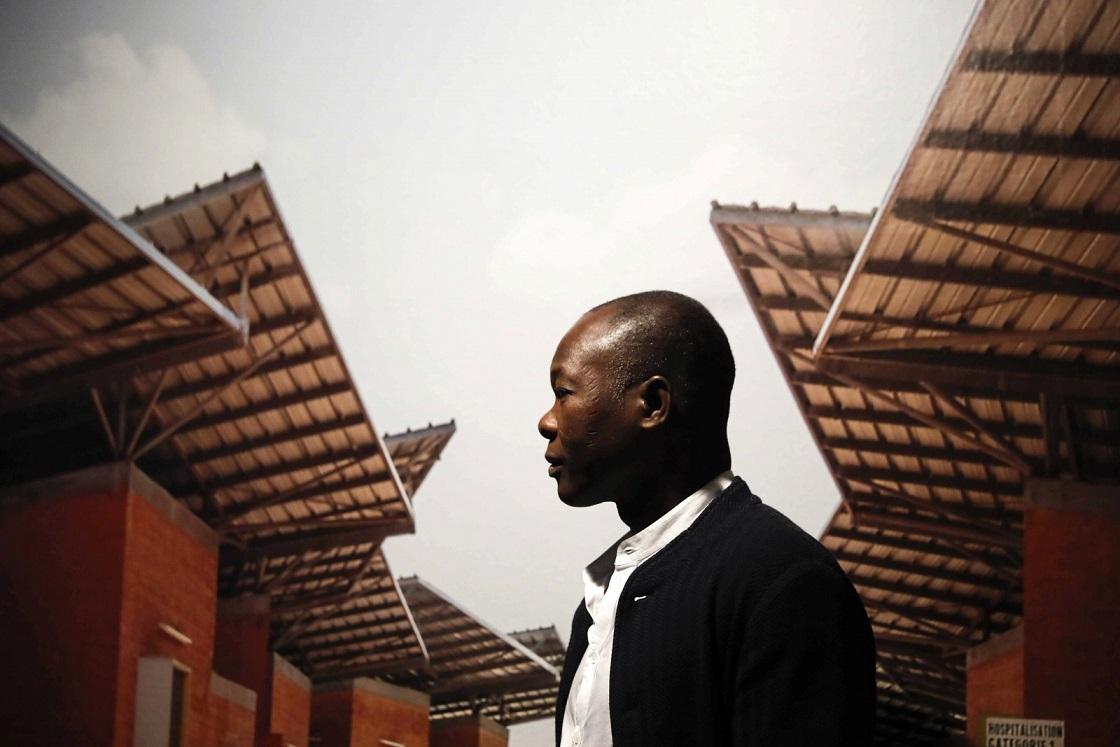
Africa-Press – Mozambique. The Order of Architects of Mozambique said yesterday in statements to Lusa that it felt “justice has been done to African architecture” with the 2022 Pritzker Prize being awarded to Burkina Faso’s Diebedo Francis Kere, highlighting “the Africanity present in the projects” of the winner.
“It is with great joy that we receive the news that Francis Kéré won the Pritzker, because it is justice that is done to him, since he had already been nominated in the past, and it is also justice that is done to African architecture,” the Order’s Secretary General Anselmo Cani, told Lusa.
Cani said that no-one could be indifferent to the award-winner’s unique architecture.
“He found a style of his own, which combines elements of modern technology and ancestral African technology,” emphasised Cani , who personally met the Pritzker winner in Brussels in 2017.
Anselmo Cani, who is also the deputy director of the Faculty of Architecture and Physical Planning at Eduardo Mondlane University (UEM), said that the award would increase the visibility of the work being done in Africa, living up to the quality of projects developed by professionals in the area on the continent.
Luís Lage, a professor at the Faculty of Architecture and Physical Planning at UEM, told Lusa that Francis Kéré’s work was relevant today because it was based on the idea of sustainability and the reconciliation of architecture with the challenges posed by the climate.
“There is a lot of geography in Francis Kéré’s work, because he develops projects based on local materials and attention to sustainability,” Lage declared.
Lage highlighted that Mozambique was following in Kéré’s footsteps, because the architect had designed a school and an urban settlement in the province of Tete, central Mozambique.
Kéré is the first African architect to win the Pritzker, the most important award in world architecture, the organisation announced Tuesday.
About Diébédo Francis Kéré
Francis Kéré (b. Diébédo Francis Kéré, 1965) was born in Burkina Faso – one of the world’s least educated and most impoverished nations, a land without clean drinking water, electricity or infrastructure, let alone architecture.
“I grew up in a community where there was no kindergarten, but where community was your family. Everyone took care of you and the entire village was your playground. My days were filled with securing food and water, but also simply being together, talking together, building houses together. I remember the room where my grandmother would sit and tell stories with a little light, while we would huddle close to each other and her voice inside the room enclosed us, summoning us to come closer and form a safe place. This was my first sense of architecture.”
Kéré was the oldest son of the village chief and the first in his community to attend school, only the city of Gando didn’t have a school, so he left his family at the age of seven. His small childhood classroom in Tenkodogo was constructed of cement blocks and lacked ventilation and light. Trapped in that extreme climate with over one hundred classmates for hours at a time, he vowed to one day make schools better.
“Good architecture in Burkina Faso is a classroom where you can sit, have light that is filtered, entering the way that you want to use it, across a blackboard or on a desk. How can we take away the heat coming from the sun, but use the light to our benefit? Creating climate conditions to give basic comfort allows for true teaching, learning and excitement.”
In 1985, he moved again, this time, much further from home, travelling to Berlin on a vocational carpentry scholarship, learning to make roofs and furniture by day, while attending secondary classes at night. He was awarded a scholarship to attend Technische Universität Berlin (Berlin, Germany) in 1995, graduating in 2004 with an advanced degree in architecture.
Although far from Burkina Faso, Kéré’s mind never strayed from his native homeland. He recognized the responsibility of his privilege, establishing the Schulbausteine für Gando foundation, translated as “school building blocks for Gando” and later renamed Kéré Foundation, in 1998 to fundraise and advocate for a child’s right to a comfortable classroom.
His first building, Gando Primary School (2001, Gando, Burkina Faso), was built by and for the people of Gando. Locals offered their input, labour and resources from conception to completion, crafting nearly every part of the school by hand, guided by the architect’s inventive forms of indigenous materials and modern engineering.
The success of Gando Primary School brought him the Aga Khan Award for Architecture in 2004, and was the catalyst for establishing his practice, Kéré Architecture, in Berlin, Germany in 2005. The realisation of additional primary, secondary, postsecondary and medical facilities soon followed throughout Burkina Faso, Kenya, Mozambique and Uganda.
Kéré’s built works in Africa have yielded exponential results, not only by providing academic education for children and medical treatment for the unwell, but by instilling occupational opportunities and abiding vocational skills for adults, therefore serving and stabilising the future of entire communities.
With each trip back to Gando, Kéré has bestowed purposeful ideas, technical knowledge, environmental understanding and aesthetic solutions, but his service to humanity through cultural sensitivity, process of engagement and devotion proves as a constant example of generosity to the world.
“I considered my work a private task, a duty to this community. But every person can take the time to go and investigate things. We have to fight to create the quality that we need to improve people’s lives,” he says.
His work has expanded beyond school buildings in African countries to include temporary and permanent structures in Denmark, Germany, Italy, Switzerland, the United Kingdom, and the United States. Two historic parliament buildings, the National Assembly of Burkina Faso (Ouagadougou, Burkina Faso) and Benin National Assembly (Porto-Novo, Republic of Benin), have been commissioned, with the latter currently under construction.
Additional awards include the Cité de l’Architecture et du Patrimoine’s Global Award for Sustainable Architecture (2009), BSI Swiss Architectural Award (2010); the Global Holcim Awards Gold (2012, Zurich, Switzerland), Schelling Architecture Award (2014); Arnold W Brunner Memorial Prize in Architecture from the American Academy of Arts & Letters (2017); and the Thomas Jefferson Foundation Medal in Architecture (2021).
The architect has been a visiting professor at the Harvard University Graduate School of Design (Massachusetts, United States), Yale School of Architecture (Connecticut, United States), and holds the inaugural Chair of Architectural Design and Participation professorship at the Technische Universität München (Munich, Germany) since 2017. He is an Honorary Fellow of Royal Architectural Institute of Canada (2018) and the American Institute of Architects (2012) and a chartered member of the Royal Institute of British Architects (2009).
About the Pritzker Prize
The Pritzker Prize is the most important award in the field of architecture, awarded to a living architect whose built work “has produced consistent and significant contributions to humanity through the art of architecture.”
These are the Pritzker Prize winners since 1979:
1979
. Philip Johnson, United States
1980.
Luis Barragán, Mexico
1981.
James Stirling, United Kingdom
1982.
Kevin Roche, United States
1983.
I. M. Pei, United States
1984.
Richard Meier, United States
1985.
Hans Hollein, Austria
1986.
Gottfried Böhm, Germany
1987.
Kenzo Tange, Japan
1988
. Oscar Niemeyer, Brazil and Gordon Bunshaft, United States
1989.
Frank Gehry, Canada—United States
1990.
Aldo Rossi, Italy
1991.
Robert Venturi, United States
1992.
Álvaro Siza, Portugal
1993.
Fumihiko Maki, Japan
1994.
Christian de Portzamparc, France
1995.
Tadao Ando, Japan
1996.
Rafael Moneo, Spain
1997.
Sverre Fehn, Norway
1998.
Renzo Piano, Italy
1999.
Norman Foster, United Kingdom
2000.
Rem Koolhaas, Netherlands
2001.
Jacques Herzog and Pierre de Meuron, Switzerland
2002.
Glenn Murcutt, Australia
2003.
Jørn Utzon, Denmark
2004.
Zaha Hadid, Iraq-United Kingdom
2005.
Thom Mayne, United States
2006.
Paulo Mendes da Rocha, Brazil
2007.
Richard Rogers, United Kingdom
2008.
Jean Nouvel, France
2009
. Peter Zumthor, Switzerland
2010
. Kazuyo Sejima and Ryue Nishizawa, Japan
2011.
Eduardo Souto de Moura, Portugal
2012.
Wang Shu, China
2013.
Toyo Ito, Japan
2014.
Shigeru Ban, Japan
2015.
Frei Otto, Germany
2016.
Alejandro Aravena, Chile
2017.
Ramón Vilalta, Carme Pigem and Rafael Aranda, Spain
2018.
Balkrishna Doshi, India
2019.
Arata Isozaki, Japan
2020.
Yvonne Farrell and Shelley McNamara, Ireland
2021.
Anne Lacaton and Jean-Philippe Vassal, France
2022
.Diébédo Francis Kéré, Burkina Faso
For More News And Analysis About Mozambique Follow Africa-Press