Africa-Press – Namibia.
The Namibian Parliament has incorporated the use of artificial intelligence (AI) to transcribe debates, translate documents and analyse amendments.
AI-powered tools are helping MPs in decision-making, legislative drafting, research and public interaction.
In a report released recently, National Assembly Speaker Saara Kuugongelwa-Amadhila acknowledged the potential of AI to enhance parliamentary efficiency, transparency and inclusivity across the Southern African Development Community Region.
What is more, Parliament’s administrative desk has acknowledged that AI has been, since its inception, beneficial for administrative work.
The draft AI Bill, which aims to ensure ethical use, is being finalised.
It will work alongside the related Data Protection Bill and Cybercrime Bill.
“Namibia is committed to building a digital infrastructure and capacity through the e-Parliament Strategy, which aims to improve service delivery, legislative processes and citizen engagement,” Kuugongelwa- Amadhila said in the report.
The report emanates from a conference attended by over 300 delegates, including speakers and Members of Parliament from 15 Southern African Development Community (SADC) member states.
Regional experts and development partners attended the Plenary Session last year in Zimbabwe.
AI was high on the agenda among talking points.
The forum highlighted that, despite the prospect for opportunities of AI, parliaments face hurdles such as outdated information technology systems, poor data quality, lack of AI literacy and ethical concerns.
AI adoption also presents ethical concerns, data privacy issues and the digital divide among SADC member parliaments.
But the role of AI is envisaged to improve transparency, accountability and oversight by automating data analysis and integrating predictive models.
SADC aims to strengthen parliamentary oversight through collaborative, data-driven governance models, mitigating risks of AI biases and misinformation.
Digital tools and AI-enabled consultation mechanisms will also promote greater public participation whilst addressing the challenges of digital literacy.
Additionally, there was a push for regional cooperation in building AI expertise, especially through education, training and public-private partnership.
Countries such as Estonia, Italy and Brazil were reported to be already using AI for transcriptions, translations and bill amendment analysis.
The report also notes that, from the United Arab Emirates (UAE) to Pakistan, parliaments are integrating AI to modernise governance.
The UAE’s AI Act has set a global benchmark, while Pakistan’s Senate has launched an AI-powered chatbot to improve legislative access.
The challenges with adoption are illustrated by the United Kingdom’s Public Accounts Committee, for instance, which flagged transparency and digital skills gaps as major barriers.
However, Namibia noted its commitment to using AI to support but not to replace democratic processes.
“Regional collaboration on AI governance and best practices will be essential for responsible and inclusive AI integration,” Kuugongelwa – Amadhila pinpointed at the time.
Moreover, Zimbabwe highlighted its collaboration with government ministries to ensure seamless logistics and technological readiness.
It pushed for regional cooperation in building AI expertise, especially through education, training and public-private partnership.
Academic institutions in Zimbabwe and other parts of SADC are driving parliamentary innovation through initiatives like AI-powered Hansard translation tools and advanced legislative tracking systems.
The universities have also launched regional AI literacy programmes aimed at equipping both lawmakers and citizens with critical digital skills for more effective inclusive governance.
While the adoption of AI presents opportunities, she acknowledged that challenges faced include funding , infrastructure, human capacity and regulatory frameworks that must be addressed.
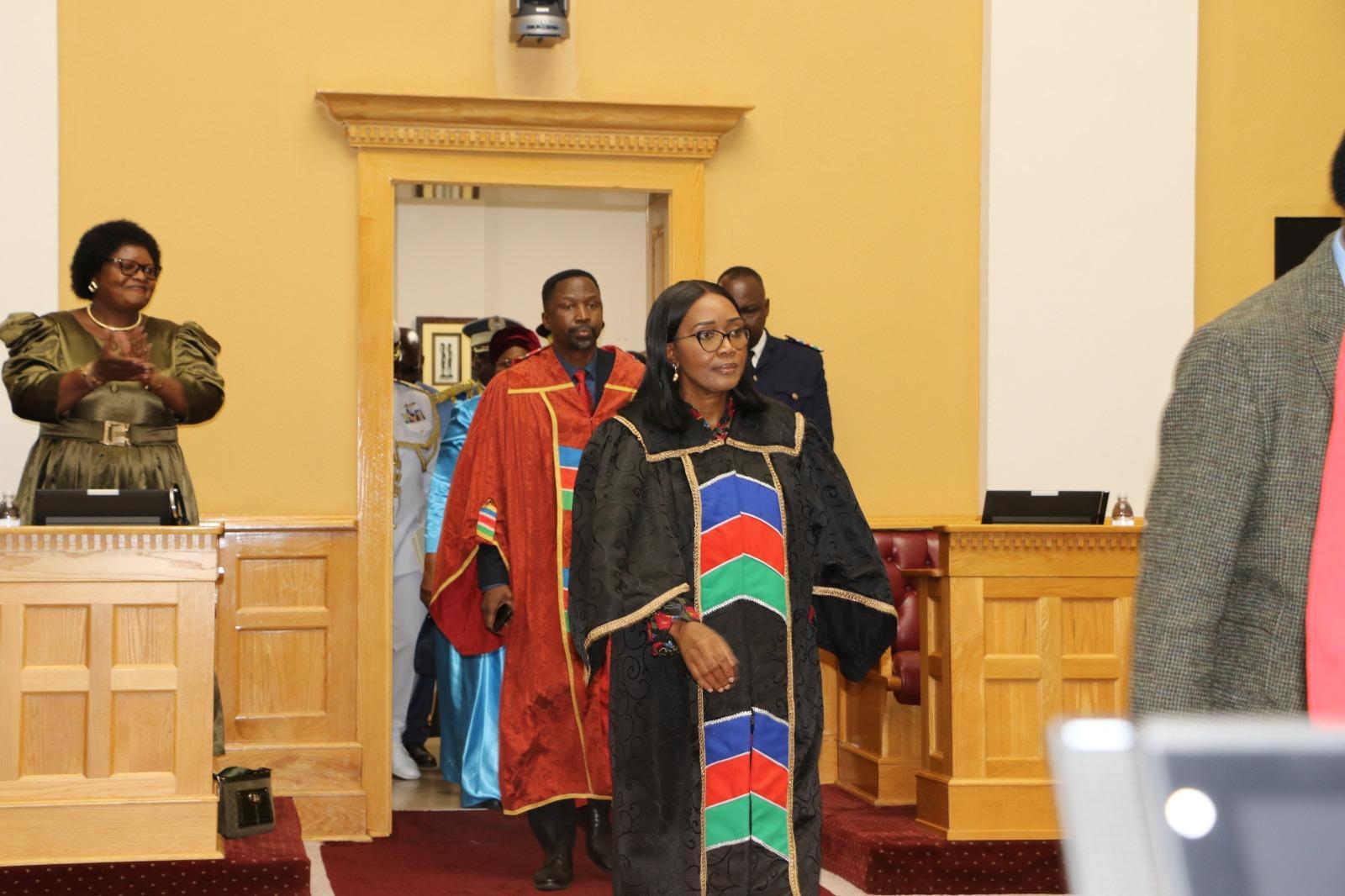
Moreover, Kuugongelwa- Amadhila and other Members of Parliament from the SADC region, were officially sworn in as new members of the SADC Parliamentary Forum during the 57th Plenary Assembly Session in Victoria Falls, Zimbabwe.
Other members of the Namibian delegation participated as observers.
Namibia, as the host country of the SADC PF since 1997, reaffirmed its commitment to supporting the transformation of the Forum into an SADC Regional Parliament.
The Ministry of International Relations and Trade is currently reviewing the draft protocol on the establishment of the SADC Parliament.
The eighth National Assembly will conclude this process.
Namibia also signed the agreement to amend the SADC Treaty to establish the SADC Regional Parliament on 26th June 2024.
The country became the 10th member state to do so.
The agreement entered into force on 11th July 2024, officially establishing the SADC Parliament as one of the institutions of SADC under Article 9(1) of the SADC Treaty.
For More News And Analysis About Namibia Follow Africa-Press