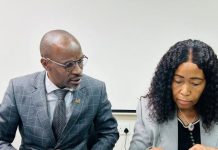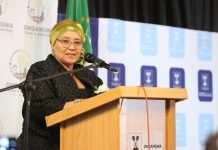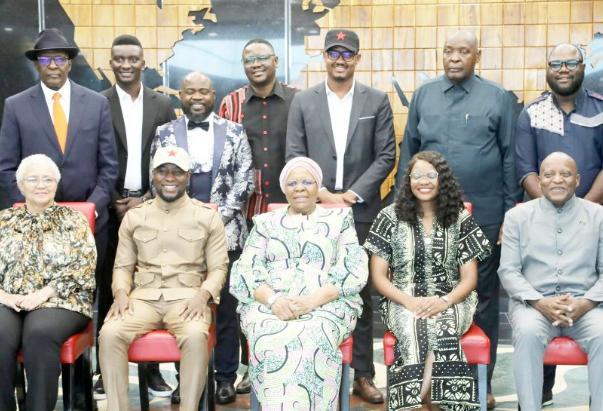
Africa-Press – Namibia. President Netumbo Nandi-Ndaitwah on Friday met a delegation from the Affirmative Repositioning movement at State House in Windhoek, in what both sides described as a substantive engagement focused on governance, economic development and land delivery.
The meeting forms part of the President’s ongoing consultations with political parties.
Addressing the visiting delegation, Nandi-Ndaitwah said the engagement was important for strengthening dialogue among elected leaders.
“As elected representatives, we are all leaders, and we have a responsibility to exchange so that we can lead our people in the right direction,” she said.
She added, “I said I am going to meet all political parties representing the National Assembly one-on-one. I started last year, and we are almost coming to an end.
I also didn’t want it to go into the next financial year without completing this round,” she said. The meeting was attended by senior government officials, including Prime Minister Elijah Ngurare and other members of Cabinet.
Document-based
Leading the AR delegation, party leader Job Amupanda said the movement approached the meeting with detailed proposals and written submissions. “We didn’t come here for photos. As you could see, we came with documents, and our discussion was document-based,” Amupanda told reporters after the meeting.
He said the engagement covered a wide range of issues, including economic development, governance reforms and institutional accountability.
“We were discussing various issues, from the economy to effective governance to the accountability of state institutions, making sure that we follow through,” he said.
According to Amupanda, the discussions also involved exchanging proposals and identifying areas where the party’s ideas aligned with government priorities.
“We gave proposals, and the President and her Cabinet also briefed us on key important issues and, obviously, areas of convergence and things that we need to be able to do,” he said.
Planting season
Amupanda likened the meeting to a “planting season”.
“When it is raining, you plant. The President is planting; we are also planting so that the seeds can germinate, and we will all be able to have fruit,” he said. The AR leader added that the discussion lasted longer than expected because both sides went through the proposals in detail. “We had to go document by document, briefing by briefing, cross-pollinating ideas,” he said. Among the issues raised by the AR delegation were economic development and employment creation, particularly among young people. Amupanda confirmed that the party presented specific proposals on how to stimulate economic growth.
“We gave specific interventions on how we can stimulate growth and how we can use the fiscal space to be able to stimulate certain activities,” he said.
He added that the movement’s approach focused on broader structural reforms rather than isolated policy debates.
Burning issues
The AR delegation also raised concerns about the effectiveness of oversight institutions and accountability mechanisms within government. “As far as the ideas, the aspiration and the principles of the President, we are together. Our concern is how these things are implemented,” he said.
He cited government programmes such as youth development initiatives as examples where implementation must match policy intentions. “You can’t, for instance, have a youth fund and everyone is excited about it, and then in the implementation something else happens,” he said.
Since its inception over a decade ago, land delivery and housing finance have been high on the AR agenda. Friday’s meeting was no different. Their discussions focused on systemic solutions to Namibia’s housing shortage, including increasing land supply and improving financing mechanisms.
“You need to deliver land in terms of supply and demand dynamics. Once the land is available, you actually have to build,” he said.
He added that questions such as who services land, at what cost and how housing is financed are central to resolving the crisis.
“In this country, a large portion of the profits of financial institutions comes from housing bonds. The housing crisis benefits some people,” he said.
Beginning
Amupanda said the meeting was only the beginning of further discussions between the AR movement and the government.
“This is the beginning where we are going to have more conversations, not only with the President but also with key functionaries of government,” he said.
He also stressed that AR intends to combine its activist roots with parliamentary oversight. “We remain activists, but we are now taking a strategic institutional approach because we are in Parliament, and we can hold the Executive to account,” he said. The documents submitted to the President include proposals on economic development and employment creation, effective governance and accountability, electoral reform and urbanisation, he said.
“We see the President as someone running a very important institution. We have no choice but to engage to make sure we see specific progress,” he said.
It was the first time in over 10 years that the movement had visited State House.
Back in 2015, AR leaders and the late president Hage Geingob, primarily in 2015 and 2016, met in high-stakes engagements focused on land reform and youth empowerment in Namibia. One of the meetings resulted in a commitment to service 200 000 plots countrywide.
A subsequent meeting in 2016 sought to address the slow implementation of the agreements made in 2015. After talks failed to yield desired results, AR dragged Geingob to court to compel Geingob to honour the commitment. However, the court ruled in Geingob’s favour, stating he was not obliged to fulfil the political promise.
For More News And Analysis About Namibia Follow Africa-Press