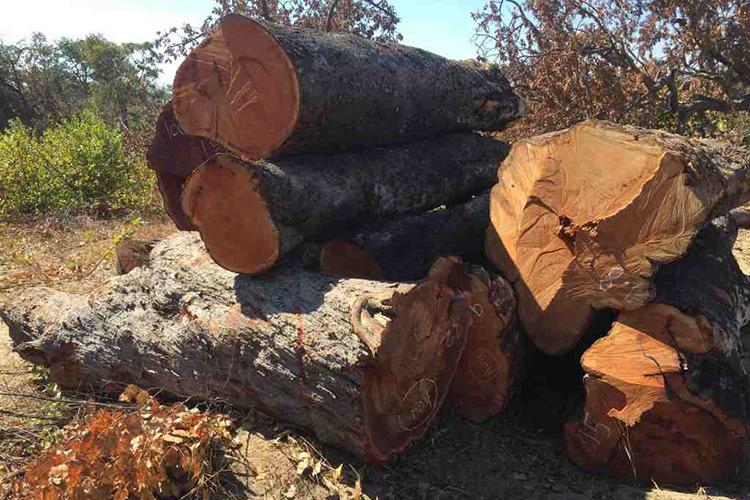
Africa-Press – Namibia. ZAMBEZI regional governor Lawrence Sampofu has warned residents against deforestation to avoid drought like in other regions.
He was speaking last week during a panel discussion on “On how to integrate local communities as equal partners in sustainable forest resource management”.
The panel discussion was spearheaded by Hans Seidel Foundation together with the Desert Research Foundation of Namibia, with funding from the European Union. According to Sampofu, the forest plays a crucial role in mitigating the effects of climate change, and where there is a forest there is rain.
“If we look to the [north-]west, the Oshana region and even further, we will hardly see any forest left. We also know that people in these north-western regions experience frequent droughts,” he said.
Increasing and maintaining forests is, therefore, an essential solution not only to climate change but also for the people’s livelihoods. “Our communities also depend on the forest and its products for their livelihoods. However, Namibia has lost nearly a fifth of its forest area over the past 30 years,” he lamented.
Sampofu explained that the forest lost in the country is mainly man-made and happens through wildfires, clearance of land for food production or illegal harvesting of wood.
“I hope that we all become more eco-mindful of Namibia’s diverse natural wealth. Indeed, targeted [interventions] will help us to make a significant impact towards these goals,” he said.
The Namibia Sustainable Forest Management project manager, Lara Beer, who was also in attendance, noted that the aim of sustainable forest management is to ensure that forests supply goods and services to meet both present-day and future needs and contribute to the sustainable development of communities.
As a result, if the forests and trees are sustainably managed, they will make vital contributions both to people and to the planet by bolstering livelihoods, providing clean air and water, conserving biodiversity and responding to climate change.
“In the northeast of Namibia, the local communities are the main forest users. Their community rights were expanded with the introduction of community forests through the Forest Act of 2001. As such, local people are encouraged to take responsibility and to become actively involved in forest management,” she said.
She added that if they take care of their forests properly, they will generate enough revenue from them. The revenue from forests depends to a large extent on available resources and social dynamics, she said.
“While more densely wooded areas have a higher revenue potential for firewood and timber, the availability of non-timber-forest products can provide local communities with a more important source of income,” she advised.
She said when stakeholders come together regularly to discuss crucial topics such as sustainable forest management, they can make an impact in forest resource management.
For More News And Analysis About Namibia Follow Africa-Press