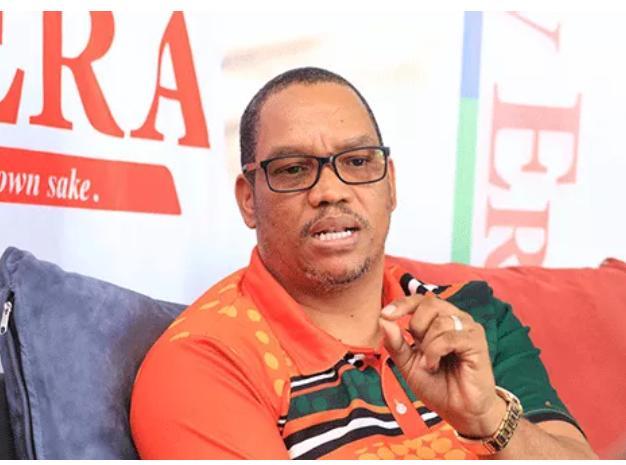
Africa-Press – Namibia. Landless People’s Movement leader and chief change campaigner Bernadus Swartbooi said President Netumbo Nandi-Ndaitwah’s intentions to heighten oversight and control over the petroleum industry appear bona fide.
He said this is in support of the Petroleum Amendment Bill insofar, as it seeks to establish a petroleum council in the Ministry of Mines and Energy.
He is, however, diametrically opposed to vesting overall powers over the sector in the Office of the President.
Among other reasons, vintage Swartbooi, in his legal element on Tuesday in the National Assembly, highlighted what he saw as loopholes in the proposed legislation.
He placed special attention on the functus officio principle, pointing out that once powers are conglomerated in the Office of the President, any decision made by the Head of State can only be challenged in court.
“In other words, an investment decision is made from whichever corporation. The decision comes from the State House, and they don’t agree with it. The President has become functus. She can’t review her own decision, so the matter will now have to be reviewed in a court of law because the President was involved in the initial decision. By virtue of the construction of this law, she becomes functus. While giving her power, power is taken away from her and given to the courts.
The courts will then take their own time unless an urgent process of law is allowed,” Swartbooi said.
Functus officio is a Latin phrase, meaning “having performed his or her office,” describing a legal doctrine where a judge, arbitrator or official loses authority over a matter once they have rendered a final decision.
Swartbooi also expressed concern that they cannot easily hold the President accountable for upstream petroleum issues in the same way they can question a minister. Instead, Swartbooi proposed that, instead of putting the petroleum products’ upstream unit in the President’s office, it should be transformed into a monitoring and evaluation structure.
“There is a genuine approach in wanting to not create additional problems. She realises the sector is so sensitive and so big and matters to the economy of the country in such a fundamental way that, as President she cannot keep it very far from herself in her view… one must appreciate the novelty in that,” he said.
Divine intervention
Adding their voice to the discourse in the National Assembly on Tuesday, Body of Christ leader Festus Thomas cautioned that the law is not a neutral administrative rearrangement.
He said the proposed bill violates the constitutional principles of fair, rational administration and separated, accountable governance.
Enter National Democratic Party president Martin Lukato, who also rose to decline the bill.
He urged that, despite oil production widening the gap between the rich and poor, oil companies, which destroy the natural environment in most cases, do not pay the affected people, as the proceeds and profits from oil are usually shared by the companies and ruling elite.
“Shell and British Petroleum Oil Company have damaged environments in which oil is being extracted, especially in Africa. In a politically skewed system, the oil-producing area is totally neglected, as the profits are syphoned and utilised in places where it is not mined. The people from such areas continue to be poor despite sitting on oil wells,” Lukato stated.
Mr Controller
Meanwhile, Affirmative Repositioning activist-in-chief Job Amupanda posed urgent oral questions in Parliament on the same day about oil advisors overshadowing the ministry of mines and energy’s decision-making and executive functions over the petroleum industry while the bill is still pending passing.
Amupanda wants to know who really controls the sector amidst the ongoing political and legislative brouhaha.
Amupanda raised concerns that oil advisors at the State House are already performing duties that legally belong to the Ministry of Mines and Energy.
He questioned why these advisors are handling local content policy instruments and attending official platforms when the law has not yet been changed to move these powers to the presidency.
However, mines and energy minister Modestus Amutse assured Amupanda that he is still the man calling the shots, dismissing any assertions to the contrary.
“There is an upstream unit within the ministry, and my personal advisor is also within that unit, sitting just next to my office. When decisions are made, of course, there are consultations here and there with the upstream unit, but the minister takes the decisions,” he replied.
For More News And Analysis About Namibia Follow Africa-Press