Africa-Press – Rwanda. A youth enterprise programme has contributed to Rwanda’s labour market, generating more than 128,000 jobs and billions of francs in business income, as policymakers and development partners move to scale up its impact.
This is according to findings presented at a high-level policy dialogue held on March 17 in Kigali.
The meeting brought together participants from relevant entities including the Ministry of Youth and Arts, the United Nations Development Programme (UNDP), and the European Union to review results from the AGUKA tracer study and map out the initiative’s next phase.
AGUKA, a youth enterprise programme has contributed to Rwanda’s labour market, generating more than 128,000 jobs and billions of francs in business income,
Since its launch in 2022, AGUKA has supported youth-led enterprises that have created over 128,000 jobs—more than 30,000 classified as decent work—while generating more than Rwf34 billion in income, Rwf10 billion in net profits, and Rwf2.25 billion in tax revenues, as per the study findings.
Officials said the data underscores the programme’s growing role in advancing Rwanda’s push toward a private sector-led, entrepreneurship-driven economy.
The dialogue focused on using the findings to refine the programme and address persistent challenges, particularly access to finance, job quality, and inclusion.
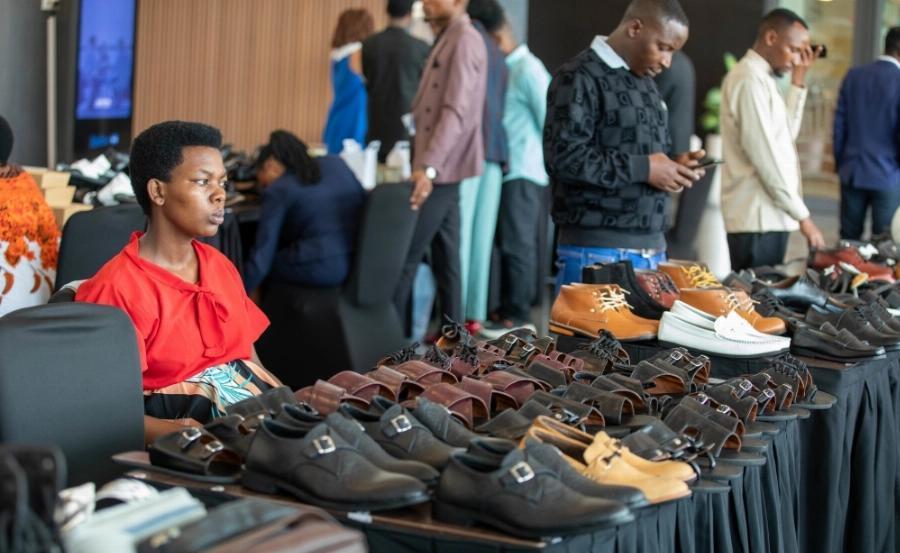
AGUKA has been providing end-to-end support to young entrepreneurs, from idea development and skills training to seed funding and business expansion. It is designed to boost youth employability while contributing to broader economic transformation, according to its developers.
For beneficiaries like Dieudonné Iradukunda, founder of Youth Proud Ltd, AGUKA has been a turning point in transforming business ideas into viable enterprises. He shared that the support received through the programme enabled him to grow his business, create jobs, and gain the confidence to expand further.
“AGUKA gave us the opportunity to turn our ideas into something real,” he said, noting that access to funding and mentorship played a key role in strengthening his business operations.
However, he pointed out that access to finance remains a major hurdle for many young entrepreneurs looking to scale.
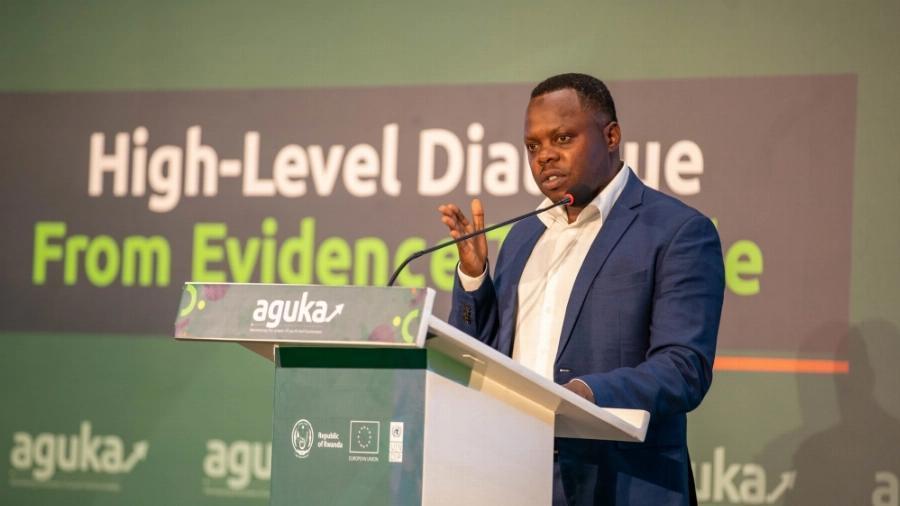
Speaking at the dialogue, Minister of Youth and Arts, Jean Nepo Abdallah Utumatwishima, said the findings confirm that AGUKA is not only delivering results but also shaping a new model for youth development in Rwanda.
He noted that the programme’s success now calls for expansion into a more advanced phase, dubbed AGUKA 2.0, which will build on lessons learned and deepen impact through stronger partnerships.
Minister of Youth and Arts, Jean Nepo Abdallah Utumatwishima addresses youth who benefited from Aguka initiative.
“We have found that the AGUKA model is working,” he said, emphasising that the next phase will focus on scaling what works while addressing existing gaps. He added that the dialogue marked the beginning of a continuous process to refine and strengthen the programme, rather than a one-off discussion.
The Minister underscored that access to finance as the most pressing challenge facing young entrepreneurs, which should be addressed with urgency.
To respond to this, he announced plans to launch an AGUKA Youth Fund aimed at supporting young entrepreneurs ready to expand their businesses. The fund, backed by partners including UNDP, the European Union and other development agencies, is expected to provide more accessible financing solutions and unlock growth opportunities for youth-led enterprises.
Iradukunda said that continued support through initiatives like the planned youth fund could unlock even greater potential for youth-led businesses.
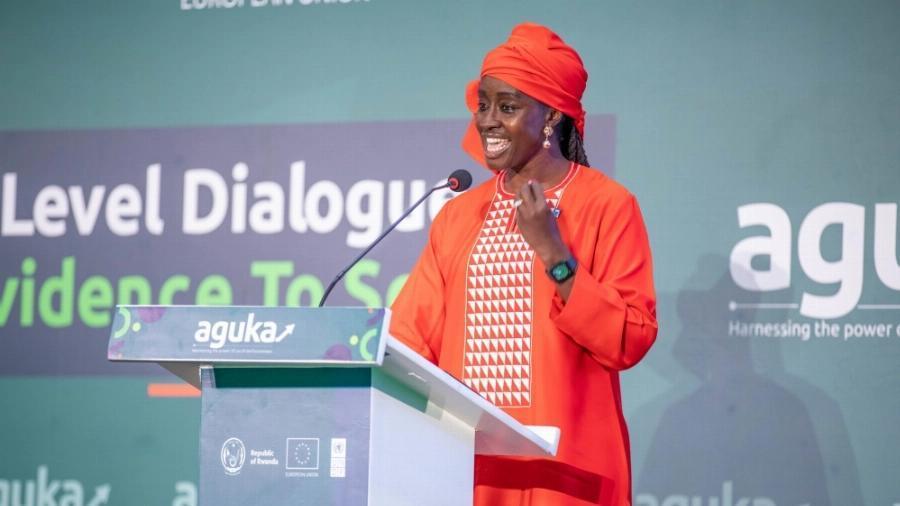
The United Nations Development Programme (UNDP) Rwanda Resident Representative, Fatmata Lovetta Sesay, underscored the transformative impact of AGUKA, describing it as a critical platform for unlocking youth potential through skills development, mentorship, access to finance, and market opportunities.
The United Nations Development Programme (UNDP) Rwanda Resident Representative, Fatmata Lovetta Sesay, speaks at the event.
She stated that the programme’s results—over 128,000 jobs created and billions generated in business income—demonstrate what is possible when young entrepreneurs are given the right support.
Using a vivid analogy, she likened young entrepreneurs to a spark that needs protection to grow. “Youth already have the spark. What they need is support to protect that spark and help it grow into a flame,” she said, emphasising the role of partnerships in nurturing sustainable businesses.
However, she cautioned that despite the progress, key challenges persist, particularly limited access to affordable finance, the prevalence of informal and short-term jobs, and barriers facing women and vulnerable groups. She stressed that addressing these constraints will require stronger collaboration between government, financial institutions, and development partners.
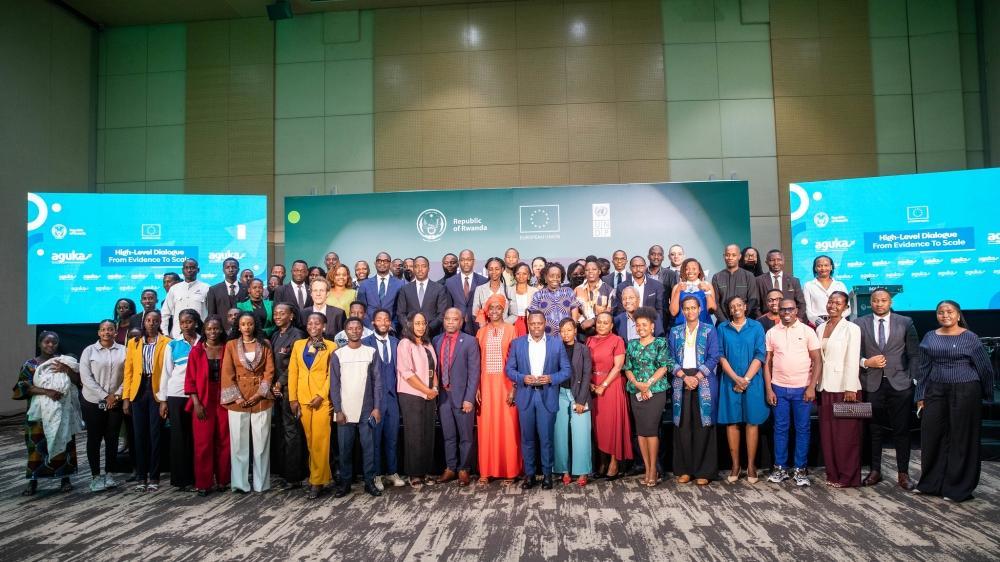
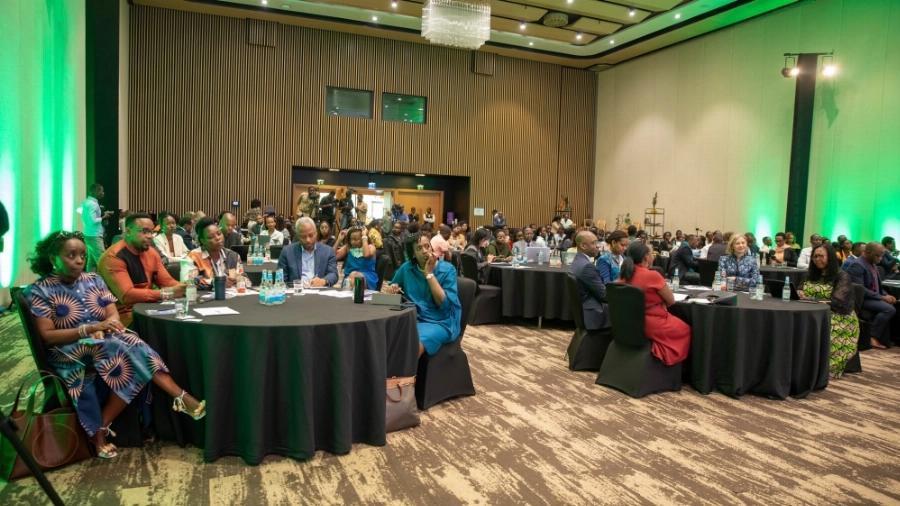
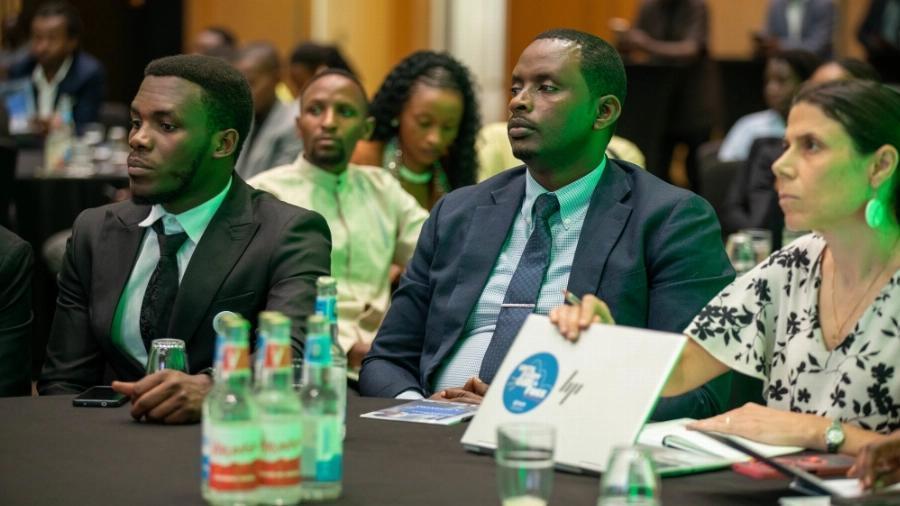
Participants during the dialogue that focused on using the findings to refine the programme and address persistent challenges
Sesay added that the dialogue comes at a critical time, as Rwanda seeks to scale job creation under its national development agenda.
“This is not only about sharing evidence, but about mobilising partnerships and investments to take what works to scale,” she said, reaffirming UNDP’s commitment to supporting youth-driven, inclusive economic transformation.
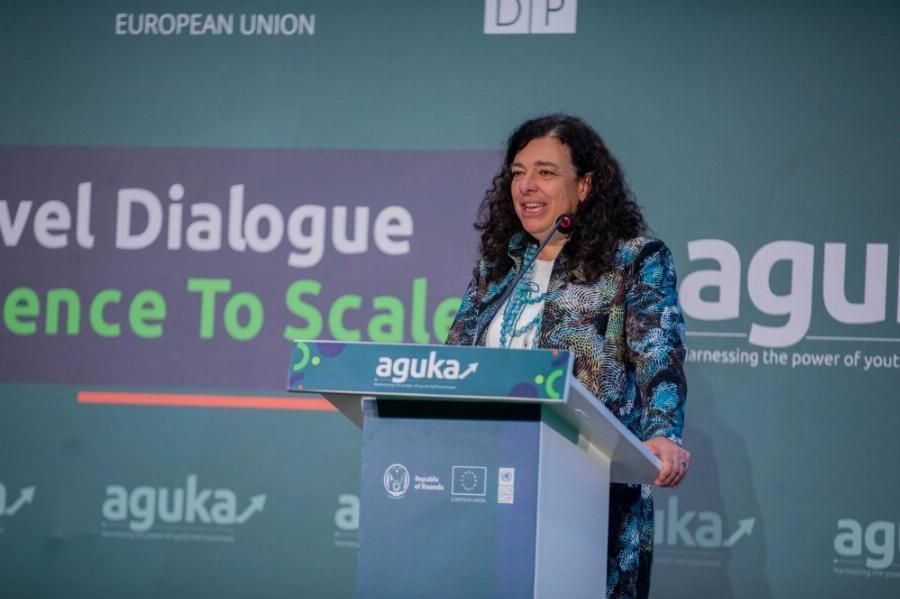
The European Union Ambassador to Rwanda, Belén Calvo Uyarra, highlighted AGUKA as a strong example of what coordinated partnerships can achieve in advancing youth entrepreneurship and job creation. She noted that the programme reflects the power of collaboration between the Government of Rwanda, UNDP, and development partners in translating ambition into measurable results.
Belén Calvo Uyarra, European Union envoy to Rwanda,highlighted AGUKA as a strong example of what coordinated partnerships can achieve in advancing youth entrepreneurship and job creation.
She pointed to the programme’s achievements—including tens of thousands of jobs created, billions of francs generated in income and profits, and growing tax contributions—as clear evidence that investing in youth enterprises delivers both economic and social returns.
“Each number represents a young Rwandan who has chosen opportunity over uncertainty, building businesses that support families and strengthen communities,” she said.
Despite these gains, the Ambassador emphasised the need to address persistent barriers, particularly access to finance and the transition of small enterprises into more productive and sustainable businesses.
She said that the next phase should focus on scaling impact by strengthening linkages between finance, skills development, and enterprise support systems.
“The findings are not just a snapshot—they provide a roadmap,” she said, calling for continued collaboration to ensure that more young entrepreneurs can grow their businesses and contribute to Rwanda’s long-term economic transformation.


For More News And Analysis About Rwanda Follow Africa-Press