Africa-Press – Rwanda. Rwanda’s High Commissioner to the United Kingdom, Johnston Busingye, has called on the UK government to prosecute Genocide suspects living on British territory.
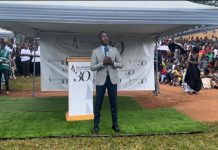
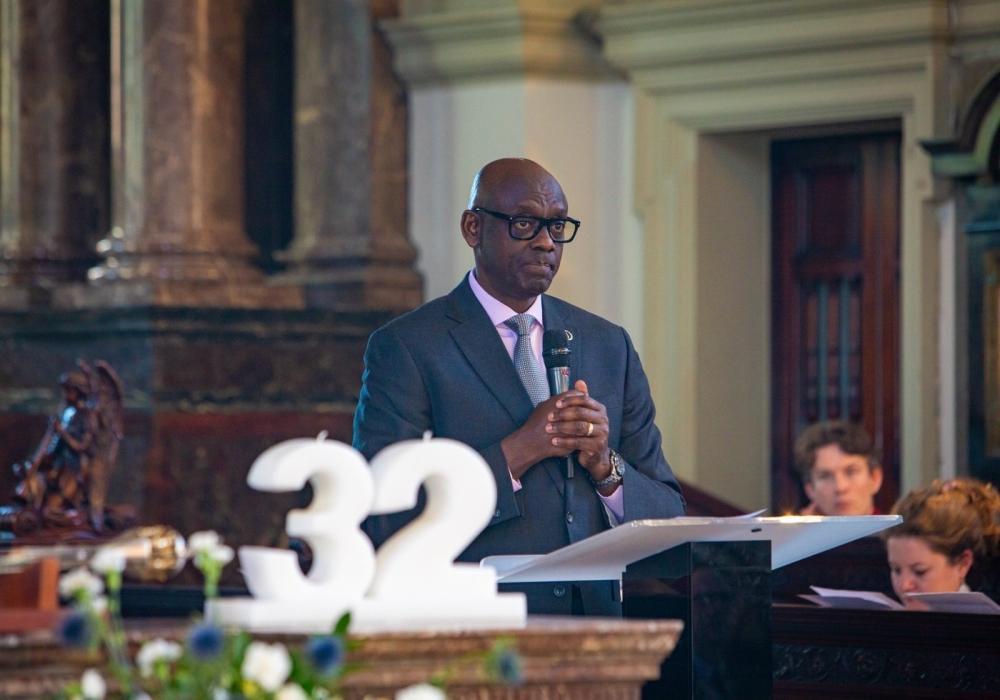
Speaking during the 32nd commemoration of the 1994 Genocide against the Tutsi at St Marylebone Parish Church in London on Tuesday, April 7, Busingye said the suspects are known, but justice has been delayed.
“Thirty-two years after the genocide, the United Kingdom remains the only country in the West where known genocide suspects continue to live untried. Survivors know who they are and where they are, yet justice has been repeatedly delayed,” Busingye said during the event attended by Rwandans living in the UK, diplomats, British officials and friends of Rwanda.
HC @BusingyeJohns reflected on the genocide against the Tutsi and the international community’s failure to stop it:
“Let us honor those we lost not just through remembrance, but through action, defending truth and standing firmly against injustice.” #Kwibuka32 London
pic.twitter.com/dV5goUwA2j
— Rwanda in UK (@RwandaInUK) April 7, 2026
Busingye said remembering the Genocide must go hand in hand with confronting genocide ideology and ensuring accountability for perpetrators.
He also reflected on Rwanda’s recovery since 1994, saying the country had rebuilt through strong leadership, economic reform and home-grown solutions.
“Today, Rwanda is a model to the world on how to remember, on how to unite, and how to renew,” he said.
He added that Rwanda’s transformation has been driven by accountable leadership, women’s inclusion, and long-term investment in sectors such as tourism, agriculture, technology and finance.
He pointed to initiatives such as Umuganda, Umwiherero and Umushyikirano as examples of Rwanda choosing “to do things differently.”
Shirley Ayorkor Botchwey, Secretary General of Commonwealth, said the world failed Rwanda during the Genocide against the Tutsi and warned against denial and distortion of its history.
“We gather today in solemn remembrance for the 32nd commemoration of the 1994 Genocide against the Tutsi in Rwanda. This is a moment not only to honour the memory of over one million innocent lives lost, but also to confront a painful truth: the world failed Rwanda,” she said.
Botchwey said remembrance must be accompanied by action against hate speech, discrimination and historical revisionism.
“To remember is to resist indifference. To remember is to defend truth against denial and distortion. Denial of genocide is not merely an affront to memory, it is a threat to peace,” she said.
She praised Rwanda’s post-genocide recovery, saying its community-based justice, reconciliation efforts and inclusive governance had become an example to countries emerging from conflict.
Also speaking at the event, Michael Gray, Head of Hereford International School which plans to open a school in Kigali, said Rwanda’s journey over the past three decades showed that renewal after genocide is possible.
A regular visitor to Rwanda, Gray described the country as “a symbol of hope, transformation and innovation.”
“Having travelled to Rwanda for more than fifteen years, I have witnessed a nation that has rebuilt with remarkable leadership, courage and vision,” he said.
Gray credited Rwanda’s recovery to strong leadership, women’s empowerment and economic planning.
“Where women thrive, where women are safe and where women are empowered, a country succeeds,” he said.
He also highlighted Rwanda’s economic progress, noting that growth has averaged between 7 and 8 percent over the last 25 years, driven by investment in tourism, conservation, digital technology, mining, agriculture and banking.
During the event Marie-Rose Rurangirwa, a survivor who was 15 years old during the Genocide, gave her testimony.
Rurangirwa said the Genocide did not begin in April 1994.
“The Genocide did not happen overnight. It was carefully planned and methodically executed,” she said.
“The Genocide against the Tutsi did not begin in April 1994. It was decades in the making, built on propaganda, discriminatory laws, and daily practices that systematically devalued Tutsi lives.”
She recalled how the Tutsi were publicly humiliated, singled out and labelled as “cockroaches” through media and political rhetoric.
“When hate speech became normalised, when conspiracy theories spread unchecked, when discrimination was tolerated, we were one step closer to violence,” she said.
“Not all hate ends in genocide, but every genocide has been preceded by it.”
Rurangirwa said survivors continue to live with the psychological scars of the Genocide decades later.
“As a child and young person after the genocide, I carried an invisible weight: grief without language, images I could not erase, and questions I could not answer,” she said.
“I looked normal on the outside. Inside, everything had changed.”
She urged people to challenge hate speech and false narratives in their communities before they escalate.
“Do not wait for hate to become ideology, or ideology to become violence,” she said.
For More News And Analysis About Rwanda Follow Africa-Press