Africa-Press – Rwanda. Milk collection centres (MCCs) in Nyagatare District, Eastern Province, have raised concerns over high electricity costs, saying recent tariff changes have squeezed their profit margins and disrupted operations.
According to the Dairy Farmers’ Union in Nyagatare District, the centres are billed under the residential category instead of the industrial tariff.
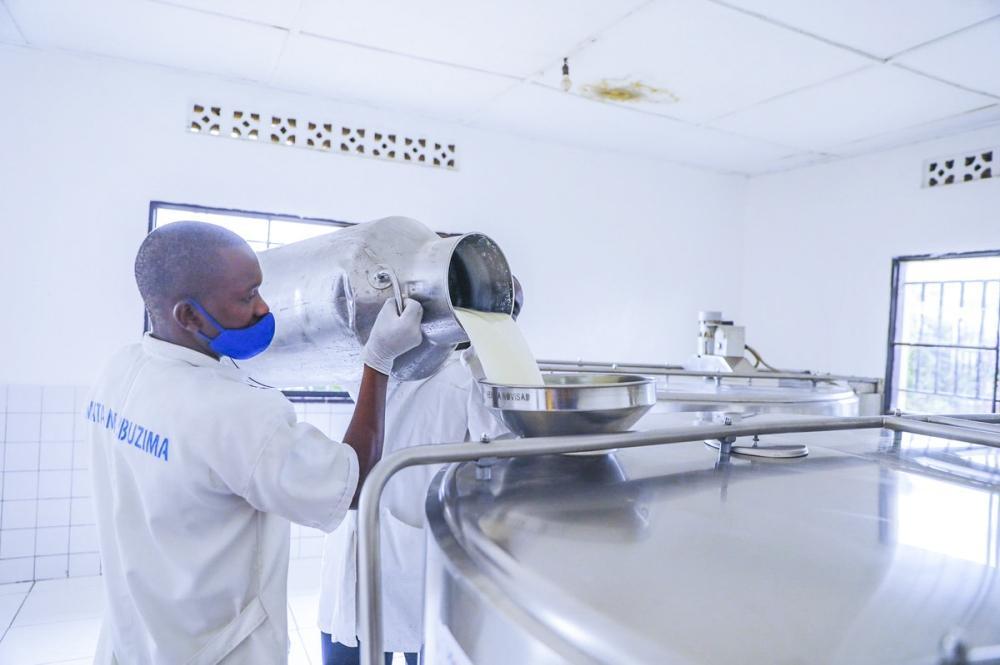
Milk collection centres (MCCs) in Nyagatare District, Eastern Province, have raised concerns over high electricity costs.
The classification stems from tariff adjustments introduced in October 2025 by the Rwanda Utilities Regulatory Authority(RURA), aimed at streamlining electricity costs across sectors.
Managers of milk collection cooperatives say the current pricing model makes it difficult to maintain the cooling systems required to keep milk fresh.
Orem Kitatire, the Manager at Bugaragara Cooperative (Isangano Milk Collection Center) in Rwimiyaga Sector, noted that the impact of the new rates was felt immediately.
“Before the new tariffs were introduced, we could purchase 2,060 kilowatts for Rwf300,000. Now, the same amount only buys 1,449 kilowatts,” he said. “This means the price per kilowatt has risen from Rwf145 to Rwf207.”
Kitatire noted that medium-sized industries that consume between 100,000 and 1,000,000 kilowatts annually have seen their tariffs reduced to about Rwf133 per kilowatt.
However, milk collection centres which previously fell under the same category are billed under residential rates, a classification operators say has created a significant financial strain on cooperatives.
“After paying workers, taxes, and high electricity bills, our expenses exceed our income, leaving us unable to break even,” he noted.
The financial pressure is also felt by MCC-Matimba. Gaspard Rutaboba, the manager at the centre, explained that the tiered residential pricing structure penalizes high-usage facilities like cooling centers.
“For a residential customer, the price is Rwf89 for 20 kilowatts monthly, but if you exceed 50 kilowatts, the price goes up to Rwf369,” he explained. “Before the adjustment was made, we spent Rwf400,000 per month on electricity, it has now increased to Rwf550,000.”
Godfrey Kayitare, the Chairperson of Nyagatare Dairy Farmers Union, said the union has already brought these concerns to district officials.
District yet to intervene
Henry Kakooza, the Interim Mayor of Nyagatare District, confirmed that local authorities are aware of the issue, noting that a meeting was held in January with the Farmers’ Dairy Union and all MCC presidents in the district.
“We wrote to REG requesting that they address the matter, and we also discussed electricity pricing with the Ministry of Agriculture and Animal Husbandry (MINAGRI) and the Ministry of Trade and Industry (MINICOM),” Kakooza said.
He explained that the main challenge lies in how “industry” is defined. Because milk collection centres only cool milk rather than process it into finished products, they do not qualify for the industrial tariff category managed by MINICOM.
“MINAGRI is now following up with MININFRA to explore how MCCs can be moved from the residential category into a separate classification for agricultural and livestock processing,” he said.
Kakooza added that the aim is to create a special category with subsidized rates. “We hope that by the end of April, there will be a dedicated tariff for MCCs,” he said.
For More News And Analysis About Rwanda Follow Africa-Press