Africa-Press – Rwanda. Last week President Evariste Ndayishimiye convened a national development forum aimed at presenting his vision, a new development agenda and setting the tone for his leadership since he came to power.
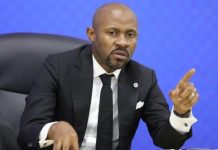
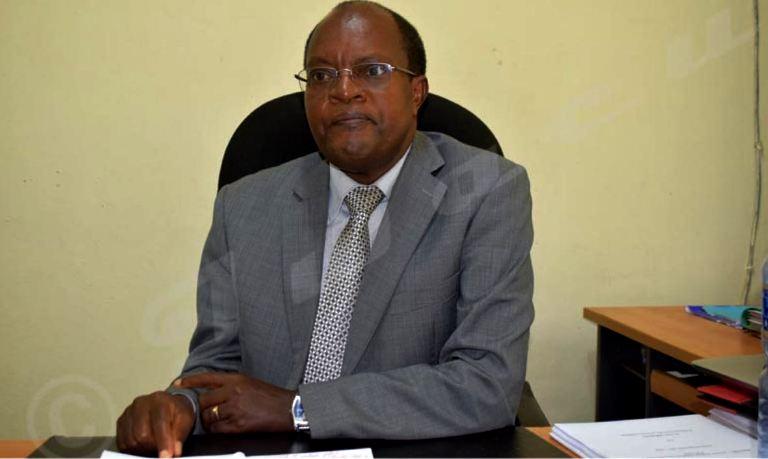
According to Prof. Julien Nimubona a political scientist [pictured above], what President Ndayishimiye presented was not worth to be described as a vision.
“Compared to the forum in general, unlike speeches, I didn’t see a vision. Saying that “the goal is for Burundi to be an emerging country by 2040″. This is not a vision. In political science, this is called a slogan,” said Prof. Nimubona.
“A vision is a coherent strategy based on specific objectives to be achieved with resources that can be mobilized to achieve them,” he said in an exclusive interview. Below is a detailed analysis of the forum through the lens of Prof. Nimubona.
By organizing this forum, what do you think is the message behind?
In my opinion the forum was more than the meeting of the Estates General on Development. For the first time, this forum allowed the debate between intellectuals and politicians all coming from the system in power.
The panelists, the guests, were what are called “organic intellectuals”. That is, intellectuals organically linked to power. Which means that what they said or the recommendations made were not coming from the opposition. All members of the executive were seated, listening like students in class.
Before this forum was convened, President Ndayishimiye had made a number of interventions deploring bad practices within the State, criticizing the judiciary, the administration, even if it meant sacking certain senior executives, questioning mining contracts.
Lost investments (example of the Mpanda dam with its 54 billion FBU, etc.) A propensity which connotes a desire to want to destroy these bad practices within the system. Nevertheless, he encountered indifference from his close collaborators.
By organizing this forum, it seems to me that he got it right by opening a window within what I call the big mute of the Cndd-Fdd: this majority made up of the intellectuals of this party. And if we don’t look closely, this class is constantly dominated by a power, admittedly military-civilian.
But, a militant power where partisan power prevails over technocratic power. While it is the latter that promotes development. Through this forum, I think the Head of State wanted to give a voice to this category of people.
“Make Burundi an emerging country by 2040”, the first edition of the National Forum on the Development of Burundi was opened on Thursday, November 18.
What is the point of System experts talking to system managers?
The biggest question that torments President Ndayishimiye is how to implement changes with the managers at the controls for the past fifteen years. Implementation of recommendations made requires the correction of the deficiencies of managers that have been at the helm for the past 15 years.
The question is, “Why will they want to change all of a sudden when they never have in over 15 years?” In view of all this, one comes to wonder: “If this is the case, does the Head of State have the right men in the right place? to drive its long-awaited changes? “.
For you, this forum starts the debate within the Cndd-Fdd?
This forum is going to soon trigger an unavoidable debate within the ruling party. Like in 1992, With the start of multipartyism in Burundi, this greatly disturbed the Uprona party. I remember Nicolas Mayugi, at the time secretary general. He spoke of “a possible democracy within a single party.
Currently within the ruling Cndd-Fdd party, there is debate whether strengthening of democratic culture is still possible. With this forum, I fear that the President of the Republic has opened a Pandora’s box.
Do you think all relevant themes have been explored?
It seems to me that the disturbing themes were not mentioned. In this regard, I have listed four other topics that could have been discussed in this forum.
The first forgotten theme: it is the issue of opening up the democratic space. A prerequisite for the stabilization of Burundi. No briefing was made on how to borrow to get Burundi out of this cycle of political violence.
Nevertheless, I have the impression that the actors present did not take this into account. In the absence of a more integrative democracy, the democratic majority is confused with the partisan majority. An unnamed mistake because it results in the systematic exclusion of opposition parties and ethnic minority groups. Knowing that investments are conditioned by internal stability, I believe that this point should be discussed.
The second theme not mentioned is the issue of demography. Which one could associate with climate change. Whatever you do, the demographic pressure on the earth, on the education of children (crowded classrooms), puts pressure on the quality of health care.
The other unmentioned problem is the environment. For a country like Burundi, over 95% of which depends on agriculture, climate change must be a priority. All the more reason, it was advisable to study the strategies. The third theme little mentioned is administrative governance.
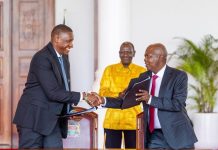
The quality and access to public services is a headache. Because of patronage, neo-patrimonial, ethnicist practices, a dispute persists between the population and the State. In my opinion, an opportunity which would have made it possible to identify the main axes, beyond building confidence. Governors of Southern Province and Eastern province respectively listen as their Burundian counterparts speak
Is the ongoing contact with the Rwandans a possible normalization of bilateral relations?
The 4th theme that has not caught the attention of experts is regional integration and international development. Knowing that our economy, to a certain extent, also depends on that of the countries of the sub-region.
This theme would have made it possible to show how much the antagonisms between States (case of Rwanda, Uganda) weigh on our economy. Political realism has always prevailed in Burundi-Rwanda relations. As evidenced by the post-colonial history of these two countries in the management of the issue of Rwandan refugees, etc.
Currently, the problem is that public opinion, especially Burundians forget, what are the issues behind the rapprochement between these two countries. Of course, Burundi has communicated more about its desiderata, in particular, the delivery of alleged putschists.
The big question that persists: is Burundi ready to make concessions with regard to the grievances of Rwandans? However, I have no doubt that over time a solution for a possible resumption of bilateral cooperation will be found.
The recent lifting of sanctions by the United States against certain Burundian politicians. A good thing ?
A nuance. Even in the decree of President Biden canceling the said sanctions, he welcomes a marked improvement in governance, the rule of law, etc. It is only necessary for the Burundian authorities to think that this is recognition.
Sometimes international decisions can be a way of encouragement. History of moving quickly while respecting democratic principles. In the case of the lifting of these US sanctions, it is indeed an encouragement from the head of state to continue his reforms. The same strategy used by the EU in initiating this dialogue for the lifting of their sanctions.
On the one hand, the United States lifted the sanctions. On the other, the EU, which is renewing them. Your reaction.
One thing should be known: the United States of America as well as the countries of the Union of 27 are for the imposition of respect for democratic principles (human rights, good governance, etc.). However, the literature on these kinds of issues varies from power to power.
Americans get information through a network of government services (embassies, NGOs, intelligence and information services (CIA, FBI, Medical Corps, etc.). And these services are so marked by the logic of government policies For them, only the politico-economic issues count.
However, in the case of Burundi, since 2015, China has gained a foothold in Burundi, strengthening its positions in the sub-region. by the Americans and the EU.
However, who says cooperation of China with Burundi, refers to its penetration into the east of the DRC, with as a corollary the armed groups which abound. In light of all this, the United States of America felt it was better to protect its strategic interests, rather than cry out about human rights abuses.
Are there sufficient prerequisites to release counterbalance?
Also, we must not lose sight of the fact that in the United States of America, democracy is an elitist democracy. Often the president decides without consulting his people. A situation poles apart from the EU. European countries are fundamentally democracies of opinion. However, not all 27 countries have the same perception of respect for democratic principles.
For example, during the dialogue with the EU, some countries like France and Belgium were somewhat open. The opposite of the Germans. Another thing to note is that EU diplomacy is heavily influenced by civil society organizations.
This is why, when the European Parliament wanted to rule on the resumption of cooperation, the reports of these human rights organizations undoubtedly tipped the scales in the deliberation of MEPs, blocking the action of ministers. which, quite possibly, would have allowed the situation to evolve. I think that is currently the case with this renewal of the sanctions against these personalities.
Is this to say that lifting of EU sanctions against Burundi is not coming soon?
For tomorrow, I don’t know. But, if ever, it intervenes it will be a purely politico-realistic decision. A decision which tends to encourage the President of the Republic to translate into concrete actions his many speeches of reforms on the national and international level. Also, we must separate individual sanctions from those against a country.
For More News And Analysis About Rwanda Follow Africa-Press