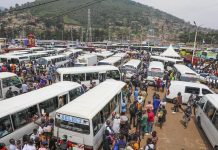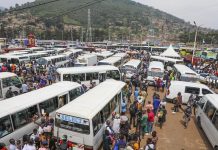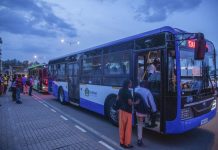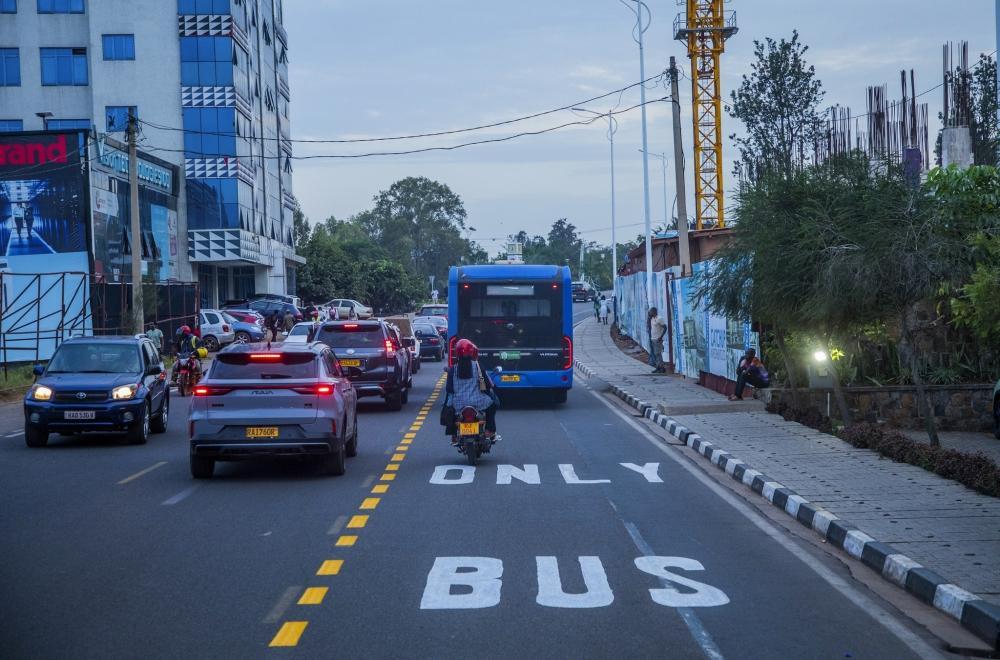
Africa-Press – Rwanda. The government last week introduced a park-and-ride system alongside expanded dedicated bus lanes, in a move aimed at cushioning residents from rising fuel costs while making public transport more accessible, especially for those without nearby bus routes and motorists willing to leave their cars and complete journeys by bus.
Speaking to The New Times, Emma Claudine Ntirenganya, Director General for Communication and Community Education at the City of Kigali, said the initiative is designed to support different categories of users.
“The initiative aims to address rising fuel costs by supporting those who want to use public transport but live in areas without bus routes. It also caters to those who can afford fuel but are willing to switch to public transport, providing them with parking spaces along the way, as well as helping visitors unfamiliar with the city identify where they can park and ride,” she said.
The model is also expected to reduce fuel consumption, ease traffic congestion and cut emissions amid volatile global fuel prices linked to conflicts in the Middle East. It builds on ongoing efforts to improve public transport, she added.
Identified sites include Kabuga Bus Station with about 1,000 parking spaces; Amahoro Stadium (Kwa Rwahama) with around 2,000 spaces; Kigali Pele Stadium; the former Magerwa site in Ruyenzi, Kamonyi District; and Gahanga grounds. Public parking is charged at Rwf200 per hour.
Why the model matters
Julien Alaire, Director of International Operations at Transitec, an international engineering and consulting firm specialising in sustainable mobility and transport planning, said the immediate priority is to ensure that rising fuel prices do not place excessive pressure on household incomes.
He noted that if Kigali residents can maintain similar commuting times and costs, the broader economy will be partially shielded from global shocks.
“Park-and-ride schemes offer motorists an alternative to costly journeys. Thanks to dedicated bus lanes, public transport will be much faster and more attractive,” he said.
Alaire explained that transport choices are largely influenced by journey time, comfort and cost. Even car owners, he noted, may opt to park and take a bus if public transport is faster and more convenient than driving into congested city centres.
He added that in Europe and the United States, paid parking policies are often used to discourage all-day parking in central areas, while park-and-ride systems help connect suburban areas to central business districts.
For the system to work effectively, he stressed the need for reliable public transport, high-quality park-and-ride facilities and integrated ticketing that allows seamless transfers. Monthly travel cards, he added, can further simplify access.
Lessons from other countries
Kevin Kamanda, a transportation engineering analyst, said park-and-ride systems offer a practical and immediate solution during fuel price shocks, particularly in cities where commuters heavily depend on private cars.
He noted that many people are locked into car dependency due to habit and infrastructure, making sudden behavioural change driven by fuel prices alone difficult.
“These systems ease that transition by providing reliable, affordable shared transport from suburban parking hubs into city centres. Instead of burning half a tank daily, drivers use a fraction of fuel to reach the facility, then pay a minimal fare for the rest,” he said.
According to Kamanda, this reduces congestion, lowers household transport costs and significantly cuts carbon emissions by reducing the number of vehicles on the road.
He cited international examples, noting that cities such as Oxford and Cambridge in the United Kingdom have reduced city-centre traffic by up to 20 per cent through park-and-ride schemes. He also pointed to Bogotá’s TransMilenio system, where dedicated bus lanes transformed commuting by prioritising high-capacity vehicles over single-occupancy cars.
“When buses move efficiently, punctuality improves, productivity increases, and citizens reclaim time previously lost to congestion,” he said.
Expected impact in Kigali
Ivan Muhizi, a transportation engineering graduate from the University of Rwanda, said park-and-ride systems can help reduce both fuel consumption and emissions while improving efficiency.
“These systems allow motorists to park their cars in one location and then use public transport to reach their final destination,” he said.
He explained that reducing the number of vehicles entering the city centre significantly lowers fuel consumption at a national level, an important factor for a developing country.
“The math is simple: the less we drive into the city, the less we spend on fuel,” he said.
Muhizi added that the system reduces reliance on single-occupant vehicles by promoting high-occupancy transport, lowering emissions per passenger and supporting national strategies such as NST2 and Vision 2050.
Drawing on experiences from countries such as Switzerland, the Netherlands, Singapore, Italy and Germany, he said successful systems are secure, accessible, affordable and strategically located.
He outlined likely outcomes, including lower national fuel demand and reduced exposure to global fuel shocks, increased public transport ridership, building on recent trends showing about a 30 per cent rise and improved traffic flow due to reduced congestion in central areas.
He also highlighted environmental benefits, including reductions in carbon dioxide (CO2), carbon monoxide (CO) and nitrogen oxides (NOx) emissions.
At the same time, he pointed to structural impacts, noting that park-and-ride facilities could encourage suburban growth, with areas such as Gahanga, Kabuga and Ruyenzi likely to develop faster.
Challenges to watch
Kamanda warned that limited public awareness, especially among commuters from outer neighbourhoods, could lead to violations of bus lane rules, undermining the system’s effectiveness. He also cited limited parking capacity and insufficient route coverage in residential areas.
“Expanding bus routes beyond main roads into local streets will ensure no community is left behind. Strong enforcement by the Rwanda National Police, combined with public education campaigns, will be essential to maintaining discipline and protecting the system’s long-term integrity,” he said.
Muhizi identified behavioural resistance as a key challenge, noting that some commuters may be reluctant to shift from private cars due to convenience or status perceptions.
He suggested incentives and awareness campaigns to encourage uptake.
He also pointed to limited parking space and weak first- and last-mile connections as potential barriers, noting that users may avoid the system if access to parking hubs or final destinations is not convenient.
For More News And Analysis About Rwanda Follow Africa-Press