Africa-Press – Rwanda. Marie-Anne Nyinawumuntu from Kicukiro District was just 16 years old during the 1994 Genocide against the Tutsi.
Having witnessed the killing of her family devastated her and, for years, she believed justice could never be served.
“I always thought those who killed my parents and siblings would never face justice. At one point, I even had thoughts of revenge,” Nyinawumuntu told The New Times as Rwanda observed the 32nd commemoration of the Genocide.
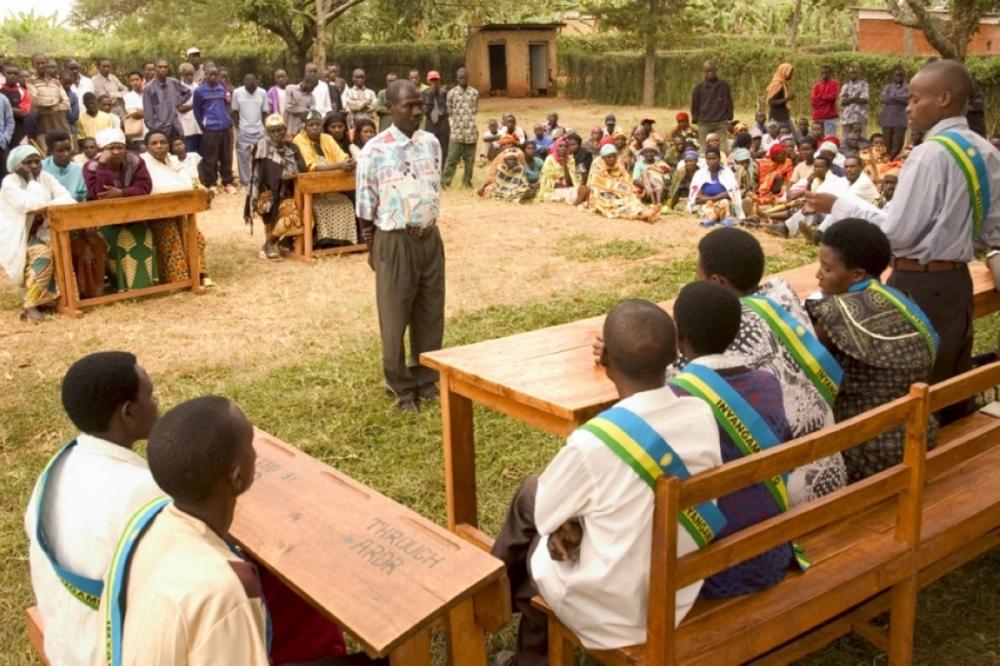
Her perspective began to change with the introduction of Gacaca courts, community-based tribunals that tried hundreds of perpetrators. Although she initially attended hearings without fully understanding their significance, she later witnessed the trial of those responsible for her family’s death.
“They were convicted and given different sentences depending on their crimes. For me, it was not about how long they would stay in prison, but the fact that they were held accountable,” she said.
More than three decades after the Genocide, Gacaca remain one of major homegrown solutions that facilitated healing, accountability, and reconciliation.
Established in 2002, the community-based courts were designed to address the overwhelming number of genocide-related cases that had crippled the formal judicial system in the aftermath of the Genocide, which claimed more than one million lives.
Over a period of ten years, the Gacaca system handled more than 1.9 million cases before officially closing in 2012.
Unlike conventional courts, Gacaca relied on community participation in the trials, encouraging members to share testimonies and perpetrators to confess their crimes, seek forgiveness, and, where possible, make reparations. Borrowed from Rwanda;s ancient judicial system, Gacaca courts relied on members of the community known as Inyangamugayo (persons of integrity) who acted as judges. This approach not only accelerated the delivery of justice but also played a critical role in rebuilding trust and fostering healing among Rwandans.
For most survivors, Gacaca was the first time they saw perpetrators being held accountability for their crimes.
Nyinawumuntu said that Gacaca paved the way to her healing and reconciliation with families of the perpetrators, some of whom have returned after serving their sentences.
“I accepted them. We now live together in the same community,” she said.
Gacaca handled cases at ‘remarkable speed’
According to officials such testimonies reflect the broader impact of Gacaca across the country.
The courts were instrumental in handling genocide cases at a scale that would have overwhelmed conventional systems, said Faustin Nkusi, spokesperson for the National Public Prosecution Authority (NPPA).
“Gacaca courts were able to handle hundreds of thousands of cases with remarkable speed, far beyond the capacity of ordinary courts, including the ICTR (a United Nations tribunal) and national judicial systems,” he said.
He added that the process encouraged truth telling that led to the discovery of burial sites, identification of victims and perpetrators, and a clearer understanding of the events that unfolded during the Genocide.
“In the aftermath of the Genocide against the Tutsi, the formal judicial system had largely collapsed. Without Gacaca, resolving these cases could have taken decades,” Nkusi noted.
He also highlighted that Gacaca demonstrated the effectiveness of decentralised, community-based justice mechanisms in post-conflict societies.
Harrison Mutabazi, spokesperson for the Judiciary, highlighted Gacaca’s lasting institutional legacy, particularly in shaping Rwanda’s Alternative Dispute Resolution (ADR) mechanisms used today, such as mediation and plea bargaining.
“Gacaca showed that restorative approaches to justice can work,” he said.
Legal experts agree that the Gacaca model laid the foundation for modern justice innovations in Rwanda.
Claudine Dushimimana, Chairperson of the Rwanda Law Reform Commission, said Gacaca emerged as a pragmatic response to an unprecedented justice crisis.
“Gacaca revived traditional conflict resolution practices rooted in Rwandan culture,” Dushimimana said.
She noted that the system emphasised truth-telling, confession, forgiveness, and reintegration, principles that continue to underpin Rwanda’s justice framework today.
According to Dushimimana, Gacaca’s legacy is evident in the institutionalisation of ADR mechanisms, including Abunzi committees introduced in 2010, the establishment of the Kigali International Arbitration Centre, and the integration of mediation and plea bargaining into legal procedures.
“These mechanisms promote efficiency, cost-effectiveness, and social harmony,” she said.
Efforts are underway to preserve the legacy of Gacaca for future generations. In 2025, the Ministry of National Unity and Civic Engagement announced that it was in the final stages of digitising and preserving Gacaca court archives. The project, launched in 2015, is expected to be completed by 2026 at a cost of Rwf5.7 billion.
Officials say the initiative will ensure that records of the Gacaca courts processes remain accessible for education, research, and the continued fight against genocide denial.
Pursuit of justice beyond borders
Although Gacaca courts have been instrumental in trying perpetrators in the country, Nkusi said, challenges remain in tracking and prosecuting Genocide fugitives abroad.
“A primary obstacle is the lack of political will in some countries to pursue prosecution or extradition,” he said.
“In addition, limited information about the whereabouts of fugitives complicates efforts to locate and apprehend them.”
He added that many suspects evade justice by changing identities, nationalities, or residences, while others exploit legal protection in host countries or even claim to be deceased.
“The failure of some states to either extradite or prosecute alleged perpetrators undermines global efforts to ensure accountability,” Nkusi said.
Since 2007, Rwandan authorities have issued more than 1,100 indictments and arrest warrants for Genocide fugitives in over 30 countries.
Although some countries have tried or extradited dozens of fugitives, more than 1,000 of these remain at large.
For More News And Analysis About Rwanda Follow Africa-Press