Africa-Press – Rwanda. The media played a direct role in spreading hate and calling for violence before and during the 1994 Gneocide against the Tutsi and Kinyamateka, a publication of the Catholic Church, was no exception.
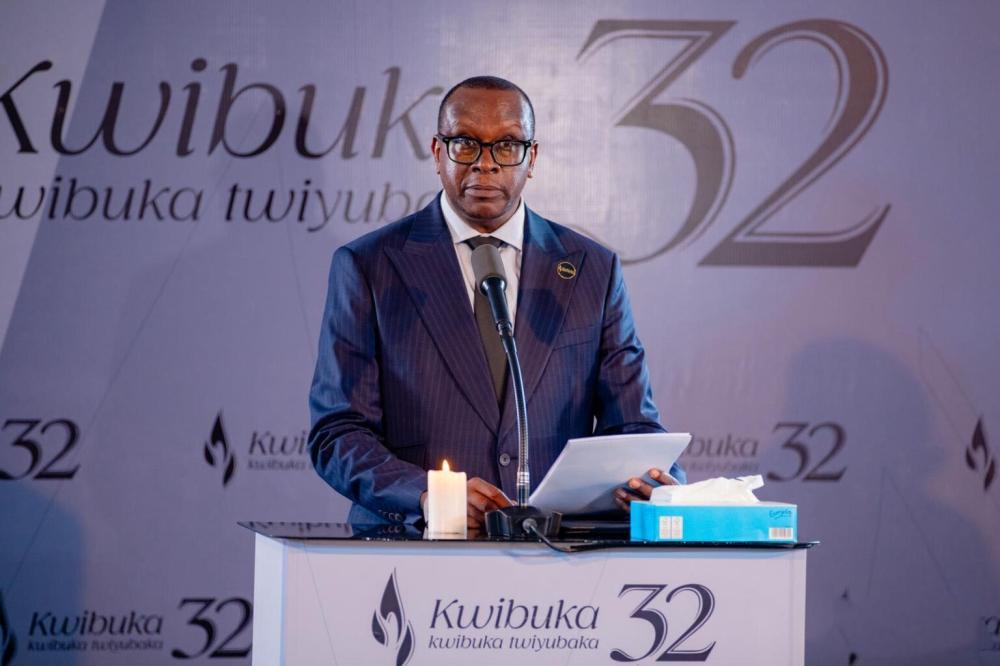
This has been noted by Jean-Damascène Bizimana, the Minister of National Unity and Civic Engagement, as Rwanda observes the 32nd commemoration of the Genocide that claimed over one million lives in just 100 days.
Once regarded as a respected newspaper, Kinyamateka gradually became associated with narratives that fuelled ethnic tensions in the lead-up to the Genocide.
Bizimana spoke about Kinyamateka in the Genocide against the Tutsi as he reflected on the historical role of the media in Rwanda, André Sibomana, a Catholic priest who turned the publication into a radicalised channel of hate ideology.
He explained that journalism in Rwanda was deeply polarised prior to the Genocide, with different media outlets serving political agendas.
According to Bizimana, the media could be categorised into public media institutions, government-supported independent media, opposition media, and media that initially promoted peace but later shifted to divisive narratives, especially when addressing issues related to the Tutsi and the RPF-Inkotanyi rebellion in the early 1990s.
Attention is increasingly turning to individuals who used influential newspaper platforms to spread extremist ideology.
Among them is Father Sibomana, a figure accused of steering Kinyamateka, one of Rwanda’s oldest and most influential newspapers, away from its original mission into a vehicle for division and radicalisation after taking over its leadership.
Who was Andre Sibomana?
He was born in Rwanda in 1954 and trained as a priest and a journalist.
From 1988, he became the editor of the Catholic newspaper Kinyamateka.
“There were media outlets that were said to promote peace and democracy, but when it came to the Tutsi, they published hate speech. I cite Kinyamateka as an example. It called for genocide,” Bizimana said, citing an example in which the newspaper alleged that Tutsi women transported cartridges in milk cans for RPA soldiers.
“Kinyamateka is among the newspapers that wore two skins. Since the time Father André Sibomana took over, he radicalised it,” Bizimana said.
Sibomana replaced Sylvio Sindambiwe, who was killed by the government of President Juvénal Habyarimana.
“Sindambiwe was not a Tutsi. He originated from Ruhango District. He was an honest man. He published articles in Kinyamateka denouncing ethnic and regional discrimination and injustice. He had a page called ‘Bazumva ryari?’ (When will they understand?). This page was aimed at advising leaders in Habyarimana’s regime. That is why he was killed and replaced by Sibomana,” explained Minister Bizimana.
Sibomana established an editorial line aligned with the extremist party MDR-Parmehutu, the minister recalled.
“Journalist Sylvestre Nkubiri said Sibomana harassed them, seeking ways to dismiss them. He said he could submit articles and Sibomana would spike them.Yet he would publish articles by hardliners like Ladislas Niyongira,” Bizimana explained.
Kinyamateka extracts
Kinyamateka publication number 1331 of November 1990 reads: “There are betrayers who rushed to welcome the haters of Rwanda.”
Those named as betrayers, Bizimana explained, were Tutsi, described as “accomplices of Inkotanyi”.
“They had been detained,” he said.
The newspaper number 1332 stated: “Haters who invaded us are called Inkotanyi.”
The newspaper number 1338 of January 1991 reads:
“In the country, some support their relatives who are refugees and are committed to assisting them in removing the republic. Some of the Tutsi supported such attacks because they hope to be returned to power and seek revenge. Another reason that pushes Tutsi to change ethnic identity is to infiltrate and become accomplices of Inyenzi.”
The newspaper number 1339 stated: “It was said and was never denied that the money Inyenzi used to buy guns to exterminate us came from Rwanda through the hands of accomplices.”
Kinyamateka number 1340 stated: “Rwandans partnered with the national army to fight the enemy by detecting accomplices, enlisting the youth to join the army, contributing resources, and providing written information explaining the issue of Inyenzi.”
Kinyamateka number 1332 also referred to the death of Maj Gen Fred Rwigema, the first Commander of the RPA forces and celebrated it, claiming that students at Nyakibanda Seminary also celebrated.
The newspaper’s report read as follows: “Those young men preparing to become priests cursed him with the strength of the Holy Spirit from the heart and said: ‘You are a calf of dog Rwigema.’”
Kinyamateka number 1344 stated that Inyenzi fled the 1959 revolution.
“It meant that Tutsi refugees had fled peace and democracy,” Bizimana said.
The newspaper stated: “It was clear that Inyenzi fled the revolution and the establishment of democracy, and the victory of the masses in 1959, and never welcomed the transfer of power to the majority.”
“They fled massacres; they did not flee peace,” Bizimana noted.
In the same newspaper, number 1399, Tutsi were portrayed as adopting foreign habits and as no longer part of the Rwandan population.
Kinyamateka number 1344 added: “This war is an ethnic war. Inkotanyi attacked Hutu and accused them of evicting their fathers and grandfathers. This is the war Tutsi started to regain power which the majority population had taken from them, so that they hold Hutu accountable for what happened in 1959, 1963 and 1973. What the Hutu cannot forget is that the Tutsi will not rest until they have regained power. However, the large number of Hutu will prevent them from achieving this goal.”
Kinyamateka urged Tutsi refugees to remain in the countries that hosted them.
The newspaper number 1338 stated: “We are fortunate that this war has strengthened Hutu unity. Even when we differ based on regions, ethnic groups and others, there is no cause for concern.”
The publication number 1339 also stated: “I do not see the basis of unity between the attackers and those being attacked. Leaders should embrace this grace given to Rwanda by God and avoid anything that can divide Hutu, because this is the trap of the enemy.”
Minister Bizimana said that what was referred to as “grace from God” was the MDR-PARMEHUTU party.
The newspaper number 1340 stated: “One of the benefits of PARMEHUTU is that it does not force impossible unity.”
When Burundi’s President Melchior Ndadaye died in October 1993, Kinyamateka stated: “Whoever hurts Burundi’s belly hurts Rwanda’s belly. Those who killed Ndadaye took away from us a light we needed. Supporters of democracy have become orphans. We will not be able to quench the thirst Ndadaye left us.”
Kinyamateka also suggested that genocide was possible, writing, “There are many ways to handle conflicts. One way is for one group to chase away the other or exterminate it.”
Bizimana said: “Killing and genocide can be carried out through words, through hate speech. Kinyamateka reached a large part of the country, including churches, parishes and schools.”
For More News And Analysis About Rwanda Follow Africa-Press