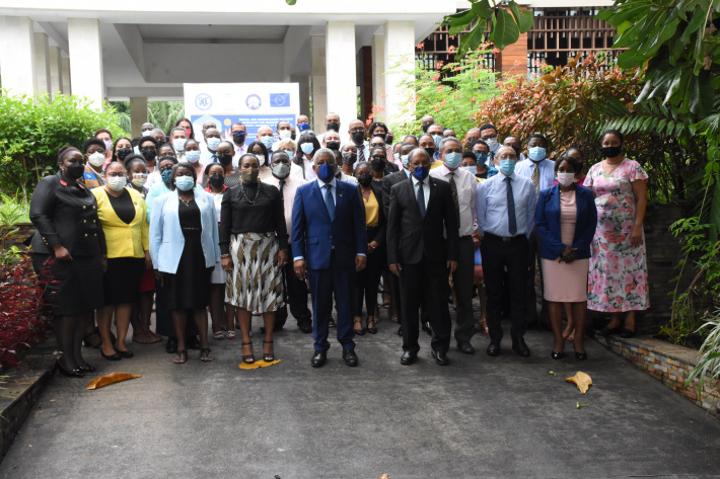
Africa-Press – Seychelles. The Women Caucus of the National Assembly of Seychelles (NAS) is hosting a two-day workshop on sexual and gender-based violence (SGBV) in collaboration with the Attorney General’s Office, Police and Social Services and with the support of the Southern African Development Community (SADC) secretariat under the theme ‘Improving National Coordination of Legislative and Procedural Response to SGBV in Seychelles’.
The workshop, which opened yesterday and continues today at the Savoy Resort and Spa, Beau Vallon, is in commemoration of the International Women’s Day to raise awareness on gender equality and empowerment of women.
During the workshop, the members of parliament are to be updated on the situation of SGBV in the country; discuss the national legislative and policy framework which enables or creates barriers for fulfillment of the human rights of all persons experiencing SGBV, especially women; be familiarised with regional (SADC) SGBV legislative frameworks and tools; and discuss possible legislative actions and motions to address identified gaps in reducing or eliminating SGBV in Seychelles.
At the end of the workshop, the women Caucus will from the knowledge gained on the status of SGBV in Seychelles and on national and regional policy and legal frameworks on SGBV with regard to the Domestic Violence and Sexual Assault Act, 2000, Amended Domestic Violence Act, age of consent, Penal Code, etc.., will develop a national legislative and policy road map for the implementation of the determined national SGBV actions and interventions; identify national and international partners to assist it in the implementation of the road map for the implementation of the national determined SGBV actions and interventions and develop necessary monitoring, evaluation and reporting tools to ensure that the proposed interventions are done.
Apart from the women Caucus and other members of parliament, including Speaker Roger Mancienne, yesterday’s opening session was also attended by President Wavel Ramkalawan; Vice-President Ahmed Afif; the Minister for Youth, Sports and Family, Marie Céline Zialor; Attorney General Frank Ally; French ambassador Dominique Mas; principal secretaries; SADC representatives; stakeholders and other guests.
In his keynote address, President Ramkalawan said the country wants to see an end to SGBV and that we should admire the commitments by all local and foreign stakeholders involved to make it happen.
He added that the country wants harmony and respect among the population and not violence.
President Ramkalawan said that among other factors to help in ending SGBV, children at a very young age should be taught to respect others.
He noted that when the country abolished corporal punishment, it was a way of teaching our children that violence is not the way to resolve issues.
He added that the National Assembly will also be called to pass a law to eliminate ‘hate speech’ and all the various forms, among other laws in the same context, as the country wants a society where hate speech is not encouraged and that it is dully punished and with the hope that it is eliminated.
The President encouraged the workshop participants to make use of the presence of the Attorney General to better understand the provisions of the various laws to not only keep them away from the punishments the different laws proclaim but to pass on the values to help the people to maintain standards that will restore harmony and respect to make our society peaceful and loving.
President Ramkalawan, who spoke about some of the different laws in our civil code that protect the rights of individual, also commended the National Assembly for its contributions in regards to passed laws but recommended that they wait for a little while for the commencement date for the Domestic Violence act which they had passed and which was assented to on June 20, 2020, as work is being done to train stakeholders who will be implementing the law.
President Ramkalawan stated that while we in Seychelles have laws that protect women and children against violence and others, including forced marriages, these atrocities, especially against children, are still taking place in other SADC countries and the fight must continue to eliminate them.
He added that our state is leading by examples where recently two high ranking police officers are taking the consequences for assaulting a female subordinate and a civilian, which was not acceptable.
He said that if each one of us is committed to eliminating SGBV against both sexes, in all its forms, it will be then that we will be able to say that we are on the right track and moving forward.
He added though that we have to continue to fight against the violence which is bringing down our communities.
Earlier in her opening remarks, the chairperson of the women Caucus, Hon. Regina Esparon, noted that SGBV by men against women, women against men and adults against children, across all ages in the country, is on the increase.
She added that due to an outcry and for respect of human rights, amid the high level of stigmatisation and taboos resulting in many cases not being disclosed, the nation has been more receptive to address the issue through collaborative education and advocative efforts for change by local stakeholders and international partners.
Hon. Esparon noted that a study on gender-based violence (GBV) in 2016 by the National Bureau of Statistics (NBS) in collaboration with the department of social affairs and a gender link based in South Africa revealed that both men and women in the country suffer from GBV with 58% of women and 43% of men having experienced some form of GBV. It also showed that one out of ten persons have experienced rape; 172 women and 155 men, out of 1516 respondents, reported of having experienced physical intimate violence while 78% of women and 79% of men confirmed that they have experienced some form of abuse before reaching the age of 18.
She noted it is a sad fact that the number of persecution related to GBV is shockingly very low compared to the number of cases.
She added that the members of parliaments need to be sensitised on SGBV laws as it is vital for their interventions and networking with other stakeholders for alignment with the country’s zero tolerance to SGBV.
Sharing some words to the participants, Speaker Mancienne thanked the women Caucus for taking up the matter which demonstrates the National Assembly’s readiness to engage in matters at the core of our social wellbeing.
He noted that the workshop is not only a matter of duty but a matter of conscience as well as the issue is dirty linen and should not be left in the cupboard uncleaned.
Speaking of behalf of SADC secretariat, Kealeboga Moruti, senior officer public security, expressed the secretariat’s appreciation to the country for prioritising the workshop and its commitment to the SGBV eradication agenda.
Mrs Moruti said that there is evidence that SGBV is on the increase in the SADC region triggered by various factors that require consulted efforts from all stakeholders to ensure a coordinated approach to effectively end in gender positive response.
She noted that SADC, in 2018, conducted a gender-based comprehensive study in the SADC region and it was found that the most suffered by victims were emotional violence while slightly one in ten have experienced physical violence.
She noted that SADC has SGBV tools and platforms in place, among experts in the workshop, to guide national response of member states to domesticating their laws, including enactment and implementation of comprehensive legislation among others to create national policies and strategies.
In his video message for the occasion, European Union representative (EU), Ambassador Jan Sadek, based in Botswana, said EU supports the eradication of SGBV in SADC and around the world as it is not only an attack against human rights and fundamental freedom but one of the greatest injustices of our times which touches all countries, communities and families and an obstacle to national development and poverty reduction goals.
He added that EU’s contributions demonstrate its commitment to eradicating all forms of violence against women and girls.
For More News And Analysis About Seychelles Follow Africa-Press