
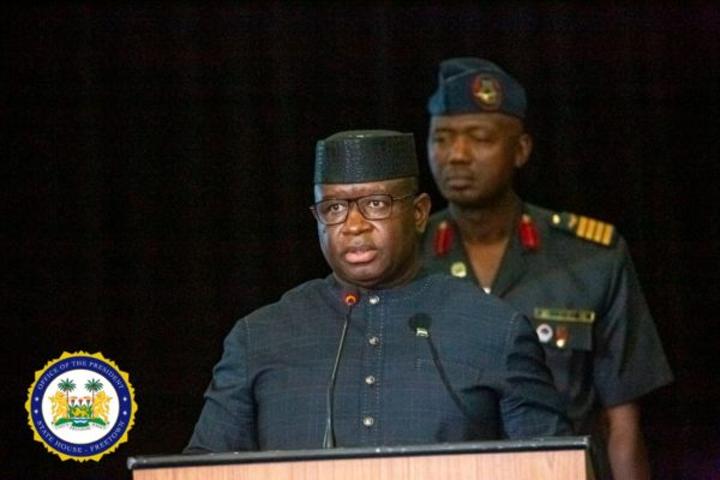
Africa-Press – Sierra-Leone. President Julius Maada Bio of Sierra Leone, on Monday delivered a keynote address at an Energy Sector Roundtable conference held in Freetown, aimed at attracting much needed investments for the country’s flagging energy sector.
Since Sierra Leone was declared bankrupt in the 1980s, it has never recovered its post-independence boom in electricity and water supply, as successive governments struggle to meet the growing costs of providing heavily subsidised utility service across the country.
With fewer than 30% of homes in Sierra Leone connected to the national grid and enjoying access to electricity and constant supply of safe, clean drinking water, it is clear to see why the country is classed as one of the poorest nations in the world. And this is one of the biggest challenges facing President Bio who is seeking a second term in office.
Speaking at the energy conference on Monday, the president said: “As a Government, we have signalled that addressing energy poverty in Sierra Leone is a top national priority. We have doubled energy access to 35% in four years and hope to continue this trajectory. We believe that increased investments in electricity infrastructure, generation sources and electricity networks will unlock the massive economic potential of our country, support the modernisation of our economy, especially in the areas of agriculture and manufacturing, and expand human capital development services.”
But this has not come cheap for the government. Subsidising electricity is expensive and takes money away from the delivery of other public service priorities, such as health and education.
“Over the last two years alone – through the COVID-19 pandemic and the current global economic crisis – the Government has paid over $200 million US dollars in subsidies to keep lights on in homes and businesses and make energy affordable for citizens. We must, however, transition to a more financially sustainable model. I ask this Roundtable to address and proffer solutions to making the energy sector commercially viable and attractive to investors,” says President Bio.
Will investors put their money in helping to solve Sierra Leone’s perennial energy crisis?
You can read the full text of his speech below:
Ministers of Government, Members of the Diplomatic and Consular Corps, Development Partners, The Private Sector, Friends, Distinguished Ladies and Gentlemen, I am honoured and delighted to welcome you to this Energy Sector Round Table. A hearty welcome to our Development Partners – the Management and Technical Teams of the World Bank Group, the Millennium Challenge Corporation–(MCC), the African Development Bank–(AfDB), the Foreign, Commonwealth and Development Office–(FCDO), the International Finance Corporation–(IFC), the Japan International Cooperation Agency–(JICA), the United Nations Office for Project Services – (UNOPS, the International Monetary Fund (IMF), USAID and Power Africa.
Thank you for being a valued partner and contributing to Sierra Leone’s sustainable economic development and social progress. Let me also commend and thank our private sector partners for your socio-economic contributions and the critical role you will continue to play alongside the Government in developing our nation’s energy sector — a special welcome to you all.
I am happy to see all the essential players in the energy sector present here this morning, and I can feel the energy in the room for fruitful deliberations. I value your impactful voices and presence at this Roundtable with the theme “Charting a Path to Sustainable Energy for All”.
Energy is the engine that powers economies. The more energy economies have, the more prosperous their people are. Lack of energy is Africa’s most critical challenge, with the world’s highest energy poverty.
In Sierra Leone, access to electricity remains a challenge in terms of reliability and affordability. Our sustainable economic growth and prosperity depend on solving the crisis of energy. It will require a more significant commitment than ever before, for our present and future depend on it. We must take bold steps, think differently and act with a greater sense of urgency.
We meet again after 18 months in unfamiliar and harsher socio[1]economic circumstances. Global food and energy insecurity have worsened due to the COVID-19 shocks and lingering global economic insecurity due to the Russia-Ukraine crises.
The global economic downturn has hugely impacted Sierra Leone as the rest of the world. We bear the most significant burden of shrinking investment dollars, global supply chain disruptions, unpredictable shortages and price hikes in food and petroleum products. Energy prices are higher now than 18 months ago.
The high and rising energy prices continue to have an adverse impact on other growth sectors of our economy. I am not an economist, but I know that with food and fuel priced in US dollars, a stronger dollar means that these essential commodities will get more expensive.
There is also a greater risk of debt distress for emerging economies, especially as interest payments in dollars and refinancing become more expensive. But as a Government, we are determined to keep our national development priorities on track.
Despite rising global energy prices, we must continue our efforts to increase energy access to communities and productive sectors of our economy in the short, medium and long term. We should also ensure that existing and future energy sources are reliable, efficient, affordable, and sustainable – for our homes, businesses, industries, schools, and hospitals.
I remain optimistic that despite global and local challenges, with close partnership with development partners and the private sector, our Government has made significant strides in the energy sector, as highlighted by the Minister.
As we progress with the Roundtable deliberations, I implore you to address the issues of supply, availability, reliability, affordability, financing, and investment in the energy sector. It is the opportune moment for policymakers, development partners, investors, sector experts, and operators to deliberate openly to address our prevailing challenges in the energy sector.
Let me draw your attention to a few critical discussion points. First, Financing of the Energy Sector. Our financing needs for achieving our energy sector goals are enormous. Access to financing remains a challenge.
Over the last two years alone – through the COVID-19 pandemic and the current global economic crisis – the Government has paid over $200 million US dollars in subsidies to keep lights on in homes and businesses and make energy affordable for citizens. We must, however, transition to a more financially sustainable model.
I ask this Roundtable to address and proffer solutions to making the energy sector commercially viable and attractive to investors. The second is Regional Power Sector Integration. The World Bank has evaluated the pressures of spiralling oil prices and other costs on our economy and proposed a Regional Emergency Solar Power Intervention (RESPITE) Project.
In December 2021, I commissioned the TRANSCO-CLSG Interconnection Line to the Kenema Substation at Tiloma, spurring socio[1]economic development in Bo, Kenema and 21 rural connected communities. We look forward to completing the substations at Kamakiwe, Yiben, and finally, in Linsan, in neighbouring Guinea, where the line will connect to the ongoing Gambia River Basin Development Energy project (OMVG) with Guinea, Guinea-Bissau, Senegal, and the Gambia.
I believe that regional energy connectivity and trade will bring about sustainable socio-economic transformation in Sierra Leone and the ECOWAS region. I encourage this Roundtable to further deliberate on how best Sierra Leone can harness these new cross-border power transmission opportunities within the regional power pooling mechanisms framework.
The third point I want us to consider is the issue of Energy Transition. In line with our global commitments to climate actions, Sierra Leone stands ready to build a greener, more sustainable energy future. We are open to gradually moving away from using heavy fuel oils and other thermal sources and improving access to clean energy sources.
I hope this Roundtable will guide us in mobilising the appropriate financing mechanisms for our clean energy transition aspirations and ways to forge strategic partnerships for clean energy. Additionally, we must do all possible to support women who suffer the most from relying on solid biomass to cook, with children on their backs, and working so hard to feed their households. I am particularly keen on us developing a program to manufacture clean cooking stoves that are affordable to citizens.
Fourth is the development of the Millennium Challenge Compact following a successful Threshold Programme. On the margins of the just concluded UN General Assembly, I had fruitful discussions with Madam Alice Albright, the CEO of the MCC. I reaffirmed our Government’s commitment to upholding democratic ideals and continuing our credible track record of transparency and good governance.
The Compact will support our efforts to provide affordable and reliable electricity to benefit generations of Sierra Leoneans. The Fifth point to consider is Renewable Energy Mini-grids as an alternative approach to energy access.
Our Government has created the enabling environment for renewable energy mini-grid investment with associated regulation, licensing and tariff procedures. With 80 Mini Grids in operation, Sierra Leone is a leader in mini-grid deployment, and we are proud of this achievement.
We encourage and welcome additional sustainable investments from credible and strategic partners. As we do so, let us be mindful of the delicate balance between minimising cost-reflective tariffs for rural populations while minding the commercial viability of those mini-grids. I expect that this Roundtable will propose innovative ideas for making the Sierra Leone market even more attractive.
The Sixth consideration for this Roundtable is Rural Tariffs. During my tours in rural communities, I am constantly confronted with the issue of high electricity tariffs. I look forward to the pilot Tariff-Buy-Down project implemented by Cross Boundary and funded by GEAPP/Rockefeller Foundation.
I also look forward to new proposals for lowering tariffs, especially for rural electricity consumers. Seventh is the National Electrification Plan Digital Platform. I am informed that for over a year, the Ministry of Energy has worked with the World Bank to develop a National Electrification Plan Digital Platform that uses an online Geospatial Resource Management Software tool by Village Data Analytics.
I am also informed that the tool will enable energy planners to identify specific populations and areas deficient in energy access. We can craft an integrated strategy for expanding energy access to those populations with data generated and analysed. The Platform will facilitate robust planning and competitive procurement processes essential for delivering sustainable energy solutions.
I am hopeful that this Roundtable will discuss the role of data analytics in developing sustainable and integrated solutions to the challenge of energy poverty.
Finally, we need a coordinated response to reliable and affordable energy access. I believe that structured and coordinated energy access is possible if we deploy a diversity of solutions on a least-cost basis and in line with energy demand. A generous mix of clean energy generation sources; grid expansion and extension; affordable solar home solutions; and the financing of additional mini-grid and off-grid networks in hard-to-reach areas are all possible.
As a Government, we have signalled that addressing energy poverty in Sierra Leone is a top national priority. We have doubled energy access to 35% in four years and hope to continue this trajectory. We believe that increased investments in electricity infrastructure, generation sources and electricity networks will unlock the massive economic potential of our country, support the modernisation of our economy, especially in the areas of agriculture and manufacturing, and expand human capital development services.
We must urgently design the appropriate energy systems to address our energy needs to unlock our nation’s sustainable development potential. The collective actions of all the relevant stakeholders at this Roundtable will help propel us to meeting our energy sector aspirations. We all must do more together!
Together, we will unlock Sierra Leone’s energy sector potential – conventional and renewables – and develop energy mixes that will light up Sierra Leone from the North, South, East and West and power our industries. The task is immense, but the benefits will be rewarding.
I am pleased to officially launch the National Electrification Plan Digital Platform and declare this Energy Sector Roundtable open. Thank you for your kind attention, and I wish you successful deliberations.
For More News And Analysis About Sierra-Leone Follow Africa-Press