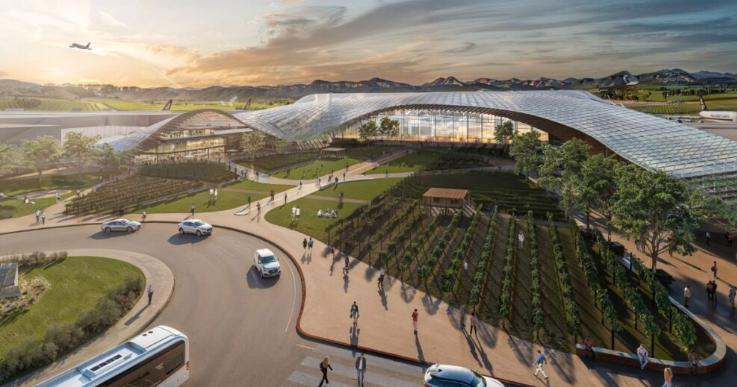
Africa-Press – South-Africa. One of South Africa’s largest property developers, Growthpoint, has invested in the Cape Winelands Airport precinct, with construction set to begin in early 2026.
This development is expected to become the Western Cape’s next-generation aviation, hospitality and industrial hub.
It is located on a 150-hectare site 13 km northeast of Durbanville, where is built by the South African Air Force in 1943.
Formerly known as Fisantekraal Airfield, it is a privately led airport that was developed as a base for Lockheed Ventura bombers.
It was renamed the Cape Windelands Airport in 2020 and is currently used as a general aviation facility and a popular base for flight training.
However, the site’s owners, RSA Aero, plan to convert it into an international commercial airport and a hospitality and industrial hub.
These plans received a significant boost when Growthpoint, South Africa’s leading Real Estate Investment Trust (REIT), sealed a deal with an initial investment in the project.
Growthpoint co-owns V&A Waterfront and holds group property assets to the value of R155.8 billion across retail, office and logistics properties.
On Thursday, 16 October, the REIT announced that it has made an initial investment with the right to co-invest and develop the new Cape Winelands Airport precinct.
Growthpoint said this marks the start of a strategic partnership to deliver “the Western Cape’s next-generation aviation, hospitality and industrial hub”.
“The privately-owned airport, set to be developed on the site of the airfield previously known as Fisantekraal, is designed to strengthen the region’s logistics, trade and tourism infrastructure,” it said.
“The property group’s initial investment is one of several pillars in a long-term partnership for the design, development, delivery and management of the properties within the Cape Winelands Airport precinct.”
It explained that, under the agreement, Growthpoint will assume long-term property and asset management responsibilities, with the right of first refusal to co-invest in future property developments. Growthpoint will also oversee the development’s main contractor.
Therefore, the Cape Winelands Airport team will lead the aviation strategy and master planning of the international aviation hub, while Growthpoint will contribute institutional capital, property expertise, and sustainability leadership.
Building a next-generation airport
“This partnership represents a step-change for Cape Winelands Airport,” said RSA Aero CEO Nicholas Ferguson.
“Growthpoint’s partnership provides the institutional foundation and delivery capacity needed to build an airport precinct of global quality that will serve the region for generations to come.”
Growthpoint CEO Norbert Sasse said Cape Winelands Airport and its visionary partners have set in motion a “powerful catalyst for long-term value creation” and a legacy asset for the Western Cape.
“We are pleased to take part in this opportunity and to contribute to Cape Town’s and South Africa’s sustainable growth,” he said.
Growthpoint estimates that the airport will sustain around 35,000 direct and indirect jobs and just over 100,000 direct and indirect jobs during its initial 20 years of operation.
The development represents an expected initial investment of approximately R8 billion in Cape Town, which will deliver the terminal buildings, runway and a 450-hectare developable estate.
Cape Winelands Airport will also aim to be the “greenest” airport in the world, with a focus on sustainability at every phase of development.
It will function largely with renewable energy and be supported by water reuse systems, driving a carbon-neutral agenda.
“Our commitment to Cape Winelands Airport aligns with Growthpoint’s purpose of creating space to thrive,” Sasse said.
“The project is centred around aviation, but it’s also about unlocking inclusive growth, enabling enterprise and setting new standards for sustainable development.”
Pending Environmental Impact Assessment approvals, construction of Cape Winelands Airport could begin in early 2026.
The development will proceed in phases, starting with runway and safety infrastructure, followed by the terminal, cargo and industrial precincts.
On this timeline, the airport is targeted for commissioning by 2028 with capacity for more than five million passengers annually by 2050.
The full rollout will unfold over more than two decades, in step with the region’s evolving growth and infrastructure needs.
For More News And Analysis About South-Africa Follow Africa-Press