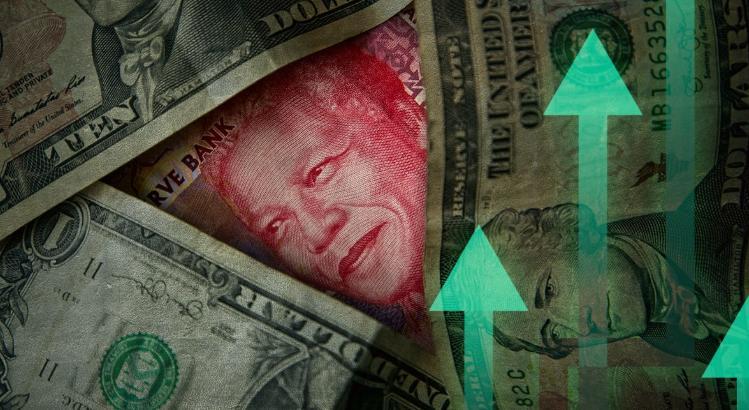
Africa-Press – South-Africa. Since the rand’s introduction in 1961, the currency has experienced severe swings, with the past decade marking a period of significant weakness.
Over this time, the rand gained a reputation as a highly volatile and weak currency compared to the United States dollar.
However, in 2025 to date, the rand has experienced a notable rebound, with the currency remaining remarkably resilient in the face of global shocks.
Over the past quarter of 2025, the rand has outperformed most of its emerging market peers and even commodity currencies such as the Australian dollar.
In a 2023 newsletter, Old Mutual’s Symmetry chief investment strategist Izak Odendaal explained that the rand was introduced in 1961.
Up until the 1980s, the rand was a managed currency, meaning its exchange rate was determined by the government.
While these types of currencies allow for more stability, the exchange rate can become unrealistic over time as it does not necessarily line up with underlying economic realities.
This is why, in 1981, it was decided that the rand’s exchange rate would be left up to the market. Soon after, it came under pressure from a surging United States dollar, losing 71% of its value by December 1985.
This marked the start of the rand’s infamous reputation for volatility, with the local currency being one of the most actively traded in the world.
Odendaal explained that there is a benefit to this volatility, as it discourages reckless foreign borrowing and overreliance on imports.
South Africa’s limited reliance on foreign borrowing has been one of its key advantages over the past few decades, as it has avoided the so-called ‘original sin’ of emerging market economies.
Many other emerging markets have been forced to take on foreign debt in stronger currencies, which has increased their vulnerability to exchange rate risks.
South Africa has managed to avoid this trap, with foreign-denominated debt only constituting a fraction of the state’s total debt.
This is attributed to the country’s highly developed, sophisticated and deep capital markets compared to its emerging market peers.
However, Odendaal noted that the rand’s volatility also has drawbacks, as it significantly impacts investment returns.
In addition, this volatility has been paired with rand weakness, with the currency having steadily weakened against the United States dollar over the past few decades.
Source: Old Mutual and Izak Odendaal
Decades of decline
The rand’s weakening over the past few decades is attributable to several different factors, from a stronger dollar to South Africa’s persistent current account deficit.
A stronger United States dollar has undeniably placed pressure on the rand, as the greenback has grown to become the most influential currency in the world.
The US dollar is not only the world’s primary reserve currency, held by central banks across the globe, but also dominates trade and commodity pricing.
Odendaal cautioned that the rand should not be seen as the country’s share price, as an exchange rate refers to a swap ratio of two currencies, meaning there are always two different sets of dynamics at play.
“In the case of the rand/US dollar exchange rate, it is both the rand and the dollar that matter,” he said.
However, this is not to say that some of the blame for the rand’s decline lies at South Africa’s feet, with the country’s economic decline and heightened risk playing a large role.
Aluma Capital chief economist Frederick Mitchell previously explained that the fair value of the rand actually sits between R11.30 and R14.30 to the United States dollar.
However, due to the significant risk premium embedded in the local currency, the rand is trading far above this fair value.
Mitchell explained that this risk premium is driven by domestic policies that are seen as hostile to foreign investment, such as BEE and expropriation without compensation.
These economic strategies and South Africa’s growing government debt burden discourage capital inflow into the country and exacerbate foreign investor concerns.
He said these concerns are further amplified by South Africa’s contentious international stance, notably with the country’s increased alignment with global outliers like Iran, Hamas and Russia over the past few years.
All of these factors combined have led to a sharp decline in foreign direct investment in South Africa, which has also punished the rand in the process.
Source: BER 30-year macroeconomic review
Up-and-coming
This combination of homegrown troubles and a stronger United States dollar has seen the rand lose substantial value over the past few decades.
Many expected this trend to continue, with the rand starting 2025 on the back foot as the looming threat of United States tariffs weighed on the currency.
These factors, combined with South Africa’s three-Budget debacle, saw the rand weaken significantly at the start of the year.
The local currency nearly breached the dreaded R20/USD mark in April, after United States President Donald Trump announced wide-ranging tariffs on several countries, including South Africa.
However, as 2025 has progressed, the rand has steadily gained value, and is currently up over 7% against the United States dollar in the year to date.
By early October, the rand was trading near R17/USD, its strongest point in more than two years.
Many experts have pointed out that the rand’s gains in 2025 are not as much attributable to the local currency’s strength as the US dollar’s weakness.
Foord Asset Management portfolio manager Rashaad Tayob recently explained that the rand’s rebound began as part of a global retreat from the dollar.
This was partly due to the Federal Reserve interest rate cuts and growing concerns about the United States’ economic outlook.
In 2025, many investors became disillusioned with the greenback as the key factors driving US exceptionalism over the past 15 years are slowly fading, bringing down the dollar with them.
This weakening of the US dollar spelt good news for South Africa, as the greenback’s losses turned into a win for the rand.
However, Tayob pointed out that the story has become more local in the second half of the year, as the dollar has steadied, yet the rand’s strength has kept growing.
He explained that the local currency has been supported by foreign inflows into emerging markets and a powerful rally in gold and platinum prices.
“For once, South Africa’s high real yields and trade surplus have combined with improving risk sentiment to support the currency rather than punish it,” Tayob said.
A more mature currency
It is important to note that many of the factors that have supported the rand in 2025 are not merely short-term wins, but could be indicative of longer-term trends.
For example, many believe investors’ disillusionment with the US dollar points to the end of an era for the greenback.
While the dollar will maintain its dominance as the world’s reserve currency and the primary currency used in global financial transactions, 2025 has marked the end of a 15-year run of strength.
Therefore, emerging markets like South Africa are set to benefit, as a weaker dollar eases financial conditions and results in lower inflation.
Reserve Bank Governor Lesetja Kganyago has also pointed out that the rand is no longer the volatile currency it once was.
Kganyago said the currency is settling down to a “more mature stage of life”, arguing that the currency deserves more respect for its recent stability.
“When people tell you the rand is a weak and volatile currency, encourage them to think again,” he said.
“I would also like more people to recognise that rand volatility has declined. Option-implied volatility is now at long-term lows.”
“Yet, outside of financial markets, most people still believe the rand is a highly volatile currency. The only problem with this view is that it no longer describes the facts in front of us.”
He attributed this, at least in part, to South Africa’s lower inflation over the past year, with the country now more in line with its global peers.
With an official lowering of the country’s inflation target expected soon, this low inflation environment is set to continue, which will also support the rand going forward.
This, combined with signs of hope for South Africa’s economic turnaround, with Eskom and Transnet in significantly better positions than they were just a year ago, could see the rand gain even more ground in the coming years.
For More News And Analysis About South-Africa Follow Africa-Press