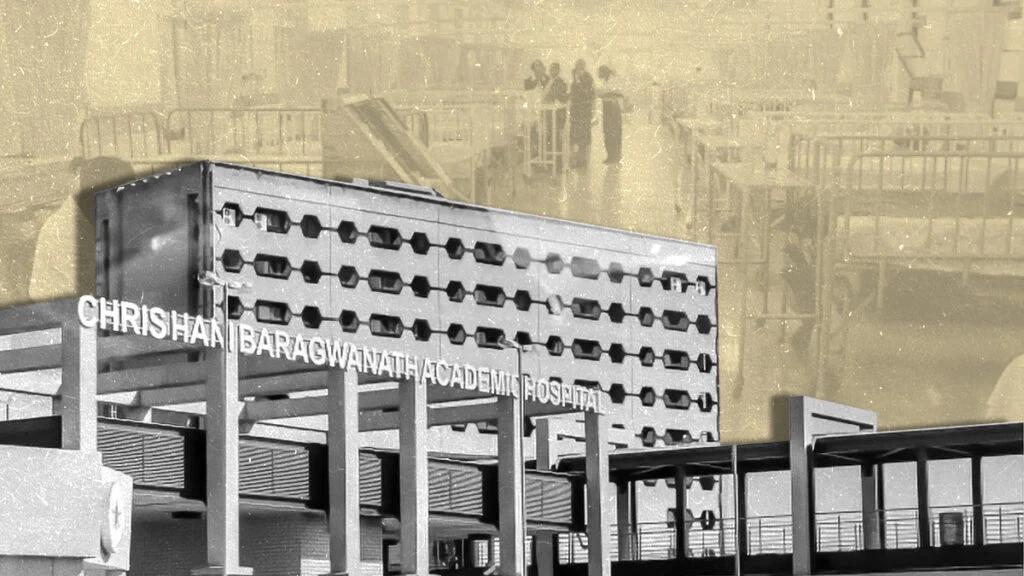
Africa-Press – South-Africa. Chris Hani Baragwanath Hospital (Bara) was once known as the world’s biggest hospital ever built.
For decades, it stood as a testament to what’s possible in South Africa’s public health system and a symbol of medical ambition.
Today, however, its condition tells a very different story. Years of poor maintenance, weak administration, underfunding and failing infrastructure have caused the hospital to decline to the point where it can no longer function at the scale it once did.
The hospital began during the Second World War as a military facility for British troops. Its name came from John Albert Baragwanath, a Cornishman who owned a nearby trading post.
In 1948, soon after the National Party took power, the government bought the hospital for £1 million and moved the nearby black hospital into the facility.
It opened with 480 beds. The apartheid government quickly used Baragwanath as proof that it was providing healthcare to black South Africans.
Historian Dr Simonne Horwitz explained that the government promoted the hospital’s size and scale to support its policy of separate development at a time when it faced global criticism.
Over the years, Baragwanath grew rapidly. The Wits medical school formed a strong relationship with the hospital, helping it become a major training institution.
After 1994, the hospital was renamed Chris Hani Baragwanath Hospital in honour of the anti-apartheid leader.
In 1997, it applied to the Guinness Book of Records to be recognised as the world’s largest hospital by number of beds.
However, while it once held that distinction, it has since been overtaken by modern mega-hospitals built in countries that continue to invest in large-scale public healthcare.
Baragwanath, by contrast, has steadily shrunk in capacity. Staff shortages, past renovations, administrative problems, and failing infrastructure mean that far fewer beds are usable today.
In 2011, then health minister Aaron Motsoaledi announced that the hospital would be reduced to 1,200 beds to align with international norms.
Renovations have dragged on for years, and emergency patients have repeatedly been diverted to other hospitals. At one point in 2023, much of the main medical casualty unit was still closed.
The hospital’s Mazibuko told Africa Check in 2016 that no wards had been closed but that some were being renovated.
He said that this process was almost completed. “The bed occupancy is 3,400 [with] 2,888 usable,” he said. However, today it is now sitting at 3,200 beds.
The slow collapse
According to Prof. Stephen Hendricks, a public health specialist in South Africa, a serious concern with a hospital as large as Chris Hani Baragwanath, which has grown haphazardly over the last 70 years, is that it is costly to maintain.
Although doctors and nurses trained at Baragwanath have significantly benefited from the high patient load and diverse medical cases, the hospital’s overall condition has deteriorated sharply.
Professor Daynia Ballot, who has worked in Gauteng hospitals for more than 30 years, has charted the slow collapse of hospitals during this time across major hospitals such as Bara.
She pointed to failing infrastructure, including crumbling buildings, leaking pipes, sewage spills, water shortages and electricity blackouts, as the reasons for the decline in service.
Flooding, pests, broken air-conditioning and extreme temperatures have also become common problems.
Overcrowding increased the risk of dangerous hospital-acquired infections, and load shedding placed patients in ICU and surgery at serious risk because backup generators do not always start.
At times, surgeons have had to scrub using buckets because there was no running water.
Although years have passed since then, many problems remain unresolved. In 2024, the Standing Committee on Appropriations met with unions representing staff at major Gauteng hospitals, including Bara.
They reported severe staff shortages due to a moratorium on filling posts, extremely high nurse-to-patient ratios, and a lack of cleaners, which forces nurses to take on cleaning duties.
Overcrowding is made worse by poor patient referral systems, leaving staff demoralised and stretched thin.
Hospitals also face major equipment shortages, including MRI machines and other essential medical tools. Laundry services are unreliable, compromising hygiene.
Records departments lack proper storage, printing and scanning equipment, causing patient files to go missing.
Some archives are kept in unsafe basement spaces near sewerage pipes, and some hospitals lack basic fire extinguishers.
Budget planning remains inaccurate because patient numbers from other provinces and neighbouring countries are not properly accounted for.
Today, Chris Hani Baragwanath Hospital still covers 70 hectares, roughly 130 football fields, and employs around 6,760 people. It remains one of the biggest hospitals in the world, ranking sixth globally.
Chris Hani Baragwanath Hospital
2010
1942
For More News And Analysis About South-Africa Follow Africa-Press