Africa-Press – South-Africa. South Africa’s narrow tax base is under severe strain, and going another year without adjusting the country’s personal income tax (PIT) brackets for inflation risks driving capital flight.
Referred to as ‘bracket creep’, South Africa’s PIT brackets were last adjusted for inflation in the 2023/24 fiscal year, acting as a “stealth tax” that increases the state’s revenue without requiring rate hikes.
However, Finance Minister Enoch Godongwana may not be able to rely on this measure to increase the state’s tax take in his upcoming 2026 Budget, as it would risk capital flight and souring investor confidence.
This is according to Aluma Capital chief economist Frederick Mitchell, who expects the National Treasury to tread cautiously in setting the 2026 Budget.
Mitchell described the Treasury as balancing on a “fiscal tightrope”, with positive momentum underway but severe risks also remaining.
“With a current total debt-to-GDP ratio hovering around 77%, maintaining a disciplined fiscal strategy is paramount,” he said.
“The anticipated primary surplus, expected to reach 2.5% of GDP by 2028, provides a glimmer of optimism.”
In addition, Mitchell said the government’s coffers should benefit from an ongoing commodity boom, with South Africa set to reap the rewards of soaring precious metal prices.
Foord chief investment officer Nick Balkin previously estimated that the ongoing commodity rally could boost the government’s tax intake by R20 billion per annum over the next two years.
This is due to increased corporate income taxes from South Africa’s JSE-listed mining giants, which have seen their profits surge on the back of the commodity rally.
However, Mitchell said it is essential that any windfall from the commodity boom be directed toward reducing existing debt rather than funding new recurring expenditures, “which could only exacerbate the situation”.
He explained that one major concern remains the government’s approach to taxation, with the state having essentially run out of options when it comes to increasing several taxes in South Africa.
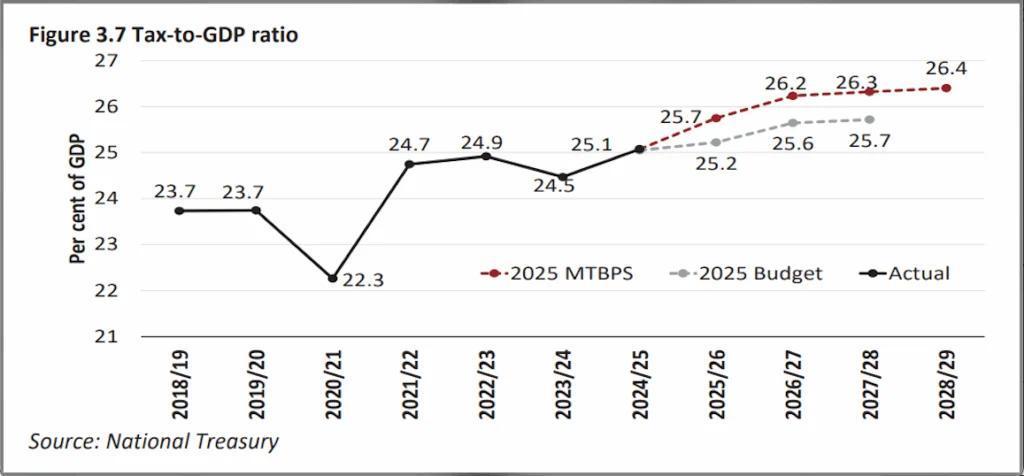
In the 2025/26 fiscal year, no inflationary adjustment to tax brackets and rebates added around R15.5 billion to the government’s tax take.
Tax troubles
Mitchell explained that, with about 80,000 individuals earning over R2 million each contributing 30% of the total PIT burden, South Africa’s narrow tax base is under strain.
This is, in part, due to the government not having adjusted South Africa’s PIT brackets for inflation since 2023/24.
“The lack of adjustments for inflation in tax brackets, viewed as ‘bracket creep’, effectively represents a stealth tax hike on the very professionals who drive private investment,” Mitchell explained.
“This coercive approach does little to inspire confidence among investors and risks driving capital flight as taxpayers seek less burdensome environments.”
In addition, some economists, including Efficient Group’s Dawie Roodt, have argued that South Africa is over the Laffer Curve when it comes to the PIT.
This means that any increase in the tax rate could reduce the state’s tax revenue, as taxpayers leave the country or find other ways to avoid paying taxes.
Therefore, it would be risky for the government to hike the tax rate or leave PIT brackets unchanged for the third consecutive year.
Mitchell explained that one risk to taxpayers in the upcoming Budget is the government’s substantial social welfare obligations.
“As expenditure on social services continues to rise, it becomes increasingly critical for South Africa to balance its needs with the reality of a limited tax base,” he said.
“Maintaining a focus on fiscal discipline, rather than succumbing to political pressure to expand the social wage, is essential for long-term sustainability.”
Mitchell recommended that, to stimulate South Africa’s economic growth, the 2026 Budget must strive for sensible tax incentives.
These incentives should be aimed at elevating investment in key sectors such as manufacturing and renewable energy.
“The focus should be on broadening the tax base and fostering private investment rather than deepening existing burdens,” he said.
“Notably, the government’s commitment to deregulate certain sectors, including logistics and energy, offers fresh opportunities for private operators and could reinvigorate economic momentum.”
“With a careful, conservative approach that respects the realities of our fiscal framework, South Africa can harness its abundant resources to build a more resilient and prosperous future.”
For More News And Analysis About South-Africa Follow Africa-Press