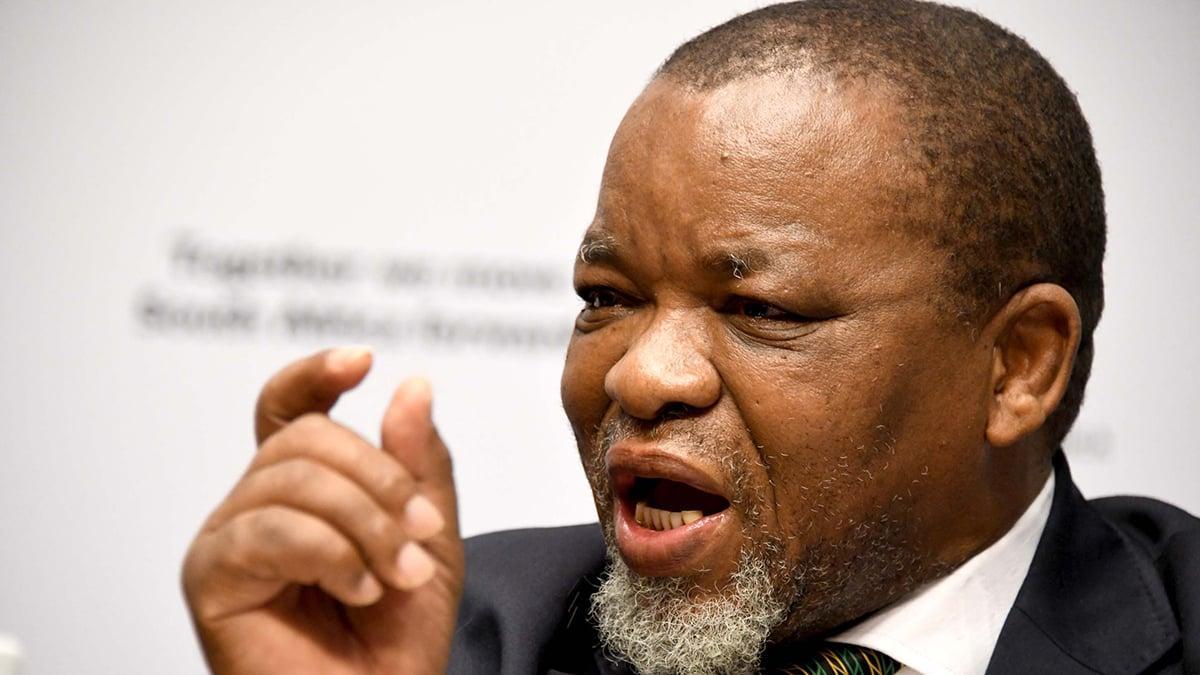
Africa-Press – South-Africa. Minister of Mineral and Petroleum Resources Gwede Mantashe said his department has removed the requirement for Black Economic Empowerment (BEE) participation at the prospecting stage for mining in South Africa.
Mantashe revealed this during his opening remarks at the Investing in African Mining Indaba, which is being held in Cape Town.
This indaba is seen as one of the most important for South Africa in years, with it coming amidst a commodity boom and after two decades of declining output from the country.
Once a global powerhouse, the local industry is now a shell of its former self. Today, the country counts among the worst mining jurisdictions in the world.
As a result, while it has benefited from the ongoing precious metals boom, particularly in platinum, it has not reaped the rewards to the extent it should.
This is largely due to the lack of exploration and prospecting that has occurred in the country over the past two decades, with South Africa becoming steadily less attractive to mining companies.
In part, this is because of the country’s dwindling gold resources, which have been largely mined out, and the shift towards industrial commodities, such as copper, that are not abundant in South Africa.
However, a more significant factor in this decline has been the destructive policies implemented by the government over the past 20 years.
This includes the disastrous Mineral and Petroleum Resources Development Act (MPRDA) of 2002, which eroded private ownership of minerals, and the onerous regulations placed on the sector with regard to BEE and transformation.
Coupled with this policy is the government’s failure to address concerns raised by the local mining industry, which include policy uncertainty, deteriorating infrastructure, and threats of nationalisation.
“You are seeing what happened in Zambia and in Zimbabwe now happening in South Africa. It has not turned around. It is still going down,” Modern Corporate Solutions mining analyst Peter Major said.
Major said he would respond to people saying that South Africa has not nationalised anything by asking them how much investment the country has received since the MPRDA came into effect.
“Can you imagine working your whole life, decades, building the most modern, efficient plant? And then you wake up one day, and the dirt it is sitting on is no longer yours?” Major asked.
“The government tells you, ‘Your plant may be sitting on some dirt, but you don’t own any of that dirt. And if you do everything we tell you, you might use it for 20 years, 25 years, and then we will decide if we want to renew it.’”
Major said this shift dramatically changes the investment case for mining in South Africa, with it significantly increasing the hurdle above which the reward justifies the risk.
BEE changes
Minister of Trade, Industry and Competition Parks Tau
To help lower the hurdle for investing in exploration and prospecting in South Africa, Mantashe announced the removal of the BEE participation requirement at this stage.
“We recognise that exploration is the lifeblood of mining. For this reason, we have removed the requirement for BEE participation at the prospecting stage,” Mantashe said.
“This is not a retreat from transformation, nor is it an endorsement of the misguided view that black participation is a barrier to economic growth.”
“It is rather a pragmatic recognition that prospecting is a high-risk phase where no economic value has yet been proven.”
This means that the BEE requirement will only be enforced when the production phase is entered, as that is when economic value begins to be created.
“Exploration adds no value. You are looking for the quantity and quality of minerals. Therefore, you do not need to carry the burden of a black partner,” Mantashe said.
“Do your exploration, and at the point of production, we can talk about having a partner.”
Mantashe explained that this change is aimed at boosting exploration and attracting investment towards South Africa from major mining companies.
“This change is designed to stimulate exploration, increase South Africa’s global share of exploration investment, and ultimately expand the pipeline of future mines,” Mantashe said.
“Encouragingly, our renewed exploration drive is already bearing fruit. New geological data points to substantial untapped mineral potential beneath South African soil.”
The announcement of the change to BEE requirements comes amid more extensive changes to the transformation framework by other parts of the government.
Mantashe’s change comes amid a two-phase review of BEE by the Department of Trade, Industry, and Competition to determine how relevant legislation can be amended to improve outcomes.
This review is largely aimed at closing loopholes that are being exploited by bad actors, with BEE increasingly becoming associated with cronyism and corruption.
The department also aims to determine whether existing BEE legislation has led to greater participation in the formal economy, or whether the benefits are going to a select few.
At the end of January, Trade Minister Parks Tau published draft changes to the broad-based black economic empowerment (B-BBEE) Codes of Good Practice.
These changes are specifically focused on funding the new Transformation Fund and changing the way preferential procurement is measured, experts at Webber Wentzel explained.
Under current B-BBEE codes, all businesses must make contributions, in cash or in kind, to these types of businesses. Some of the black-controlled businesses must also be their suppliers.
This helps companies score BEE points for enterprise and supplier development, giving them a greater chance at securing government contracts or deals with big businesses.
The changes proposed by Tau will allow businesses to instead make contributions to a centralised fund, which will then deploy money to beneficiaries.
This would mean that businesses would no longer have to identify their own enterprise and supplier development beneficiaries or go through third-party intermediaries.
Crucially, while the 3% net profit after tax spending target will remain unchanged, businesses could score more points by contributing to the fund than by making individual contributions to black-controlled companies.
For More News And Analysis About South-Africa Follow Africa-Press