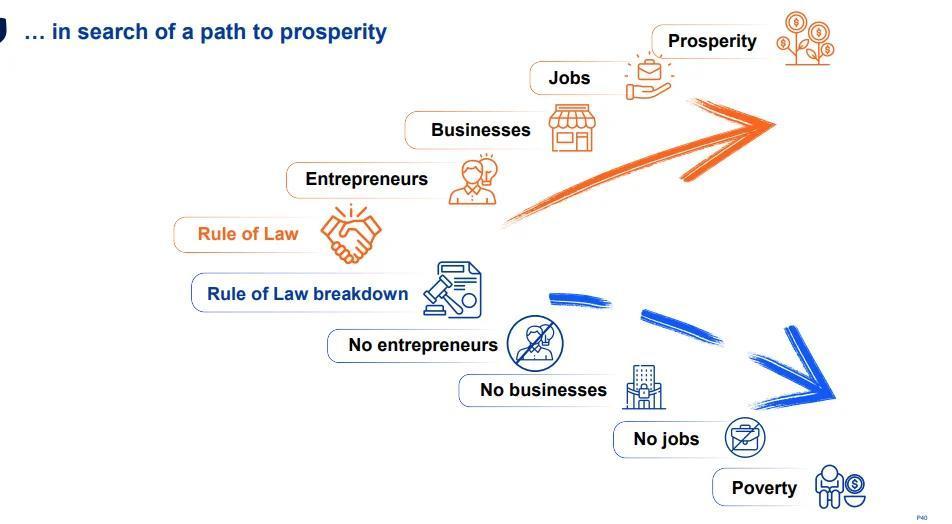
Africa-Press – South-Africa. To save its economy, South Africa must focus on the rule of law and good governance, as they are the key to achieving prosperity and avoiding poverty.
Fundamentally, the rule of law and good governance underpin a modern economy, with these characteristics being the main drivers of investment and economic growth.
Over the past decade, the rule of law and good governance have been on the retreat in South Africa, resulting in lacklustre economic growth.
A reversal of this trend is vital for the South African economy to fully turn the corner and capitalise on the momentum it picked up in 2025.
This is feedback from Standard Bank chief economist Goolam Ballim, who unpacked the bank’s outlook for 2026 at its annual Economy event.
Ballim explained that 2025 was a crucial year for South Africa, with it symbolising a shift away from stagnation and towards positive momentum.
While the country’s economic growth, on paper, is not fast enough, the progress it has made in implementing its reform agenda has put it on the right path for significantly faster growth in the coming years.
Crucially, these factors are not cyclical or fragile, with those underpinning South Africa’s growth appearing resilient, Ballim explained.
However, one of the major challenges the country faces is the decline in the rule of law and good governance, which is becoming increasingly evident in the everyday lives of South Africans through water shortages, elevated crime levels, and plummeting service delivery.
“We are accustomed to saying at Standard Bank that the rule of law is everything. Good governance is everything,” Ballim said.
“The themes emerging from the Madlanga Commission are incredibly potent and powerful. They speak to the extent of the rule of law.”
Ballim explained that this is not only a philosophical idea of belief, but also something that is practically relevant to every South African.
Apart from the decline in the rule of law and good governance being felt on a daily basis, they are also crucial for investment and economic growth.
“Sometimes I am inclined to suggest that President Cyril Ramaphosa does not have an annual investment conference, but replaces it with a governance conference,” Ballim said.
“If he replaced it with a rule of law conference, it would be more meaningful in underpinning South Africa’s reach for prosperity than the investment conference in its own right.”
Ballim has previously told Daily Investor that around three-quarters of investment and economic growth in a country hinge on the rule of law and good governance.
“I am making a bold statement here. I have said it before, and the data support me in saying that governance is about two-thirds to three-quarters of the economic growth of a country,” Ballim said.
“And so, continued improvement in the governance structure will be the bedrock of enhancing predictability, efficiencies, and increased private sector participation in the economy.”
“So, if you want to say what the silver bullet is, I’d say it is the rule of law.”
Bottoming out
One positive Ballim pointed to is that revelations in the form of the Madlanga Commission have often been the turning point for emerging markets.
These revelations, while alarming and nerve-wracking, often shock the system into responding to strengthen the rule of law in particular.
“One hopes that South Africa will follow the path of Brazil, when it had its own Operation Carwash, as it was referred to locally,” Ballim said.
Consumers, society, and investors were dismayed at the newsflow out of Brazil at this point in time, similar to how the reaction has been in South Africa and abroad to the Madlanga Commission.
“In fact, it resulted in a massive decline in confidence, in consumer spending, and in investment in Brazil. This led to a sharp economic downturn,” Ballim said.
“The irony, though, is that those very revelations would mark the bottom of the business cycle. In the aftermath of those revelations, a cleansing of some magnitude occurred, which can then serve as a bedrock for economic acceleration.”
“South Africa has the opportunity, through the Madlanga Commission and the Parliamentary ad hoc committee, to do something similar.”
Ballim explained that this would require rebuilding various investigative bodies, the National Prosecuting Authority, and the police more broadly.
“If action is taken, we could experience a very similar Brazilian rescue operation, despite the dent to confidence and, ironically, despite all the unnerving newsflow,” Ballim said.
He explained in response to questions from reporters that trying to grow an economy without the rule of law is like building a castle on quicksand – it will collapse.
Calling for improved governance and the rule of law is relatively easy to say and call for, but is practically very difficult to implement.
In South Africa, this is made more difficult by the fact that many of those people responsible for defending the rule of law may be working to undermine it.
“It is easy to say, and sometimes it has even been done, but sometimes the very politicians responsible for the rule of law are also the ones who seek to preserve their patronage networks and so forth,” Ballim said.
“This has been a crime on society for a length of time, and it is one of the things that we should continue to talk about as policy advisors and as citizens.”
Source: dailyinvestor
For More News And Analysis About South-Africa Follow Africa-Press