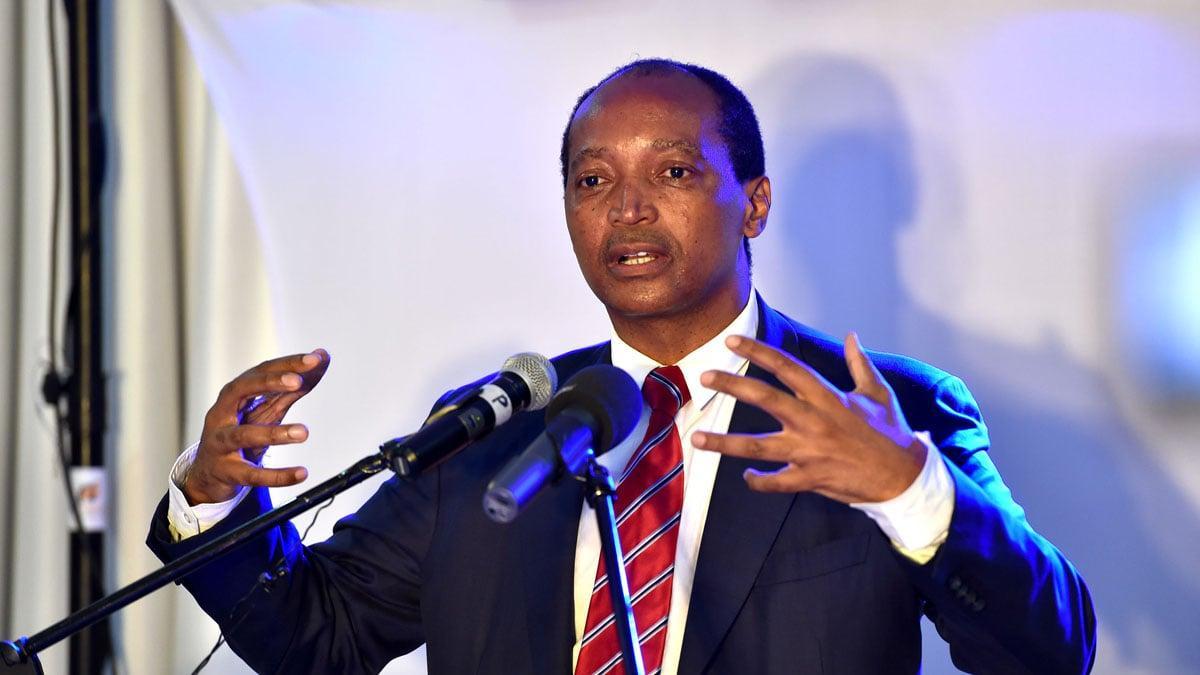
Africa-Press – South-Africa. Billionaire Patrice Motsepe has the ability to save South Africa’s mining industry from years of steady decline, if he gets into a position of authority.
Motsepe is one of the few individuals who understands the challenges of operating mines across South Africa and has the connections to rewrite the country’s mining law to make it more attractive to operate in the country.
This is feedback from Modern Corporate Solutions mining analyst Peter Major, who explained that Motsepe has what it takes to revive the backbone of South Africa’s economy.
Major’s comments came in response to claims that Motsepe is considering running for the presidency of the ANC, which is currently held by his brother-in-law, Cyril Ramaphosa.
While Motsepe has repeatedly denied wanting to run for ANC president, speculation that he is secretly planning a bid has ratcheted up in recent months as the party gears up for its elective conference in 2027.
Motsepe has been included in several public polls surveying the popularity of various presidential candidates, as supporters hold the belief that he can be convinced to run.
There have also been numerous reports of ANC branches nominating him to take over the party’s leadership. More recently, there have been reports of ANC shirts being printed with “PM Savumelana” on them.
Major told BizNews that Motsepe has the ability to significantly change the fortunes of South Africa’s mining sector for the better if he gets into a position of power.
“He would not even have to do much. He could say, ‘In view of everything that’s gone on for the last 30 years, in view of what we are seeing in peer countries, I am calling for a rewriting of our Minerals Act,’” Major said.
“He could do it like that. And, you know what? He would have more fans than enemies. That is all he has got to do.”
Major has previously criticised South Africa’s current Mineral and Petroleum Resources Development Act (MPRDA) of 2002, saying it is responsible for the decline of mining in South Africa.
In the two decades that followed the implementation of this policy, there has been little to no exploration in South Africa for new mineral deposits despite evidence of a rich bounty.
Major said Motsepe could look to get South Africa to copy the mining law in other countries and tailor it to South Africa.
“South Africa’s policy evolved over one hundred years. It was tailored to deep-level gold mines. It was tailored to expensive high-electricity refineries like the platinum mines had,” Major explained.
“So, you know, I would go back and look where our legislation was in the 1990s and do some tweaking. Modernise it a bit and give people a reason to come back to South Africa.”
“Start with wanting legislation that creates jobs, and then create legislation that puts money in the government’s coffers without killing the companies that are paying the money. He could do it.”
The collapse of South African mining
South Africa’s mining sector is a shell of its former self, with output steadily declining over the past 20 years and failing to capitalise on a historic rally in precious metals prices.
The sector that once produced mining giants ready to take on global competitors has seen little to no new mineral exploration over the past two decades.
Mining companies have been beset by policy uncertainty, increasingly onerous regulations, difficult labour relations, and declining service delivery.
This has been coupled with routine calls for the sector’s nationalisation from members of the ruling ANC and its alliance partners.
Major explained that the issues facing South Africa’s mining industry are deep-rooted, with many resulting from the MPRDA.
While the country has not nationalised any mines in the country, this act and other policies have slowly eroded the ownership rights of mining companies.
“Can you imagine working your whole life, decades, building the most modern, efficient plant? And then you wake up one day, and the dirt it is sitting on is no longer yours?” Major asked.
“The government tells you, ‘Your plant may be sitting on some dirt, but you don’t own any of that dirt. And if you do everything we tell you, you might use it for 20 years, 25 years, and then we will decide if we want to renew it.’”
Major said this effectively kills the investment case for mining in South Africa, with the hurdle for investing in the country being extremely high.
“Mines are a hundred-year investments. So, are you happy investing now? Somebody else took away your minerals, but they will let you borrow them with a lot of different terms and conditions than the day before,” Major said.
“That is something that just does not register with Pretoria. It does not register with the mindset that the ANC has or indeed that South Africa has.”
The destructive policy of the MPRDA type has crushed South African mining, turning an industry that was once the envy of the world into a shell of its former self.
“You are seeing what happened in Zambia and in Zimbabwe now happening in South Africa. It has not turned around. It is still going down,” Major said.
Apart from the industry being crushed by legislation, regulations placed on it have also become increasingly onerous.
“They were also changing legislation non-stop. You first had to have a BEE partner that owned 25%, and that quickly increased to 30%. And then, they said 70% of the money you spend had to go to BEE suppliers,” he said.
“As if nationalising property was not enough, they put on all these horrendous conditions that drove capital away.”
For More News And Analysis About South-Africa Follow Africa-Press