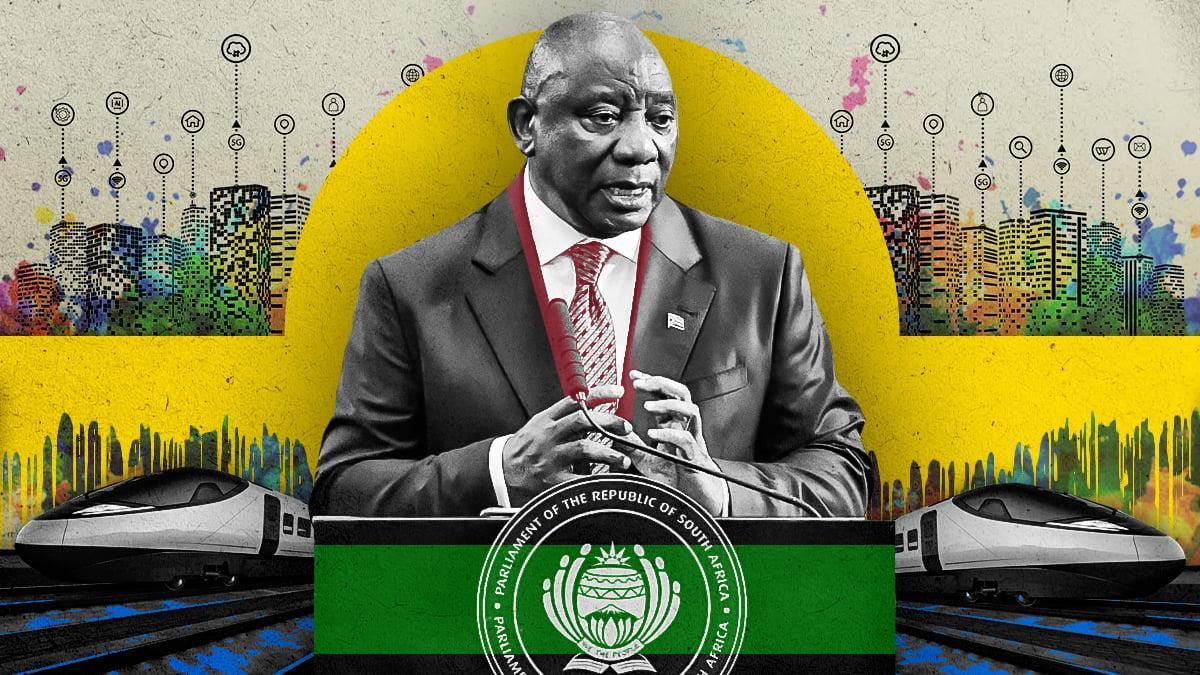
Africa-Press – South-Africa. President Cyril Ramaphosa has doubled down on the government’s commitment to Black Economic Empowerment (BEE) policies in South Africa, saying the country needs more empowerment of black people and other minorities.
This is despite increased calls to scrap or review these policies, and polls indicating widespread dissatisfaction with BEE policies and their impact.
The President addressed this dissatisfaction in response to the debate following his State of the Nation Address (SONA) earlier this month.
In this debate, various political parties raised the issue of BEE policies, which have come under fire from businesses, civil society, and government members in recent months.
For example, the DA has repeatedly called for BEE to be replaced with means-based redistribution policies to improve the effectiveness of legislation aimed at tackling inequality.
The second largest party in the Government of National Unity has even introduced legislation, the Economic Inclusion Bill, to this end.
Even some ANC members have called for a review of BEE policies. Trade Minister Parks Tau previously said BEE has become tainted by cronyism and corruption, requiring an overhaul of the policies that allowed this to happen.
Tau recently announced significant changes to the existing BEE framework, including alterations to the BEE Codes of Good Practice, with a special focus on how the new Transformation Fund will be capitalised.
Dissatisfaction with the current state of BEE policies is also felt among South African citizens.
In December 2025, the South African Reconciliation Barometer also found that 54% of the country’s inhabitants agree that Broad-Based BEE rules should be phased out.
It further found that two-thirds of South Africans think that the use of racial categories does more harm than good.
Critiques of current BEE policies range from their economic cost, estimated at around 3% of GDP each year, to claims that they have only benefitted a handful of well-connected individuals.
Ramaphosa doubles down
Ramaphosa addressed this issue in his SONA, saying the government is undertaking a review to refine and strengthen its broad-based BEE framework to ensure that it supports greater transformation and inclusive growth.
The President further addressed these critiques in his response to the SONA debate on 19 February 2026.
In this response, Ramaphosa explained that South Africa’s Constitution requires the country to redress past injustices and build a society that is equal and just.
“We cannot do that without transforming the various aspects of South African life, but more particularly the economy,” he said.
“It cannot be acceptable to anyone in this house for African people, colored people and Indian people to be poorer and have fewer opportunities than white people. It cannot be acceptable.”
“And yet, there are people in this house, in this very house, in the debate who tell us to get rid of the very measures that have been put in place to correct the gross injustice of the past.”
The President said this topic “touches a very raw nerve” in him, as he, alongside Mineral and Petroleum Resources Minister Gwede Mantashe, has deep ties to South Africa’s mining sector, where inequality was deeply entrenched.
“It is one of the principal issues that we sought to get rid of from this country – the inequality and the exclusion of black people from participating in the economy,” he said.
Ramaphosa explained how, by law, mine workers used to be divided in a way that allowed white employees to be favoured over black employees, both in terms of compensation and opportunities.
Now, he said, progress has been made in changing this, with his government’s policies instrumental in empowering workers in mining and other sectors – but added that more change is needed.
“We have seen real changes in ownership patterns, and we still need to see more, including businesses that are owned by women,” he said.
“We’ve seen changes in management control. We need to see more. We’ve seen enterprise development and skills development.”
The President referred to statistics that show the improvement in livelihoods for previously disadvantaged South Africans.
He said that, between 2002 and 2023, black households experienced real income growth of 46%, colored households saw a 29% increase, and Indian households 19%.
“It is no accident that the level of poverty in the black African population fell by 67% in 2006 to 44% in 2023,” he said.
“Nor is it any accident that the level of poverty in the colored community fell from 43% to 25% in the same period.”
Despite this progress, the President said the average income of white households is still nearly five times higher than that of black or African households.
He referred to this as a “gulf” that South Africa must close through deliberate and sustained efforts to expand opportunity.
“This is the gulf that we must close through the economic empowerment of those who were prevented from accessing those opportunities,” he said.
“Now is not the time to abandon black economic empowerment. Now is the time to make it even more effective.”
“We must see broad-based black economic empowerment, not as a cost to the economy, but as an investment in the sustainable growth of our economy.”
For More News And Analysis About South-Africa Follow Africa-Press