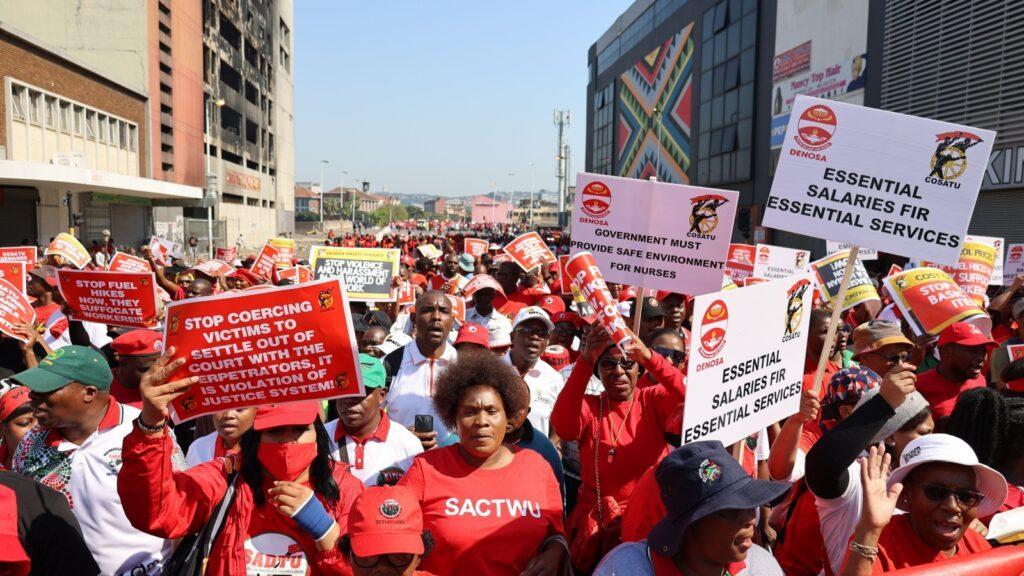
Africa-Press – South-Africa. South Africa’s government transfers too much of its resources towards the public service, resulting in inflated salaries for state employees while service delivery declines.
This transfer of resources has also limited the capital available for the state to invest adequately in maintaining and upgrading infrastructure, which has resulted in several crises in recent years, from load-shedding to water shortages.
As a result, these inflated salaries are destroying the South African economy, political analyst Moeletsi Mbeki explained to the SABC.
Mbeki explained that one of the biggest problems South Africa faces is the public sector wage bill, which has grown significantly over the past 15 years while service delivery has declined.
“The South African economy transfers too many resources to the public service. We spend a lot of money on the civil service,” Mbeki said.
“The money that should be going towards investment to repair our existing infrastructure and build new infrastructure goes to the salaries of the civil service.”
Mbeki explained that South Africa has one of the highest-paid civil services as a percentage of GDP in the world.
South Africa has spent between 10% and 12% of its total economic output on the public sector wage bill on an annual basis over the past three financial years.
This is higher than the Organisation for Economic Co-operation and Development (OECD) average of 9.2% for the period and the G20 average of around 8%.
More importantly, the OECD and G20 are composed largely of developed economies, with highly functional civil services relative to South Africa’s.
The OECD also noted that South Africa’s social services, while extensive, are not as developed as those in many European countries, which provide “cradle-to-grave” services.
In effect, South Africa’s public sector delivers fewer services at a lower level than those of developed countries, despite allocating more economic resources to it.
The data looks much worse for South Africa when comparing the public sector wage bill as a share of total spending, with it taking up a third of the state’s budget. The OECD average is 22%.
“The salaries that are being paid towards the civil servants in South Africa are destroying the economy. That is our own decision and nothing to do with the outside world,” Mbeki said.
“You cannot address unemployment, for example, by paying high salaries to the civil service. You address it by investing in infrastructure, in factories and in education.”
The National Treasury is trying to address the inflated wage bill by introducing an Early Retirement Programme to create a younger public sector that is less costly for the state to employ.
This programme, which includes voluntary exits, aims to incentivise older public servants to retire early, thereby making the state’s workforce younger and relatively cheaper.
Up to 30,000 state employees are expected to opt for early retirement, with projected savings of R5.5 billion.
Civil service incompetence
Moeletsi Mbeki
A more challenging aspect of the public sector wage bill for the government to address is the incompetence of civil servants.
This is most commonly referred to as a lack of capacity within the state to deliver services, perform its functions, or adequately plan for the future.
As a result, it translates into declining service delivery and elevated financial mismanagement across the state.
“We have a problem that we call service delivery failures, but actually it is just a polite way to refer to the incompetence of the civil service,” Mbeki said.
“We call it a lack of service delivery, but it is just the incompetence of the civil service to do its job and implement what it is resourced to do.”
To resolve this, Mbeki suggested implementing an entrance examination for individuals seeking to work in the civil service.
This would not only reduce intake into the civil service but also ensure that those employed in the public sector are highly capable.
“We need to make sure that the people who enter the civil service, at all levels, have the skills that are required to do the job that they are being employed for,” Mbeki said.
“It has to be tough. It has to be difficult because we have to compete with other countries. We have to compete with China, with South Korea, with Malaysia.”
Mbeki said that if South Africa wants to compete for global capital and investment, its civil service has to be on par with those of its peers.
In many cases, South Africa’s civil service, given how well it is paid, needs to be on par with those of highly developed countries for it to be a worthwhile expenditure.
“We will never be competitive if we do not have this. It is one of the main reasons why our economy is not competitive and is on the decline relative to other countries,” Mbeki said.
He said less money should be spent on the civil service, with that capital instead flowing to infrastructure projects.
“In our case, that extravagant expense on public salaries goes into buying foreign SUVs and not delivering services or improving service delivery,” Mbeki said.
Much of Mbeki’s analysis is echoed by that of Efficient Group chief economist Dawie Roodt, who has regularly argued that South Africa’s civil service is overpaid and underworked.
Roodt said a major problem for South Africa’s financial accounts is the state’s huge wage bill, with it consuming a large share of state spending without improving service delivery.
He also argued that the public sector is the source of much of the so-called ‘petty’ state capture, which manifests as corruption at low levels, whether through the sale of passports or bribery at a roadblock.
“There is something that I am very concerned about. The real state capture in South Africa is the civil service and tenderpreneurs,” Roodt said.
“The individuals within the civil service are completely overpaid. Not all of them, but the large majority are totally and completely overpaid.”
For More News And Analysis About South-Africa Follow Africa-Press