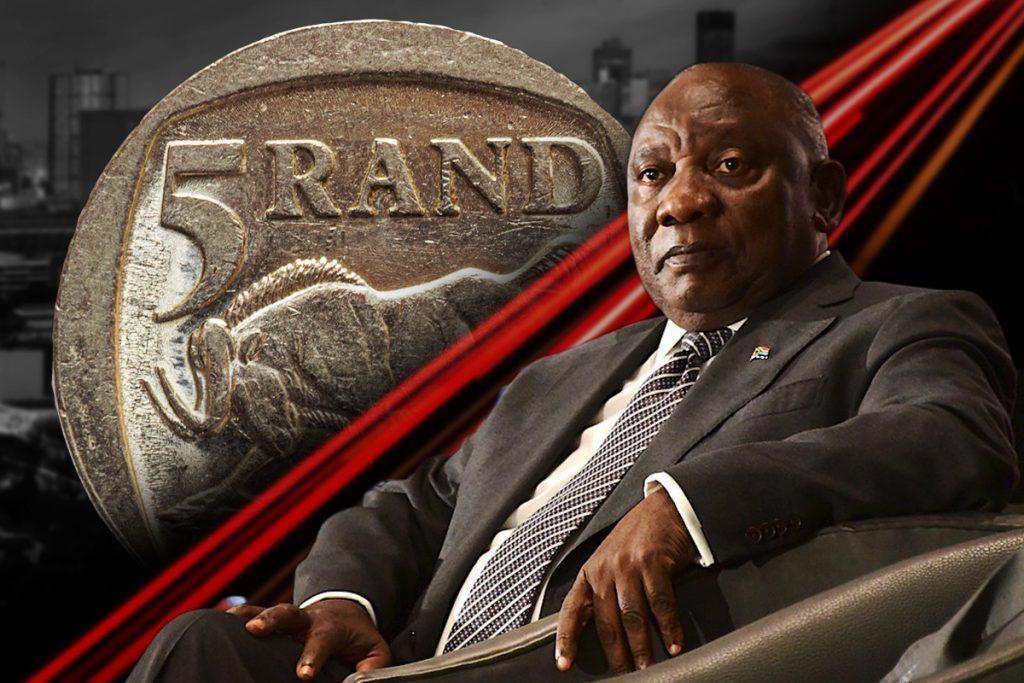
Africa-Press – South-Africa. The rand has continued to move counter to seasonal trends, and with a lot of volatility expected in global and local markets in 2024, risk is building for the local unit to end things off on the wrong side of R20 to the dollar.
According to Investec chief economist Annabel Bishop, the rand has had a muted start to the new year, which is counter to historical trends where the turn of the season is often supportive of more risky markets.
“Lower global financial risk-aversion around the turn of the year tends to see the rand experience lower volatility, and usually some strength – although this year, the domestic currency has remained weak on poor fundamentals,” she said.
Local issues appear to be the main culprit behind the rand’s weakness, with Bishop noting a bleak growth outlook and the tepid response to the government’s big energy plan (the Integrated Resource Plan 2023), which does not seem like it will be making a dent into the economy-crippling bouts of load shedding any time soon.
Meanwhile, the government is being distracted away from making the necessary changes and policies needed to stir growth and improve the operating environment for private sector businesses – instead, more focus is being placed on constraining these as politics takes centre stage due to the upcoming election, she said.
As such, the rand remains among the worst-performing emerging market currencies (y/y) against the dollar and other major crosses as well.
Given that the status quo of uncertainty will likely persist until the elections are run, there is not much hope of finding stability for the rand. And after the elections, more uncertainty persists, as talk of coalitions and significant political change will also keep markets on edge.
Election troubles
“With the election likely in Q2.24, although Q3.24 is also possible, markets will continue to be dragged down by uncertainty and political noise, with the latter escalating in the run-up to the election itself,” Bishop said.
Among some of the worst-case outcomes for the elections, a coalition government between the ANC and EFF is seen as one of the biggest economic risks.
According to Bishop, with the ANC in coalition in a number of municipalities with the EFF over the past few years since the municipal elections, there has been a noticeable deterioration in service delivery – a fact mentioned by president Cyril Ramaphosa in recent electioneering rallies.
To this end, the president and the ANC itself appear to be expressing disinterest in an ANC-EFF coalition on a national basis.
“This echoes reported discussions of the ANC NEC around the time of the release of the ANC’s coalition strategic framework, which stated, ‘(c)oalitions must be based on a common minimum programme… (of) measurable targets of service delivery’,” Bishop said.
While the ANC and EFF have been working to topple DA-led coalitions around the country since the municipal elections, doubts have been cast on whether the parties can effectively rely on each other to get anything done.
According to Bishop, it is too early to say what will happen in the elections, but the uncertainty around this persists.
What will happen to the rand?
As a base case, Investec currently projects that the rand will average higher against the dollar in the first quarter of the year (R17.95/$) while remaining elevated over the election period. However, it anticipates the currency strengthening to around R17.70 by the end of the year.
However, this is based on a host of assumptions which can change in varying scenarios. The bank outlined its five main scenario outlooks, including the likelihood (expressed as a percentage) that each one would play out.
It is worth noting that across all scenarios, the risks for South Africa are squarely on the downside – that is, markets view deterioration in the country to be a far more likely route for the country than anything that turns things around for the better.
It should also be noted that the ANC-EFF coalition outcome fits squarely in the worst-case scenario painted by the bank.
These are the scenarios, listed from most to least likely:
Baseline (47% probability)
ZAR/USD by Q4: R17.70
Conditions:
Modest economic growth lifting towards 3% year on year on positive reforms
Global financial market risk sentiment is neutral to positive
SA remains in the BB credit rating category as debt-to-GDP stabilises
Inflation is impacted by weather patterns hitting food inflation
Transition to renewables, slowly moving away from fossil fuels
Russia/Ukraine conflict eases
Little to no expropriation without compensation
Temporary greylisting
Lite down case (43% probability)
ZAR/USD by Q4: R19.30
Conditions:
Same global conditions as the base case, with worse domestic conditions
Business confidence remains depressed
Substantial electricity and water shedding takes place
Very weak rail capacity
Civil and political unrest
Risk of credit rating downgrades
Expropriation of private sector property (although limited)
High inflation on unfavourable weather conditions
Little transition to renewable energy sources
Lengthy greylisting
Severe down case (8% probability)
ZAR/USD by Q4: R21.50
Conditions:
Lengthy global recession
Global financial crisis
Insufficient monetary support
ANC/EFF coalition in 2024
Widespread, severe service load shedding
Severe civil and political unrest
Government increases borrowing from wide array of sources
SA downgraded to B from all rating agencies, eyeing CCC
Risk of default and worsening debt trap
Failure to transition to renewables
Very high inflation
Full implementation of expropriation without compensation
SA Blacklisted
Up case (1% probability)
ZAR/USD by Q4: R16.90
Conditions:
Economic growth pushes towards 5% year on year
Rising business confidence and investment
Structural constraints eroded
Global growth strong, and markets risk-on
No nationalisation or expropriation without compensation
Low domestic inflation
Lower government borrowing
Substantial transition to renewable energy and away from fossil fuels
Comprehensive measures to alleviate climate change
Short grey listing
Extreme up case (1% probability)
ZAR/USD by Q4: R15.00
Conditions:
Economic growth moves much higher, toward 7% year on year
Good governance with growth-creating reforms
Strong property rights with no nationalisation or expropriation without compensation
High business confidence and fixed investment growth
Fiscal consolidation drives debt to low rations of the 2000s
Very subdued domestic inflation
Strong global growth with a risk-on environment and a commodity boom
Rapid upgrades of credit rating back to investment grade
Very short greylisting
Quick transition to renewables from fossil fuels
source:businesstech
For More News And Analysis About South-Africa Follow Africa-Press