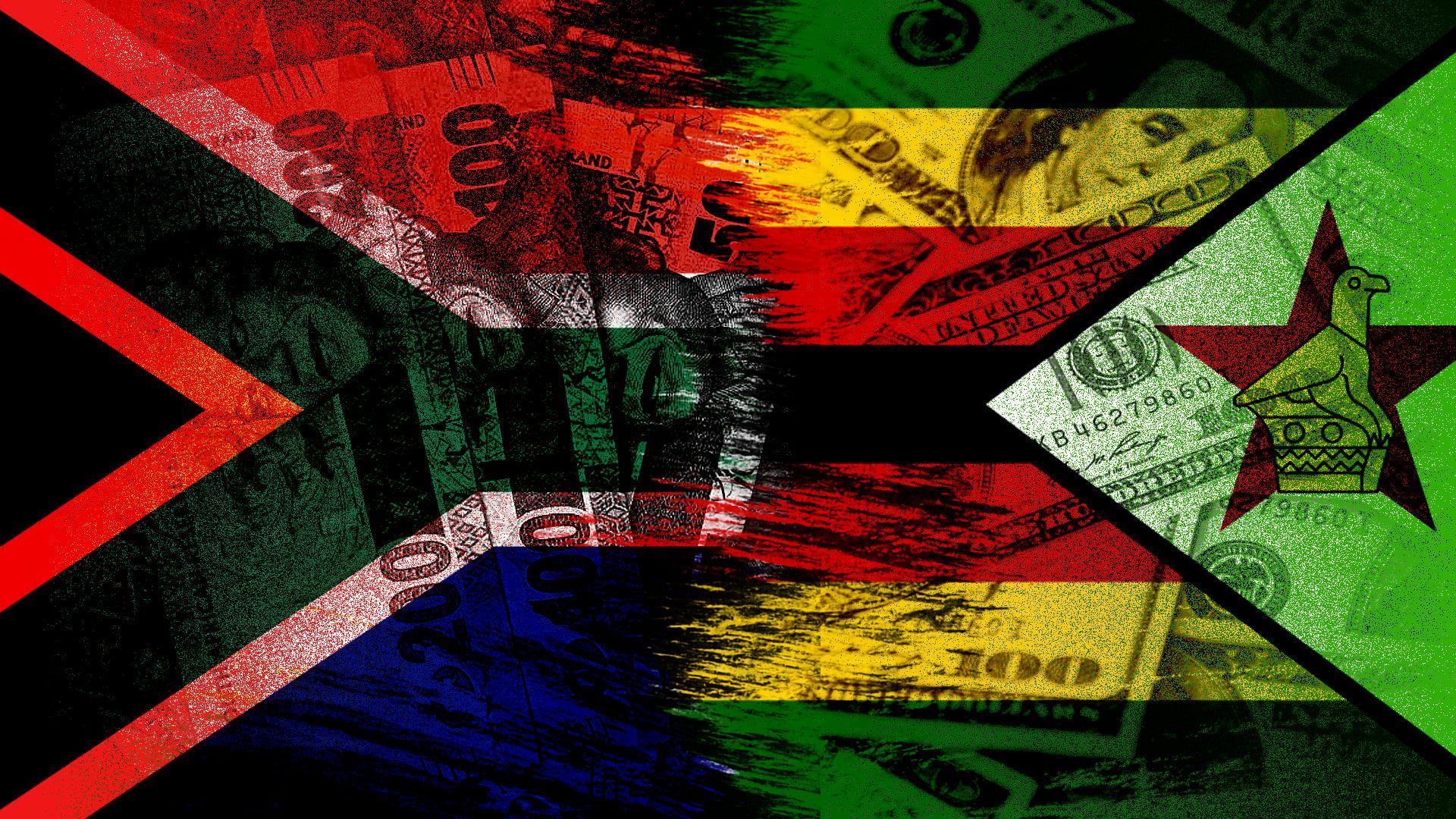
Africa-Press – South-Africa. Zimbabwe’s economy has more than tripled in size in US dollar terms over the past 15 years, while South Africa’s has largely stagnated.
While Zimbabwe’s growth is off a much lower base, it came despite the country being considered an economic basket case after decades of hyperinflation, poor government policies, and a controversial land reform programme.
South Africa, the largest and most developed economy in Africa, has stagnated over the past 15 years due to widespread corruption, load-shedding, inefficient logistics, and an increasingly onerous regulatory environment.
This lacklustre performance has been celebrated by the country’s leaders, with President Cyril Ramaphosa using the 30th anniversary of South Africa’s first democratic elections to laud the ANC’s efforts to grow the economy.
Ramaphosa said the ANC has ensured the economy has tripled in size since 1994, with this prosperity felt by a growing share of the population.
“Although there have been setbacks, although we have faced challenges both beyond our borders and at home, our economy has tripled in size since 1994,” he said.
He emphasised that this has led to job creation for millions of South Africans, with employment increasing from 8 million in 1994 to over 16.7 million today.
There was no mention of the surge in unemployment over the same period, as South Africa’s economy did not grow fast enough to absorb a growing labour force.
Ramaphosa has emphasised the ANC’s accomplishments in recent years, saying it has been working hard to overcome a decade of economic stagnation.
“Over the past five years, we have worked to revive our economy from a decade of stagnation and protect it from domestic and global shocks,” Ramaphosa said.
“We have made progress. Our economy is today three times larger than it was 30 years ago.”
However, when comparing South Africa’s economic growth rate with its African peers, the country’s performance becomes far less impressive.
In 2010, South Africa’s GDP was $417.36 billion according to the World Bank. By the end of 2024, the country’s economy was smaller at $401.14 billion. This marks a decline of 3.89%.
From these figures, it appears as though South Africa’s decade of stagnation has extended into 15 years of flat economic growth.
In contrast, over the same period, Zimbabwe’s economy has more than tripled from $12.05 billion to $41.54 billion. This signifies growth of over 244%.
This is despite the country being considered an economic basket case after it entered a decades-long downward economic spiral in 2000, following the government’s controversial land reform programme.
Zimbabwe’s expropriation of white-owned farms was followed by involvement in a war in the Democratic Republic of Congo. This collapsed the state’s finances and led to international sanctions against the country.
Inflation skyrocketed, reaching a peak of 231 million per cent in 2008, rendering the Zimbabwean dollar essentially worthless.
Basic necessities became scarce, leading to widespread poverty and hunger. This economic meltdown continues to cast a long shadow over Zimbabwe’s present and future.
Despite this, the Zimbabwean economy has grown much more strongly than South Africa’s over the past 15 years, indicating how poorly the local economy has performed.
South Africa’s economic stagnation
There are many reasons why South Africa’s economy has stagnated over the past 15 years, with the main contributors being widespread corruption, load-shedding, deteriorating infrastructure, and inefficient ports and railways.
More recently, this has culminated in private businesses losing confidence in the local economy, leading to declining fixed investment.
This type of investment is key to sustained economic growth over the long run, as it improves the workforce’s productivity.
Fixed investment refers to capital used to purchase land, equipment, machinery, and build infrastructure, as opposed to financial assets and consumption.
South Africa’s fixed investment, typically measured as gross fixed capital formation, has declined from around 30% in the 1970s to 15% today.
This has translated into poor economic growth, with fixed investment hovering around 15% for the past 15 years after the boom that preceded the 2010 FIFA World Cup.
Investec Wealth & Investment International investment strategist Osagyefo Mazwai pointed to this as the main reason the country’s economic growth has lagged that of its peers.
Had South Africa merely maintained the emerging market average of 4.5% since 2010, its economy would be around R4.1 trillion larger.
However, while South Africa’s emerging-market peers have fixed investment rates of around 25% of GDP, its share is only 15%.
“Our fundamental proposition is that South Africa needs to get back to business, and by that, we mean get back to the basics of business confidence,” Mazwai said.
He explained that the cheapest form of economic stimulus is the restoration of confidence, as that directly translates into increased investment and job creation.
This has been the case in South Africa’s past, with a high correlation between business confidence and various economic indicators since 1994.
Mazwai explained that this is not a one-way street, as business confidence is both a driver and a result of GDP growth. Improved confidence and growth create a powerful feedback loop.
“The key is that business confidence should be the main focus of the current government when solving for economic and employment growth, in turn solving for the poverty, unemployment and inequality problem in South Africa,” Mazwai said.
The direct impact of this is that South Africa’s fixed investment rate in comparison is much lower than its peers. This can be seen in the graph below, courtesy of Melville Douglas.
Note that “PDP” in the graph above should be “GDP”
For More News And Analysis About South-Africa Follow Africa-Press