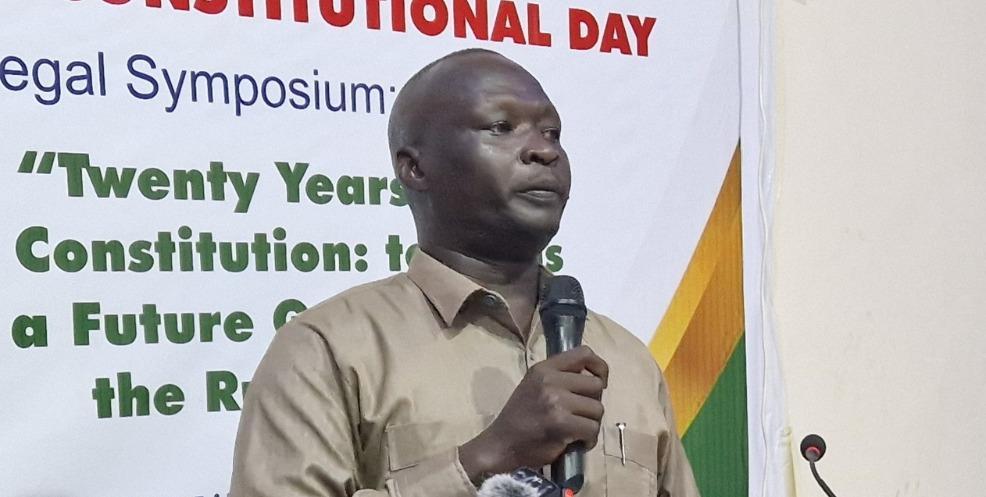
Africa-Press – South-Sudan. JUBA, South Sudan (Eye Radio) — South Sudan’s current constitutional framework has been sharply criticized as “outdated and sterile,” unable to support the development of a modern state, according to Dr. Barnaba Korina, Executive Director of the Vision Centre for Legal Studies and Training.
Dr. Barnaba made the remarks during a public legal lecture marking the 20th anniversary of South Sudan’s first constitution, organized by the African Centre for Legal Studies and Human Rights in collaboration with the Vision Centre.
A central point of Dr. Barnaba’s criticism was the failure of the government to publish new legislation promptly. He underscored the fundamental legal principle, “ignorance of the law is no excuse,” which relies on the publication of laws in the official government gazette to inform citizens of their legal consequences.
He condemned the situation in South Sudan, where some laws remain unpublished for two years or more. This, he argued, creates a cycle of legal confusion and gives defendants an “easy argument for evading accountability.”
Dr. Barnaba called on the Ministry of Justice to strictly enforce the principle that laws take effect only after being gazetted. He also stressed the need for the constitution to incorporate all ratified international treaties, approved laws, administrative decisions, and official orders, ensuring public accessibility and eliminating excuses of legal ignorance.
Discussing the system of governance, Dr. Barnaba emphasized that the constitution must clearly define the nature of the political system to enable a proper separation of powers. He cited Sudan’s historical “Palace and Manshiya” power struggle between former President Omar al-Bashir and Parliament Speaker Hassan al-Turabi, where the Constitutional Court delivered a vague ruling that failed to resolve the core dispute.
To prevent similar constitutional ambiguity and unanswered disputes, Dr. Barnaba strongly urged the Government of South Sudan to establish a dedicated Constitutional Court that would act as a safeguard for governance and rights, free from interference by the executive or legislative branches.
During the discussion, Dr. Barnaba also raised concerns over the impact of dual citizenship on state stability, warning that holders of multiple nationalities may pose a national security risk due to divided loyalties.
He referenced the outbreak of the 2013 civil conflict, noting that several senior officials holding sensitive positions in security, foreign affairs, and government were later found to hold foreign citizenship.
Renewing his call for a change in the current “sterile” system of governance, Dr. Barnaba stressed the critical importance of empowering the Judiciary, describing it as the final refuge for resolving legal conflicts and overturning contradictory rulings.
He concluded by stressing the crucial role of research centers, training institutions, and universities in strengthening public trust in the Judiciary and constitutional processes, while also defending the need for constructive criticism as essential for reform and progress.
For More News And Analysis About South-Sudan Follow Africa-Press