Africa-Press – South-Sudan. Unity State has once again emerged as a central theatre in South Sudan’s renewed violence, reflecting a long-standing pattern in which military command, territorial control, and community networks intersect. As hostilities resume, authority on the battlefield is shaped less by formal political structures in Juba than by field commanders operating with significant autonomy across defined geographic and social environments.
While Bul Nuer commanders and forces have largely operated within government military structures, opposition forces continue to draw heavily from Leek, Jikany, Dok and Nyuong communities. These alignments reflect operational realities rooted in recruitment networks and historical loyalties rather than fixed political ideologies.
The current escalation is not only a breakdown of the 2018 revitalized peace agreement but also the re-emergence of long-standing competition among local commanders who control fighters, territory, and supply routes largely independent of centralized oversight.
With the detention of First Vice President and opposition leader Riek Machar and the collapse of joint security arrangements, commanders on both sides are moving to consolidate control over strategic corridors, particularly those linking Bentiu to the Sudanese border and the Unity oilfields.
This report examines the military architecture shaping the conflict, mapping the reach of the South Sudan People’s Defence Forces (SSPDF) Fourth Infantry Division against the Sudan People’s Liberation Army in Opposition (SPLA-IO) Sector Two, alongside community militias that continue to influence battlefield dynamics.
The military landscape in Unity State is defined by a sharp urban–rural divide. Bentiu town remains under direct SSPDF control and is administered through the headquarters of the Fourth Infantry Division in Rubkona. There is no separate field commander for Bentiu itself; authority in the state capital flows directly from the division commander, making the position the most powerful military post in the state.
Under this structure, the SSPDF controls Bentiu town, Rubkona town and Guit town, as well as all county headquarters in Leer, Mayendit and Koch counties in southern Unity State. Government forces also maintain full control over Mayom County and a series of strategic positions north of Bentiu, including key checkpoints and supply routes.
Crucially, the SSPDF controls the entire road corridor linking Bentiu to the Sudanese border at Heglig, preserving a vital logistical artery for both military operations and oil-related economic activity and threatening rebel ammunition supply routes from Sudan. Beyond these urban centres and transport routes, however, much of the surrounding countryside falls outside government control.
Opposition forces maintain influence across rural areas west, south and northwest of Rubkona and Bentiu, including Tong, Kaljak and Tor Abiath (Nor Lam Wel), as well as villages east of Guit County.
This division has produced a landscape in which government forces dominate towns, administrative centres and roads, while the opposition remains embedded across large rural areas where population and community ties provide depth and resilience.
The conflict in Unity State is primarily driven by confrontations between the SSPDF and the SPLA-IO. Alongside these formal forces, allied and community-based militias play a secondary but consequential role, shaping local battlefields, influencing command decisions and complicating efforts to contain escalation.
The SSPDF operates in Unity State primarily through its Fourth Infantry Division, which functions as the central government military authority across the state and the neighboring Ruweng Administrative Area. The division controls major towns, administrative centres, county headquarters and key road corridors, including the strategic route linking Bentiu to the Sudanese border at Heglig.
Although formally subordinate to national military leadership in Juba, the Fourth Infantry Division operates with wide operational discretion, particularly during periods of active fighting, giving its commanders significant autonomy on the ground.
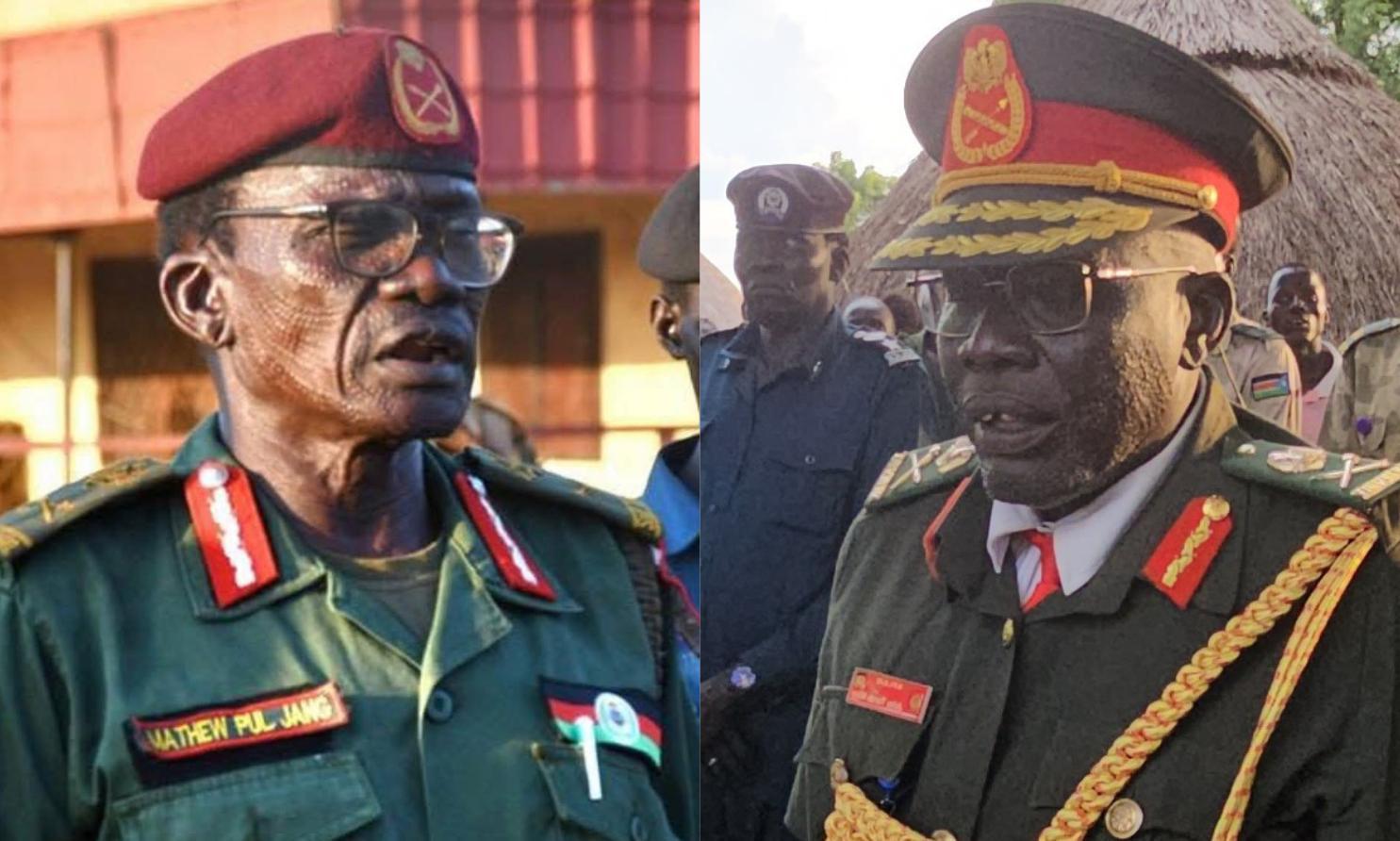
Key SSPDF commanders in Unity State include:
Opposition forces in Unity State operate under SPLA-IO Sector Two, which mirrors the government’s geographic reach but controls a fundamentally different type of terrain. While the SSPDF dominates towns, administrative centres and main roads, the SPLA-IO remains embedded across large swathes of the rural hinterland.
Sector Two fields two main divisions alongside a mobile force and exercises significant autonomy from the SPLA-IO’s political leadership, with operational decisions often driven by local battlefield dynamics rather than centralized direction.
Key SPLA-IO commanders in Unity State include:
Alongside formal military structures, community-based militias continue to shape the conflict, operating outside national command frameworks and the provisions of the 2018 revitalized peace agreement.
The Gojam militia, aligned with the SPLA-IO, is drawn largely from the Leek and Jikany communities of Rubkona and Guit counties. The group fought extensively during the 2013–2018 civil war and was never integrated into national security arrangements. Although generally aligned with the opposition, it functions primarily as a community defence force and does not fall under direct SPLA-IO command.
On the government side, the Ter Chuong, also known as the Freedom Fighters, is composed mainly of Bul Nuer fighters and maintains direct loyalty to the Fourth Infantry Division commander. Many of its members previously formed the core of the Special Division under General Puljang. Rights organizations and local communities have linked the militia to serious abuses during earlier phases of the conflict, particularly between 2014 and 2016 in rural Unity State.
The continued presence of these militias adds volatility to the fighting, as their actions are often driven by local grievances and community dynamics rather than centralized political calculations.
The renewed fighting in Unity State is unfolding against an already fragile humanitarian backdrop shaped by years of displacement, environmental shocks and economic collapse. Long before the current escalation, large sections of the civilian population had been uprooted by insecurity and inter-communal violence, forcing families from rural areas into Bentiu town and the adjacent IDP camp, both of which sit behind earthen dykes constructed to hold back repeated flooding.
Following the signing of the 2018 peace agreement, displaced communities were expected to return to their areas of origin. That opportunity never materialized. Successive years of severe flooding submerged much of Unity State’s low-lying terrain, rendering vast rural areas uninhabitable and cutting off traditional livelihoods. Entire villages in Rubkona, Mayendit, Leer and Koch counties remain underwater or accessible only by canoe, transforming displacement into a long-term condition rather than a temporary emergency.
The Bentiu IDP camp was originally established as a United Nations protection of civilians site during the civil war. Even after its handover to national authorities, persistent insecurity prevented large-scale returns. Flooding then eliminated any realistic prospect of resettlement, turning the camp and surrounding dyked areas into a last refuge for tens of thousands of people with nowhere else to go.
Economic survival has narrowed to a handful of options. Most households now depend almost entirely on humanitarian assistance, informal fishing or small-scale trade. These coping mechanisms are themselves under strain. Petroleum pollution linked to oil production has contaminated water sources and fishing grounds, poisoning fish stocks and raising long-term health concerns in communities that rely on rivers and seasonal wetlands for food and income.
Historically, civilians in Unity State fled across the border into Sudan during periods of intense fighting. That route has effectively closed. Sudan is now engulfed in its own civil war, and large numbers of Sudanese civilians from Greater Kordofan, particularly West Kordofan and the Nuba Mountains of South Kordofan, have crossed into Unity State seeking safety. With cross-border displacement reversed and internal movement constrained by both conflict and flooding, civilians in Unity State are increasingly trapped between violence, water and economic collapse.
For More News And Analysis About South-Sudan Follow Africa-Press