
Africa-Press – Tanzania. A TOTAL of 1.77tri/- is required to finance infrastructure development and strengthen teaching resources to accommodate two cohorts of pupils who will complete Standard Six and Standard Seven simultaneously next year and transition to secondary school in 2028.
The move aligns with the 2014 Education and Training Policy (2023 revision), making 10 years of basic education, comprising 6 years of primary and 4 years of lower secondary education.
Following the changes pupils who started Standard One in 2021 will complete primary education at the same time as those who began Standard One in 2022.
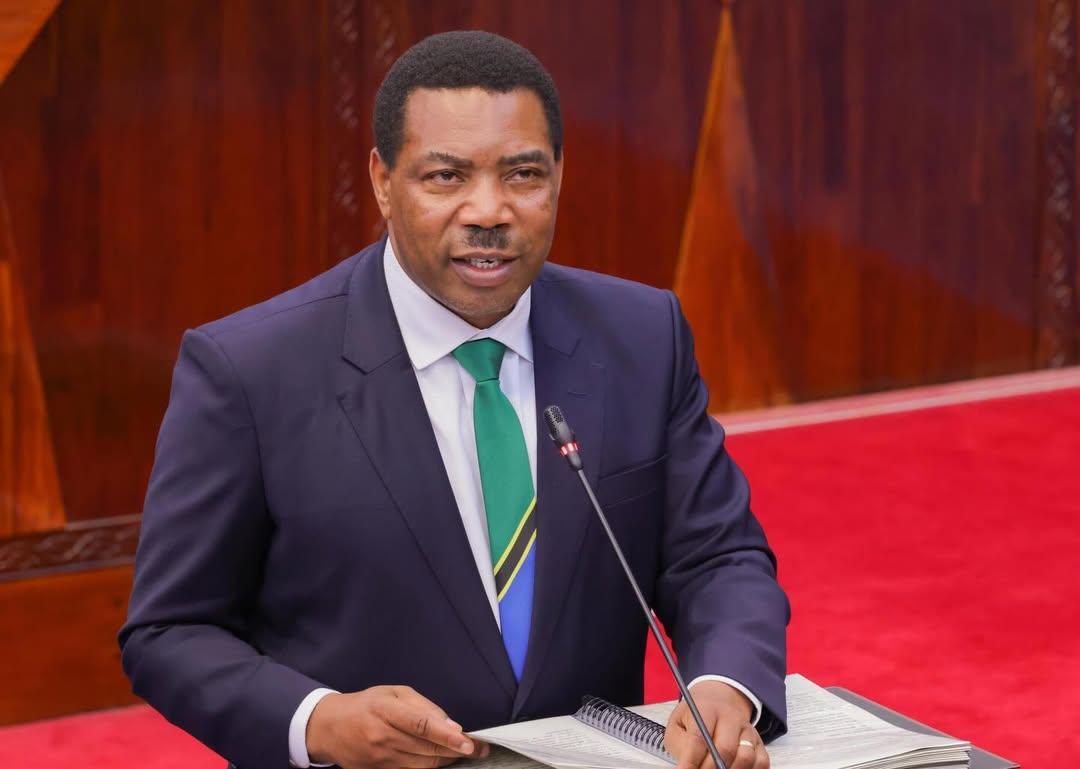
Presenting his office’s income and expenditure proposal for the 2026/27 fiscal year, in the National Assembly yesterday, Prime Minister Dr Mwigulu Nchemba said funds will be used to construct classrooms and laboratories, as well as to support the recruitment of new teachers and provide subsidies for books, examinations and school operations.
The Premier said that, according to current projections, 3,021,177 students are expected to enroll in Form One in 2028.
“The estimated cost covers the construction of 23,226 classrooms, 46,632 pit latrines and 9,366 laboratories, alongside the recruitment of 40,192 new teachers. The allocation will also cater for capitation grants, including funding for textbooks, examinations and general school operations,” said Dr Nchemba.
He explained that these requirements stem from the government’s commitment to strengthening the education sector in line with the 2014 Education and Training Policy (2023 Edition), improved curricula and broader strategic plans aimed at producing a skilled and knowledgeable workforce capable of competing in both domestic and international labour markets.
The Premier urged Regional Commissioners to take full responsibility for overseeing preparations to receive students under the compulsory 10-year basic education system, ensuring that all necessary infrastructure and services are in place ahead of 2028.
“When we speak of 10 years of compulsory education, we are moving from the concept of having a secondary school in every ward to ensuring there is one in every village. This requires thorough preparation, particularly in infrastructure development and planning for all associated needs,” he said.
For the upcoming financial year, he said the government has allocated 139.28bn/- from local government revenues for the construction of 4,193 classrooms and 13,943 latrine pits.
In addition, 7bn/- has been set aside by the central government for the construction of 233 laboratories.
On the development of vocational secondary schools, Dr Nchemba said that 88.84bn/- has been invested in the construction of 103 new schools. Of these, 27 schools have already been completed and are operational.
He added that, until February 2026, a total of 158 lower secondary schools were implementing the vocational stream under the revised curriculum, compared to 41 schools when the programme was first introduced in 2024.
To enhance the teaching of vocational subjects, 150 teachers have been sent for short-term training in India. Furthermore, 156,948 out of 172,609 teachers from 17,111 primary schools have participated in continuous professional development programmes.
Detailing on the implementation of the 2025/2026 budget, the Premier said the government is continuing with the construction of 277 new primary schools.
It has also expanded infrastructure in existing schools, including the construction of 5,439 classrooms, seven administration blocks, 21 dormitories, 26 hostels, 69 teachers’ houses, 46 laboratories, five dining halls and 70 teachers’ resource centres.
He added that the government has completed the rehabilitation of 228 primary schools and supported community-driven construction projects, including 132 dormitory structures in secondary schools, 697 classrooms in primary schools and 175 laboratory rooms in secondary schools.
Dr Nchemba also expressed gratitude to President Samia Suluhu Hassan for facilitating the distribution of laboratory equipment to 231 secondary schools, including 26 newly established national girls’ science schools.
On the continued implementation of the fee-free education programme, which covers pre-primary to advanced secondary education he said by February 2026, 383.22bn/- equivalent to 75 per cent of the allocated 510.96 bn/- had already been disbursed to 18,119 primary schools and 5,179 secondary schools nationwide.