

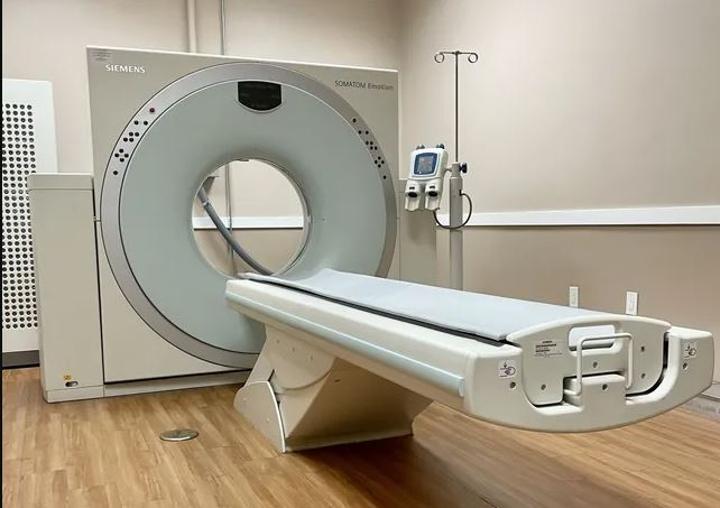
Africa-Press – Tanzania. NEWLY appointed Kagera Regional Commissioner (RC) Mr Albert Chalamila has promised to assist in getting a CT scan and a Magnetic Resonance Imaging (MRI), for emergence use at the Bukoba Regional Referral Hospital.
He made the pledge recently while addressing a public meeting held at Uhuru grounds in Bukoba Municipal Council.
He was responding to a request raised by Mr Hassan Ibrahim (25), a resident of Kashai Ward, who explained that most of the patients who sustained head injuries from road accidents had to be referred to Bugando Medical Centre (BMC), in Mwanza City, because the Bukoba Regional Referral hospital lacked the essential equipment.
Mr Chalamila explained that he would seek assistance from other stakeholders, including the Member of Parliament (MP) for Bukoba Urban, Mr Stephen Byabato, who is also Deputy Minister for Energy, to seek for the funds for buying the machines.
A computed tomography scan (usually abbreviated to CT scan, formerly called computed axial tomography scan or DAT scan) is a medical imaging technique used to obtain detailed internal images of the body.
The personnel that perform CT scans are called radiographers or radiology technologists.
Magnetic Resonance Imaging (MRI), on the other hand, is a non-invasive imaging technology that produces three dimensional detailed anatomical images. An MRI machine uses a powerful magnet to make images of your body. Unlike a CT scan, it does not use x-rays or other radiation.
Bukoba Regional Referral hospital was established in 1923 by Germans as a small health centre. It has bed capacity of 308 beds and attends an average of 560 out-patients and 160 in-patients daily.
Kagera Region has a total of 336 health facilities including 17 hospitals, 38 health centres and 281 dispensaries.
According to the 2012 Population and Housing Census projections the region had a population of 3.2 million.
“By ensuring that health facilities are equipped to deliver comprehensive emergency obstetric and newborn care services, we can effectively address the fatal complications of childbirth, including severe bleeding, infection, prolonged or obstructed labor, eclampsia and asphyxia in the newborn,” RC Chalamila said.
For More News And Analysis About Tanzania Follow Africa-Press