
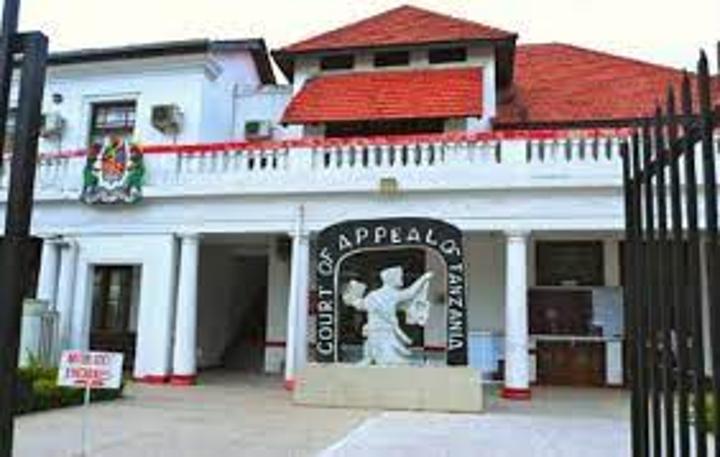
Africa-Press – Tanzania. THE Court of Appeal had rejected the appeal lodged by Registered Trustees of Orthodox Church, opposing the decision of the High Court at Bukoba, which granted businessman Rogers Mashanda ownership of two pieces of land valued at 135m/-.
Justices Jacobs Mwambegele, Rehema Kerefu and Penterine Kente ruled against the Church, the appellant, after allowing one ground of objection lodged by Mr Mashanda, the respondent, with effect that the appeal in question was time barred.
“We are of the settled view that the appeal before us is incompetent for being time barred. In the end, we sustain the preliminary objection raised by the respondent. Consequently, we strike out the appeal with costs for being time barred,” they declared.
According to them, there was no dispute that the decision of the High Court which was sought to be challenged was handed down on December 16, 2016 and the notice of appeal was lodged on December 22, 2016.
The justices noted from the record that on December 23, 2016, the appellant wrote a letter to the Registrar requesting for certified copies of proceedings, judgment and decree.
“However, the record is silent on when exactly the documents were ready for collection and when exactly the appellant was availed with the said documents as the Registrar’s letter to that effect is not included in the record,” they said.
Furthermore, the justices observed, there was no certificate of delay excluding the time taken to prepare those documents. They pointed out that pursuant to Rule 90(1) of the Court of Appeal Rules, the appeal ought to have been lodged latest by February 20, 2017.
“This is so, because, in his submission, (the counsel for the appellant) had readily conceded that he does not have any certificate of delay to exclude the days spent in obtaining the certified copies of the said documents,” the justices said.
As such, they said, the appellant was not entitled to benefit from exclusion of days envisaged under the proviso to Rule 90 (1) of the Rules.
The justices were mindful of the fact that, in his submission, the appellant counsel was convinced that his tireless efforts to obtain leave to appeal and obtain copies of some relevant documents in that application absolved him of the statutory requirement to appeal within sixty days.
“With profound respect, that is not the correct position of law. We are in agreement with the counsel for the respondents that since the memorandum of appeal was lodged on January 10, 2020 after a lapse of three years and 20 days from the date of notice, the appeal is hopelessly time barred,” they ruled.
The justices declined the invitation extended to them by the counsel for the appellant to invoke Rule 96 (7) of the Rules to grant leave and allow him to remedy the appeal, as it is in violation of mandatory provisions of Rule 90 (1) of the Rules, which prescribes the time limit of lodging appeal.
To do otherwise, it was their view, would condone non-compliance with the laws, thus plunging the administration of justice into chaos. They found the counsel’s wishes to be hot and cold at the same time because he had earlier on conceded that he had never sought and obtained a certificate of delay.
“This is to say, the said certificate is not in existence. It is therefore our considered view that (the appellant counsel’s line of argument is an abuse of the Court processes as it seeks to slot in the record of appeal what has never been part of such record,” the justices said.
Before the High Court’s Land Division at Bukoba, the respondent, Rogers Mashanda, sued the Board of Trustees Orthodox Church and Karagwe District Council, claiming for ownership of two pieces of land situated at Omugakorongo area in Ndama Village, Karagwe District in Kagera Region valued at 135m/-.
He also claimed for an order of vacant possession, payment of general damages and costs of the suit. In their respective written statements of defence, the appellant and the district council disputed the claim. However, at the end, the trial Judge decided the suit in favour of the respondent.