

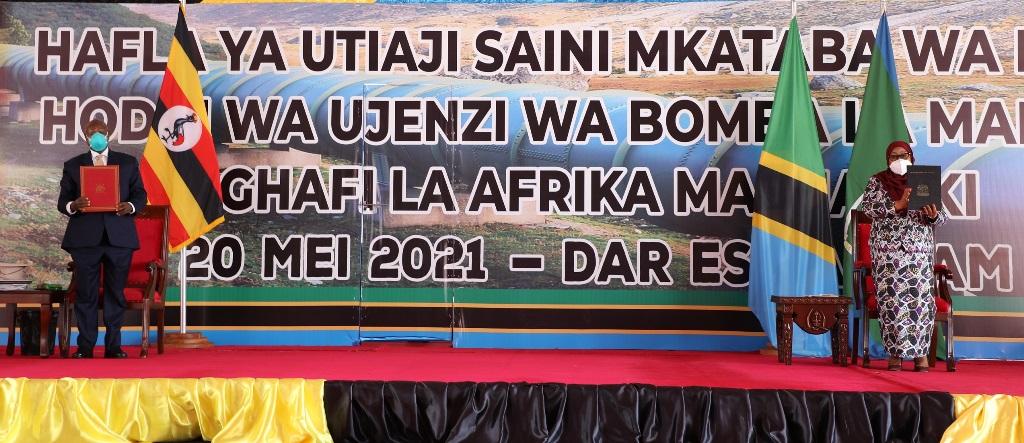
Africa-Press – Tanzania. FINALLY, the long awaited construction of Uganda-Tanzania Crude Oil Pipeline is ready to take off after the signing of a milestone agreement that signals the actual implementation of the multibillion dollar project.
Yesterday, Tanzania and investors of the project worth 3.5billion US dollars signed the agreement for execution of the 1,445 km heated oil pipeline, where 1,115 kilometers will pass through Tanzania.
The agreements were inked between Tanzania and East African Crude Oil Pipeline (EACOP) Company for the construction of the longest electrically heated pipeline in the world, likely to provide Tanzania with 59million US dollars for using her land.
The event that was held at State House in Dar es Salaam saw President Samia Suluhu Hassan and her Ugandan counterpart, Yoweri Museveni witnessing it on behalf of their governments. Uganda has so far discovered over 6.5 billion barrels of oil.
Speaking shortly after signing the agreements, President Samia said the construction of EACOP will bring economic benefits to Tanzania and Uganda, where the nationals will enjoy short and long term benefits.
According to her, the project will unlock the regional potentials and attract more investors to East Africa, and as well end the mentality that African countries are full of political instability, hunger, as well as unfavorable business and investment climate, hence, unfit for investors.
“Among other benefits, the project that is implemented by the Total company from France will provide good revenue to Tanzania and Uganda, and upon completion, will attract more international investors to East African countries,” she said.
The Head of State added that the revenue which will be generated from the pipeline operations will see Tanzania in particular getting 60 per cent of the paid tax and her Uganda counterpart 40 per cent.
According to some official reports, the huge investment on the 1,444-kilometer EACOP will construct will be the major source of direct foreign investment in both countries by 60 per cent.
Tanzania is expected to earn an estimated 3.24bn US dollars once the project becomes operational with more than 18,000 jobs set to be created over the next 25 years.
Hence, the president called for quick completion of the negotiations for the remaining parts and the project to kick off as planned.
“Our people from both countries have heard enough, all needed now is implementation, let it begin as soon as possible,” pointed out President Samia, adding that the project will also help to create employment for youths, semi-skilled and high qualified professionals.
Uganda has so far discovered over 6.5 billion barrels of oil, where President Museveni clarified that’s only 40 per cent in the Lake Albert Zone.
“Meaning there’s another 60 per cent,” he said. There are other potential areas with oil reserves in Uganda including Kalamoja in the Kadam basin.
President Museveni said the pipeline is an important infrastructure in the East African region. Burundi, DR Congo and South Sudan also have untapped oil reserve potentials.
Tanzania on the other hand has made positive headways in the oil exploration of its Eyasi Wembere basin.
Elaborating, the Minister for Energy, Dr Medard Kalemani said implementation work on building the pipeline will take 36 months.
In a related move, he extended appreciation to the President for disbursement of funds which facilitated the partnership agreement between experts from Tanzania and Uganda in the exploration of oil at Eyasi- wembere, Luono in Iramba-Singida, Kining’inila Manonga, Tabora and Nyaraja in Simiyu Region.
He pointed out that such partnerships led to the discovery of large deposits of oil at the Eyasi-wembere Basin.
Commenting, the Minister for Energy and Mineral Development (MEMD), Mary Goretti Kitutu said the signing of the agreement marks a historic milestone that would unlock opportunities for the people of Tanzania and Uganda as well as those in the East African Community (EAC) in general.
She disclosed that the people from the two countries have been very keen on acquiring information so that they prepare themselves to be able to benefit from the economic opportunities which the project has unlocked.
Thus, she appealed to the EACOP Company to expedite the next process of the project while ensuring that issue of local content is maintained.
The two Eastern African countries and the investors had already signed the Memorandum of Understanding in 2017, the Host Government Agreement, Shareholder Agreement (for the pipeline company) and the Tariff Agreement, signed in April 2021 in Uganda.
Tanzania implemented the Tanzania-Zambia Oil pipeline and the Mtwara-Dar es Salaam natural gas pipeline, in which the president believes would be an advantage also in implementing the Hoima-Tanga crude oil pipeline.