
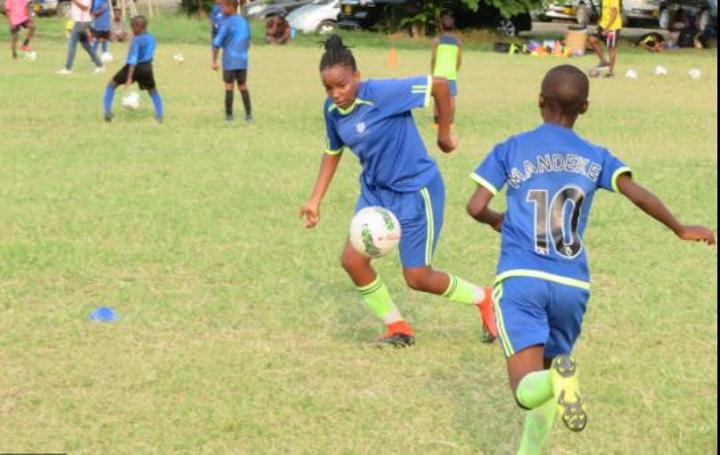
Africa-Press – Tanzania. IT is a break time at Machipi Primary School in Ifakara Town Council, in Morogoro Region, Benson Peter and other pupils are sitting under a tree. Although they were supposed to be at ground, playing, their tale is vice-versa. Giving a reason why he and his fellow school players are not playing, Peter, who identifies himself as Machipi’s right wing position player says, “We don’t have jerseys and a ball.”
Girls, too, have a similar story to tell and when asked why they are not participating in any sports and games. Pudenciana Kalubiza, is a Standard Six Pupils in the institution, loves netball, but not playing the game, because her school lacks facilities including a ground and ball. Yahaya Said Abdalah, who is their Sports and Game Master, says his pupils are not participating actively in any sports.
Despite the fact that the government released some funds to cater for various school expenses including learning and teaching materials. Despite receiving capitation grants in time and reliably, lack of sports equipment and facilities is their common problem and features also in other Primary Schools in Kilombero and Ifakara Town councils including Kilama B, Lungongole and Kining’ina.
However, by abolishing school fees and other parental contributions in both public primary schools, and later in lower secondary schools means that the government undertook the responsibility to ensure that the institutions were provided with adequate funds to operate. The government releases 10,000/-each for every Primary School pupil to cover costs of textbooks, teaching materials, maintenance, examinations and sports.
Launching the University of Dar es Salaam’s modern library on 28th November, 2018, President John Magufuli said the Government of Tanzania releases 28.3bn/-directly to schools as capitation grants on monthly basis.
Kilama B, Kining’ina, Machipi and Idete teachers are thankful of the alms they have been getting constantly without missing. But, the amount that is being spent in the area of sports and games leaves unanswered questions.
At Sports stakeholders’ meeting in Dar es Salaam held on May, this year, the Minister of Information, Culture, Arts and Sports, Dr Harrison Mwakyembe told teachers responsible for sports in all grades including primary schools to raise talents through Inter Primary and Secondary School Games, but Machipi Primary School Sports teacher Yahaya Said Abdalah says due to how capitation grants are offered, the directive might not be fulfilled.
While school head teacher Juma Dunia says Machipi Primary School receives 629,540.17/-on monthly basis, the Sports teacher says, the schools has no opportunity to utilize the 10 per cent of the capitation grant to purchase set of jerseys, balls and other sports teaching materials.
“Generally we don’t have opportunity to utilize the 10 per cent for sports activities at Machipi. The amount is used to run Inter Primary School Games at Ward, District and Regional levels. We can’t prepare pupils because no any cent is left for sports purposes,” he says.
The challenge of capitation grant designated for sports is also affecting Kilama B Primary at Kibaoni Ward in Ifakara Town Council in Morogoro. The head teacher Mr Fikiri Hamis Akungwa says since the amount he receives is too little, the school administration can not spend the cash on their priorities, and save some for the sports’ requirements.’
For Ms Ashura Said who teaches Standard Four to Seven Classes at Kilama B Primary School says the amount received by the few number of pupils in some schools, especially those located in peripheries, may be the reason why the capitation is too little to run the institutions’ costs and purchase their sports items. “Capitation grant is subject to number of pupils at school, and hence if pupils are many, schools can buy a ball and do other sports related issues including funding inter school sports and games competitions,” she says.
Who to cover the vacuum?
After swearing in as the President of Tanzania, Dr John Magufuli declared free education from Primary to Secondary School, some parent misunderstood and felt that they were totally relieved off their responsibilities in rearing and meeting education costs for their children. Realizing the consequences and challenge surrounding capitation grants, parents in villages of Kilama B, Kining’ina, Mdete, Machipi and Lungongole have started taking some initiatives, including contributing in local food programmes and repairing schools building in their respective areas.
While the current sport financing programme in schools seems to bring challenges, some parents spoke to this newspaper and said that they were ready to pay for their children’s unforeseen expenditures costs, but not sports.
Xavery Simlongeli is one of the parents whose children study at Kilama B and said that they are willing to contribute for lunch and repair of schools building, thanks to awareness programme condected by the Save Education Foundation & Future Development Foundation (SEFDF) organisation.
“Now we can track capitation grants received through school account and expenditure and where there is a shortage, as parents, we compliment through contribution,” the parent added, but omitting sports and game, which are also other areas in the curriculum for the full development of a pupil in the learning sector.
Like Simlongeli, Ms Maria Likomanjogo, a parent whose child is studying at Kilama B Primary School mentions challenges facing the schools as being the same. On his side, the SEFDF Coordinator, Clarence Mosha, after abolition of all contributions in schools, parents distanced themselves from running the institutions, believing that government would be funding each and everything for them, something he says: It is a wrong perception.”
He says the misconception of free education and other challenges facing schools in Kilombero and Ifakara Town, made SEFDF to introduce engagement programmes, which aims at bringing together parents and village governments to make a follow up of the grants received and contribute whenever necessary.
The coordinator admits that despite the fact that the capitation grant is not enough to cater for all their needs, parents are not willing to support their children with sport facilities because it is not a priority.
“Imagine, there was no playing ground at Machipi Primary School. But, as parents, we managed to clear the field for the pupils to play,” Mosha adds. Ifakara’s Kilama Village Chairperson Miraji Likaya says parents are aware that grants received are not sufficient that is why they are willing to contribute, though, not in sports.
Asked why 10 per cent of capitation is not enabling Ifakara Primary Schools to purchase necessary sport items including balls, net and jerseys, Edward Sule, Acting Education Officer in Ifakara Town says the “it is not true that the amount is being returned. It is just a procedure that the amount ris being released through schools’ account. Ward, district councils have their budget which is being executed in accordance to circular.”
Before abolition of all school contributions, parents were contributing for UMITASHUMTA and UMISETA (Inter School Competions for Primary and Secondary). The vacuum created came to be filled by capitation grants system.
A best solution?
Iceland suprised the world in 2018 World Cup Competitions in Russia because it was the smallest nation with nearly 340,000 people to qualify for the tournaments. According to USA Today, the former Iceland manager, Gudjon Thordarson, was quoted as saying investing is youth sports has started paying off.
The mechanism used to develop the nation’s soccer was through fees amounted to $355, whereby every child was supposed to pay. “Every child pays the club’s tuition with a 300 euro ($355) voucher provided by the local municipality to support after-school activities,” writes USA Today.
The public engagement in sports clubs and their facilities has been described by Iceland’s officials as a best option given the fact that it gives equal opportunities to all children.
For More News And Analysis About Tanzania Follow Africa-Press